BIOCHEMISTRY - L. Stryer - 1984
VOLUME 2
PART II GENERATION AND STORAGE OF METABOLIC ENERGY
CHAPTER 19. PHOTOSYNTHESIS
19.18. Regulation of the Calvin Cycle
There are several regulatory mechanisms that ensure The Calvin Cycle Functions only when ATP and NADPH are being produced during the light reactions of Photosynthesis. The rate-limiting step in the Calvin cycle is the carboxylation of ribulose-1,5-bisphosphate to yield two molecules of 3-phosphoglycerate. The activity of ribulose-1,5-bisphosphate carboxylase increases significantly upon illumination; this activation occurs through three main pathways:
1. NADPH, generated by Photosystem I, serves as an allosteric activator of the carboxylase.
2. The rate of the enzymatic reaction increases markedly as the pH rises from 7 to 9. Light-induced proton pumping into the thylakoid lumen leads to the alkalinization of the stroma, which activates the carboxylase.
3. The carboxylase is activated by Mg2 +. Recall that Mg2 + is released into the stroma as Protons are pumped into the thylakoid lumen upon illumination (Section 19.13).
19.19. Tropical Plants Utilize the C4 Pathway to Accelerate Photosynthesis by Concentrating CO2
Tropical plants, such as sugarcane, possess an additional pathway for transporting CO2 to the site of the Calvin cycle in photosynthetic Cells. The first evidence for this pathway came from studies showing that the radioactivity of a 14CO2 pulse initially appears in the four-carbon compounds malate and aspartate rather than in 3-phosphoglycerate. The Significance of this pathway, elucidated by Hatch and Slack, is that C4 compounds transport CO2 from mesophyll cells exposed to the air to bundle-sheath cells, which serve as the primary site of photosynthesis (Fig. 19.23). Decarboxylation of the C4 compound in the bundle-sheath cells maintains a high CO2 concentration at the site of the Calvin cycle. The resulting three-carbon compound returns to the mesophyll Cell for the next carboxylation cycle.
Class="center">Fig. 19.23. Schematic diagram of the MAIN STAGES OF the C4 pathway

This C4 pathway (Fig. 19.23) for CO2 transport begins in the mesophyll cell with the Condensation of CO2 and phosphoenolpyruvate to form oxaloacetate, a reaction catalyzed by phosphoenolpyruvate carboxylase. In some species, oxaloacetate is converted into malate by an NADP+-dependent malate dehydrogenase. The malate then enters the bundle-sheath cells and is decarboxylated in the METABOLISM/14.html">Chloroplasts by an NADP+-dependent malate dehydrogenase. The released CO2 enters the Calvin cycle in the usual manner by condensing with ribulose-1,5-bisphosphate. The Pyruvate produced during decarboxylation returns to the mesophyll cell. Finally, phosphoenolpyruvate is regenerated via a reaction between pyruvate, ATP, and Pi. This single reaction, catalyzed by pyruvate-Pi dikinase, is driven by the subsequent Hydrolysis of PPi. The overall reaction of the described C4 pathway is as follows:
CO2 (in mesophyll cell) + ATP + H2O → CO2 (in bundle-sheath cell) + AMP + 2Pi.
Thus, The transport of CO2 into the chloroplasts of bundle-sheath cells consumes two high-energy phosphate bonds.
When the C4 pathway and the Calvin cycle operate simultaneously, the overall reaction becomes:
6CO2 + 30ATP + 12NADPH + 12H2O → C6H12O6 + 30ADP + 30Pi + 12NADP+ + 18H+.
Note that when CO2 is supplied to the Calvin cycle via the C4 pathway, 30 ATP are consumed per molecule of hexose produced, compared with 18 ATP in the absence of the C4 pathway. The high CO2 concentration in the bundle-sheath cells of C4 plants, maintained at the cost of an additional 12 ATP, is critical for achieving a high rate of photosynthesis in these plants, since CO2 is the limiting factor under high light intensities. This high CO2 concentration also minimizes energy loss caused by Photorespiration, a process discussed in the next chapter.
19.20. Glycolate is the Principal Substrate in Photorespiration
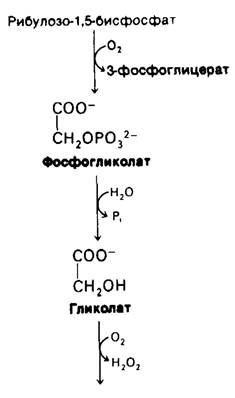
Illuminated plants consume O2 and release CO2 through a process known as photorespiration, which is distinct from mitochondrial Respiration. The Biological Role of this process remains an enigma. Glycolate, the primary substrate for photorespiration, is derived from phosphoglycolate, which is produced during the oxygenation of ribulose-1,5-bisphosphate (Fig. 19.24). This reaction is catalyzed by ribulose-1,5-bisphosphate carboxylase, which functions as both an oxygenase and a carboxylase. In fact, oxygenation and carboxylation are competing reactions that utilize the same Active Site. The resulting phosphoglycolate is hydrolyzed by a specific phosphatase to glycolate. Subsequent metabolism of glycolate takes place in Peroxisomes (also called Microbodies) (Fig. 19.25). Glycolate is oxidized by glycolate oxidase to glyoxylate. The H2O2 produced in this reaction is split by catalase into H2O and O2. Glyoxylate then undergoes Transamination to yield Glycine. Serine can subsequently be formed from two molecules of glycine in the Mitochondria.
Fig. 19.24. Formation and degradation of glycolate
Photorespiration appears to be a wasteful process in which organic carbon is converted into CO2 without the generation of ATP, NADH, or any other apparent benefit. Plants that lack the C4 pathway lose between 25% and 50% of their fixed carbon to photorespiration. In contrast, tropical plants possessing the C4 pathway exhibit a very low rate of photorespiration because the oxygenation of ribulose-1,5-bisphosphate is competitively inhibited by the high concentration of CO2 in the bundle-sheath cells. The oxygenase activity of ribulose-1,5-bisphosphate carboxylase increases more rapidly with Temperature than its carboxylase activity. Consequently, the C4 pathway plays a crucial role in minimizing photorespiration at high temperatures. The Geographical Distribution of C4 plants (those possessing the C4 pathway) and C3 plants (which lack this pathway) can now be understood at THE MOLECULAR LEVEL. C4 plants have an advantage under conditions of high ambient temperature and intense light, and thus they predominate in the tropics. C3 plants, which consume 18 ATP per molecule of hexose produced in the absence of photorespiration (compared with 30 ATP for C4 plants), function more efficiently at temperatures below 28 °C and predominate in temperate climates.
Fig. 19.25. Electron micrograph of a plant cell peroxisome

Last update: 06/08/2026
Editorial and Educational Adaptation: This material has been compiled based on the primary/original source text. The project team performed an editorial review, corrected technical inaccuracies, structured sections, and adapted the content for an educational format.
What was processed:
- elimination of formatting defects (OCR errors, structural breaks, corrupted characters);
- editorial organization of content;
- standardization of terminology in accordance with academic sources;
- verification of factual statements against the original source text.
All mentions of the author, publication year, and origin of the primary text have been preserved in accordance with the source.