Peptide Self-Regulation of Living Systems (Facts and Hypotheses) - Shataeva L. K. 2003
Peptides in Aqueous Solutions
Regulatory Peptides as Carriers of Molecular Information
The Role of Hydrogen Bonds in Molecular Signal Transmission
The identification of conservative amino acid blocks in Peptide and Protein structures can be used not only to assess their information capacity, but also to address the molecular mechanisms underlying the transmission and reception of information signals. The structural similarity of amino acid blocks within regulatory Peptides and high-molecular-weight Proteins suggests that information signals are transmitted on a "like-to-like" basis. This is in accordance with P.K. Klimov’s hypothesis that a regulatory peptide acts as a molecular oscillator, and its information signal transmission operates on the "tuning fork—resonator" principle (Klimov, Barashkova, 1993). In a general sense, molecular resonators can include both sections of polypeptide chains in high-molecular-weight proteins and specific domains of bilayer lipid structures in Cell membranes. In some cases, when a signal persists in a system significantly longer than the possible lifetime of a polypeptide, the question arises regarding the physical mechanism of long-range action and prolonged signal Translation in the medium.
Calculations of preferred peptide Conformations are usually performed under the assumption of an isotropic environment for the peptide chain. It is only for sufficiently long peptide chains—that is, for protein macromolecules—that intramolecular hydrophobic interactions between rigid, typically α-helical segments are taken into account during chain folding into a globule. This leads to The formation of a molecular core where hydrophobic amino acid residues are concentrated (Alberts et al., 1994). The outer regions of protein macromolecules are generally hydrophilic, as the side groups of hydrophilic amino acid residues are exposed to the external aqueous environment and are well hydrated; they participate in hydrogen bonding with the surrounding solvent and in Ligand-binding reactions (Hopp, Woods, 1981). Nuclear magnetic Resonance (NMR) Methods have been used to measure the rates of isotopic exchange for protons belonging to the amino and amide groups of high-molecular-weight Polypeptides with Water deuterium and tritium (Knox, Rosenberg, 1980; Krauss, Cowburn, 1981). These measurements revealed a substantial difference in exchange rates between these groups located in the interior versus the exterior Regions of the molecule. Groups situated on the outer surface remain in constant contact with water and exchange their protons very rapidly—within fractions of a second—whereas groups located within the protein interior (i.e., in regions of reduced polarity) exchange protons very slowly, taking minutes and hours.
Apparently, these low exchange rates are determined by the significant relaxation time of the intramolecular mobility of polypeptides. Only Changes in external environmental parameters, such as acidity or Temperature, affect The rate of these intramolecular motions. Thus, the large difference between the relatively slow rate of "peptide-water" proton exchange and the virtually instantaneous reflection of this exchange on the Hydrogen bond network of the surrounding water creates conditions for the continuous monitoring of Introduction/10.html">Peptide Conformation.
The polyfunctional properties of peptide chains ensure their sensitivity to mechanical vibrations and participation in electromagnetic oscillations. The intrinsic vibrations of charged (protonated or deprotonated) ionogenic groups in a polypeptide induce reversible displacements of both low-molecular-weight counterions and their associated water molecules. It is known that the propagation of mechanical vibrations in an aqueous medium containing charged particles leads to the local displacement of positive and negative charges relative to each other, resulting in an ion vibration potential (IVP) that shares the frequency of the exciting oscillation, such as ultrasound. In the case of charged macromolecules and colloidal particles in an aqueous medium, the propagation of ultrasound produces a similar effect: the charged particle and its surrounding "ionic atmosphere" oscillate, inducing a colloid vibration potential (CVP). As a rule, the amplitude of the CVP is several orders of magnitude greater than that of the IVP, an effect utilized in hydrophones (Marlow et al., 1988).
A monochromatic wave propagates through a medium and transfers energy at a specific speed, but it is evidently impossible to transmit an information signal using a monochromatic wave due to its spatial and temporal uniformity. To transmit information, one must vary either the amplitude or the phase of the wave. The mathematical apparatus for solving this problem is well known (Rabinovich, Trubetskov, 1984).
Among the many possible models of molecular long-range action suitable for translating ordered information signals, we will consider only systems of coupled Hydrogen Bonds, which exist both in peptides and in their surrounding aqueous environment. At a distance of 5–25 Å around the peptide chain, conformational rearrangements of the Hydration water hydrogen bonds occur rapidly, reflecting the state of the peptide. These changes can be observed via NMR spectra, as illustrated in Fig. 8, A. In Section 1.2.3, we already mentioned the fundamental interrelation between conformational transitions of the peptide chain and Changes in the nature of its local hydration. Fig. 8, B shows the age-related decrease in the strength of clathrate structures in Collagen, which corresponds to the dehydration of Connective Tissue in various animals.
Three ranges of electromagnetic oscillations are used to study The Structure of hydration water and the mobility of its protons: X-ray, infrared, and radio frequency ranges. In water molecules, the lowest frequencies (4 ∙ 104 Hz) characterize nuclear spin vibrations, corresponding to transitions between the molecular ground state (where proton spins are antiparallel) and the excited state (where they are parallel). These frequencies are small compared to the rates of proton exchange between water molecules (1013–1014 Hz) and belong to the radio frequency range. Interestingly, in terms of order of magnitude, they are comparable to mechanical vibrations (102–104 Hz), i.e., sound waves of the musical range (Gabuda, Rzhavin, 1978). Fig. 8 illustrates the range of electromagnetic oscillations used to study the structure of hydration water.
Apparently, the low-frequency (radio frequency) NMR spectrum of bound water can provide unique information about the interactions of regulatory peptides with the water hydrogen bond network.
When considering molecular oscillators, we must take into account the features of their structure and the corresponding frequency ranges of vibrations in which they can participate.
The first characteristic feature of oligopeptides, discussed in detail in Section 1.2.1, is their spatial Asymmetry, which encompasses structural (component) heterogeneity, chirality, non-uniform electrostatic charge distribution, and the corresponding averaged intrinsic dipole moment vector.
Class="center">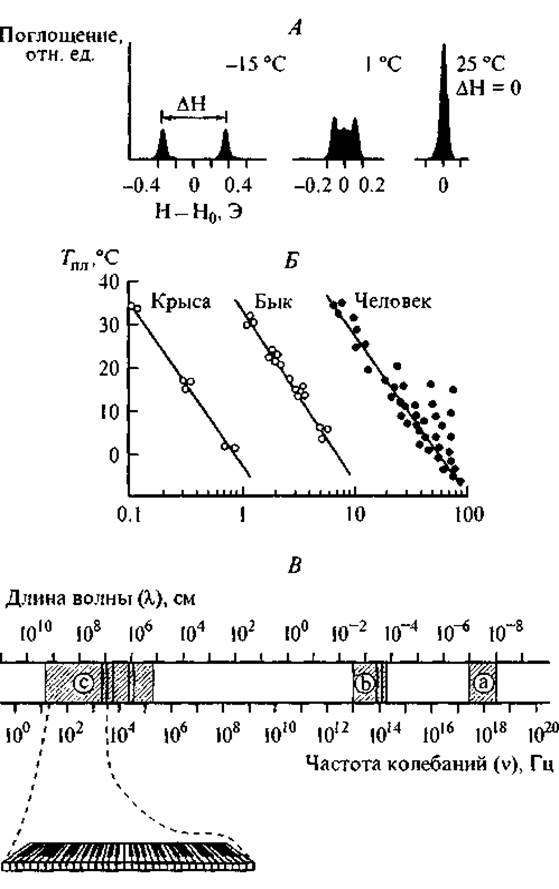
Fig. 8. Investigation of clathrate structures in collagen using NMR spectroscopy (Gabuda, 1982; reproduced with permission from the author).
A — changes in the NMR spectrum of water protons upon the destruction of clathrate structures caused by a temperature increase in hydrated collagen; B — relationship between the melting point of collagen hydrates and the age (in years) of humans and animals; C — the scale of electromagnetic oscillations and three main ranges for studying hydrate structures: a — X-ray, b — infrared, c — radio frequency range. Some frequencies of proton spin oscillations in bound water fall within the acoustic range.
The second characteristic feature of oligopeptides is the non-uniform distribution of hydrophilic and hydrophobic side groups along the chain, which results in heterogeneous hydration, including Different types of hydration for carboxyl and amino groups. This leads to an alternation of hydrate and clathrate structures of bound water characteristic of a given oligopeptide (Gabuda, 1982).
The third feature of oligopeptides is the non-uniform distribution of groups capable of forming hydrogen bonds both with the solvent and with neighboring groups. Under certain conditions, a hydrogen bond may be accompanied by proton transfer to a proton-acceptor atom and the formation of an ion pair.
Intramolecular ion-ion bonds in peptides are extremely rare, and in short oligopeptides, they do not occur due to steric constraints. In most cases, polar intermolecular interactions of peptides are based on the attraction between carboxyl and amino groups. Such an interaction is not purely ion-ion, as the interacting pair exists in two energy states:
АН…В ⇄ А- — НВ+.
Such molecular-ionic Tautomerism is of a quantum nature and therefore is not chemically rate-limited.
The mechanism and regularities of hydrogen bond formation with proton transfer have been studied in detail using low-molecular-weight proton-donor and proton-acceptor compounds as an example. Infrared (IR) spectroscopy has been widely employed in these studies. The vibrational spectra of the partners (e.g., acid group A and basic group B) upon the Formation of the AH....B complex change more strongly and specifically than any other PHYSICOCHEMICAL PROPERTIES OF the system (Iogansen, 1981). Changes in the IR spectrum reflect 1) the appearance of several new vibrations of the new AH....B species instead of the disappearing translations and rotations of the AH and B molecules; 2) radical changes in the characteristic vibrations of the hydrogen atom in the AH group (vAH); 3) frequency shifts of certain skeletal vibrations in molecules containing the AH and B groups.
The dipole moment of a hydrogen bond typically does not exceed 2–3 D, whereas the dipole moment of an ion pair reaches 15 D—that is, 4 times the dipole moment of a peptide bond and 8 times that of water. Therefore, the local orientation of water molecules in the hydration shell of interacting groups will rearrange depending on the shift of the equilibrium in one direction or the other. The rate of such rearrangements corresponds to the frequency of proton exchange between water molecules and ranges from 1012 to 1013 s-1, which is significantly higher than the rate of tautomeric equilibrium shifts.
In addition to NMR and IR spectroscopy, X-Ray Diffraction Analysis is widely used to study hydrogen bonds with proton transfer in Biopolymers. Theoretical calculations based on the obtained data have demonstrated the possibility of forming fractal-type triplet structures of bound water—that is, structures that preserve their Symmetry group on a scale larger than the molecular one (Bulyenkov, 1990). The effective proton mobility in such structures must be even higher, as it is not limited by the frequency of proton exchange between individual molecules, but is instead determined by the Physical Properties of the proton.
The feature that distinguishes a proton from all charged ions in water is that it lacks electrons around its Nucleus, giving it a radius of 10-13 cm—five orders of magnitude smaller than the radius of ordinary ions. Consequently, proton transfer from molecule to molecule occurs without the rearrangement of electronic structures and without the involvement of repulsive forces between electrons (Bell, 1977). In a certain sense, the physical properties of protons in water coincide with the physical properties of elementary particles.
Calculations show that the wavelength of protons moving at a thermal velocity at normal temperature, as determined by the de Broglie equation

is 10-8–10-9 cm. It can be hypothesized that during the rearrangement of a local hydrogen bond, the translation of this process in water may proceed via a proton tunneling mechanism—that is, through the "sub-barrier" overcoming of energy barriers (Bell, 1977; Goldansky, 1979). On the same grounds, one can assume a decisive role for clathrate water protons in the spatial propagation of signals regarding the formation of hydrogen bonds between regulatory peptides and receptor proteins.
Mitchell placed special emphasis on protons and the dynamics of cooperative hydrogen bonds in biological systems, introducing METABOLISM/2.html">THE CONCEPT OF the “proton-motive force” by analogy with electromotive force (EMF). In the mid-1950s, when research into the Structure and function of mitochondrial membranes was gaining intensive momentum, quantum electronics was developing within the realm of proprietary technologies, and the term “semiconductor” had not yet entered biophysics. Mitchell effectively introduced a parallel concept into membrane biophysics by postulating anisotropic proton conductivity across mitochondrial membranes (see Mitchell, 1976).
In the next chapter, we will examine the structure of Biological Membranes in greater detail. Their structural features not only enable membranes and their receptors to participate in intermolecular interactions with peptides, but also serve the function of an ordered dielectric medium specifically tailored for the propagation and Amplification of electromagnetic oscillations of a particular frequency.
Proton-mediated energy transport is remarkably straightforward, as it requires only a thin, topologically closed membrane that is impermeable to water and situated between two proton-conducting environments differing in free proton concentration. In other words, a pH gradient must be maintained across the membrane separating the two media. These conditions are essential not only for the operation of the proton pump, but also for translating environmental signals into the intracellular space and for coupling redox reactions with mobile hydrogen-bond networks in each medium.
Mitchell proposed introducing the term “proticity” into biophysics by analogy with “electricity,” highlighting the decisive role of “proton pumps” in cellular Bioenergetics (Mitchell, 1976). Adapting this into Russian terminology, we can translate the term as “protonics” (by analogy with “electronics”) and apply this concept not merely to energy transfer processes, but rather to the transmission of molecular information between living Cells and organisms in an aqueous environment.
Last update: 06/08/2026
Editorial and Educational Adaptation: This material has been compiled based on the primary/original source text. The project team performed an editorial review, corrected technical inaccuracies, structured sections, and adapted the content for an educational format.
What was processed:
- elimination of formatting defects (OCR errors, structural breaks, corrupted characters);
- editorial organization of content;
- standardization of terminology in accordance with academic sources;
- verification of factual statements against the original source text.
All mentions of the author, publication year, and origin of the primary text have been preserved in accordance with the source.