Biochemistry - The Chemical Reactions of Living Cells, Volume 3 - D. Metzler 1980
Nitrogen Compound Metabolism
Aromatic Compound Metabolism
Phenylalanine and Tyrosine Metabolism in Plants
Some of the Metabolic pathways of these Amino Acids that function in animals and Bacteria are also utilized by plants. However, the most prominent role in plants is played by the reactions initiated by phenylalanine ammonia-lyase and Tyrosine ammonia-lyase, which were discussed in Chapter 8, Section E, 5 [Equation (8-36)]. Figure 14-23 illustrates the primary pathway leading to The conversion of these Two amino acids into trans-cinnamic acid and its mono-, di-, and trioxy derivatives. Cinnamoyl-CoA serves as a precursor for anthocyanins, as well as other flavonoid pigments and polymeric condensed Tannins (Box 12-B). The di- and trioxynethylated products serve as starting Materials for The Biosynthesis of lignins. In addition, this figure depicts numerous other products responsible for the characteristic aroma of certain plants and various spices. It should be noted, however, that protocatechuate, which is also a product of bacterial Catabolism (Fig. 14-22), is synthesized in plants through the simple Cleavage of 5-dehydroshikimate (Fig. 14-17) followed by enolization. Hydroxylation of protocatechuate yields gallate, which, in the form of esters or other derivatives, is a constituent of "hydrolyzable tannins." These substances accumulate in plant vacuoles and are also deposited in the bark along with "condensed tannins," which are polymeric flavonoid compounds (Box 12-B) [135].
Class="center">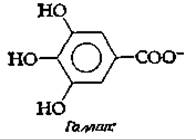

FIG. 14-23. Formation of certain Phenylalanine and Tyrosine metabolites in plants.
Lignin is a highly complex material with a molecular weight exceeding 10,000. It is remarkably stable and insoluble even in hot 70% sulfuric acid. Lignin is often described as a "statistical polymer constructed from hydroxyphenylpropane units." It is formed via the oxidative Condensation of coniferyl alcohol (Fig. 14-23) and related monomers [137–139]. The enzyme responsible for polymerization may be peroxidase, which catalyzes The formation of lignin from monomeric alcohols and H2O2. The radical formed by the removal of an electron from the phenolate anion of coniferyl alcohol exists in multiple Resonance states, in which the unpaired electron can be localized not only on the oxygen atom but also at the positions indicated by asterisks in the Structure shown below:
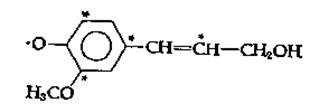
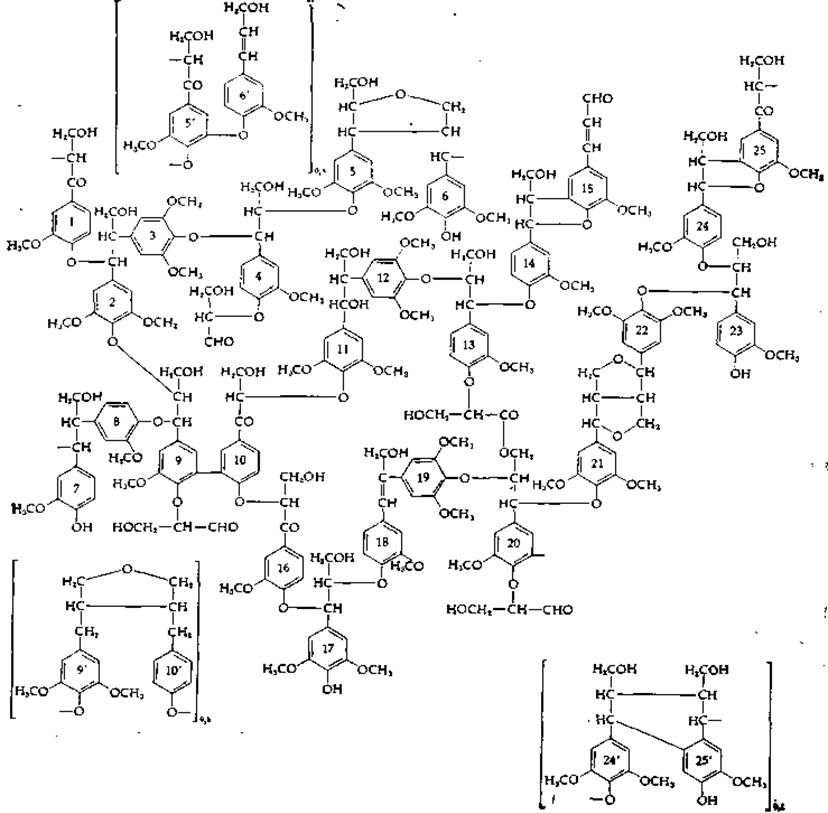
FIG. 14-24. Proposed structure of beech lignin. There are 25 different C9 units; some of these may be replaced with varying degrees of probability by the three dimeric structures given in parentheses [139].
The condensation of such radicals gives rise to a vast array of compounds. For example, dimerization yields a stable structure containing ether linkages, as shown in Equation (14-46).
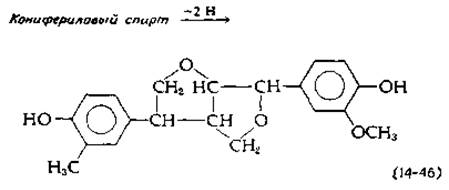
The resulting dimer still contains hydroxyl groups capable of converting into radicals and attaching subsequent units. There are at least ten Other types of intermolecular bonds (Fig. 14-24). Lignin is of exceptional value as a potential raw material source for the industrial production of Aromatic Compounds. However, no significant success has yet been achieved in its utilization.
The oxidative degradation of lignin leads to the formation of humic acids, which are an important organic component of soils [138].
Alkaloids [140, 141]
Over 2,500 alkaloids—various nitrogen-containing compounds produced by plants—have been identified. A particularly large variety of alkaloids is synthesized by plants of certain families. Alkaloids are often regarded as the End products of Nitrogen METABOLISM in plants. However, the majority of plants contain no alkaloids at all, and the fact that they are produced in some species is presumably related to ecological factors. Many alkaloids possess biological activity, exerting a pronounced effect on the animal Organism.
A significant portion of alkaloids is derived directly from aromatic amino acids. This was first established by Robinson [141, a, b] in 1917. Robinson suggested that alkaloids might be synthesized via Mannich reactions involving amines and aldehydes. In the Mannich reaction [Equation (14-47)], an amine and an aldehyde (presumably forming a Schiff base) react with a nucleophilic carbon, such as that of an enolate anion. The Decarboxylation of amino Acids can yield various amines, whereas aldehydes can be formed through The oxidative decarboxylation of amino acids (proceeding via Transamination and a-decarboxylation). Thus, Amino acids can give rise to both principal reactants utilized in alkaloid synthesis. Furthermore, the nucleophilic centers of aromatic rings—particularly those situated para to hydroxyl substituents—frequently participate in Mannich condensations. A representative example is illustrated in Fig. 14-25. DOPA is decarboxylated to dopamine, which is oxidized to 3,4-dihydroxybenzaldehyde. The Mannich reaction (via the Schiff base formation shown in the figure) results in ring closure. Subsequent oxidation of the ring yields an isoquinoline Nucleus, a characteristic structural feature of a large group of alkaloids. Methylation leads to the formation of papaverine, which occurs in the opium poppy. The related alkaloid morphine (Fig. 14-25) bears no apparent resemblance to it at first glance. However, a closer examination reveals a direct biosynthetic pathway for morphine. Essentially, this pathway involves the same type of condensation that leads to the formation of papaverine, except that tyramine is used instead of dopamine. Furthermore, two rings undergo oxidative condensation via a single C—C bond and a single ether linkage.
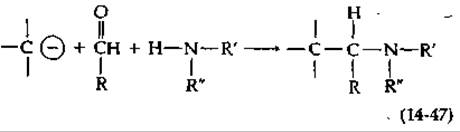
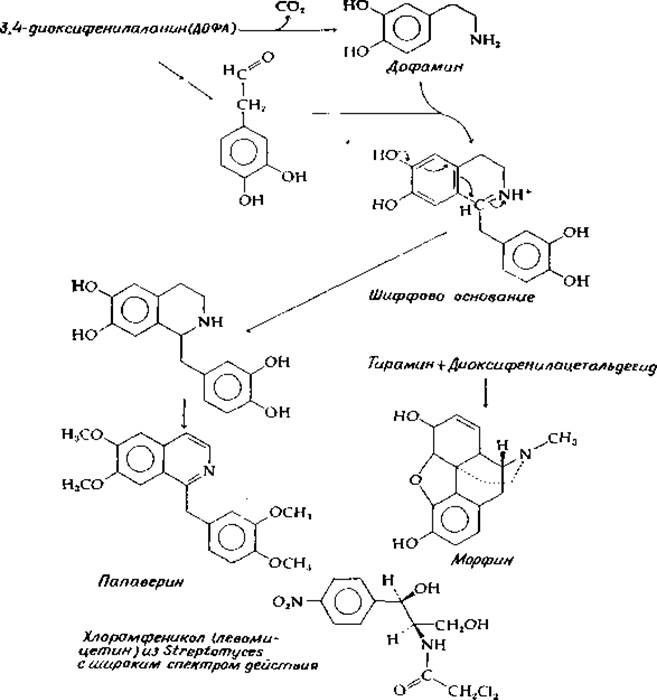
FIG. 14-25. Formation of several alkaloids and Other Compounds from tyrosine intermediate metabolites.
Although Robinson's ideas concerning alkaloid biosynthesis were initially purely speculative, they subsequently received experimental confirmation through isotope-labeling studies. Nevertheless, many unresolved questions remain. The postulated aldehydes were not found among the intermediates. It is conceivable that the Mannich condensation involves keto acids prior to decarboxylation.
Another alkaloid derived from phenylalanine and tyrosine is colchicine (Box 4-A). The six-membered ring originates from phenylalanine, whereas the seven-membered tropolone ring is formed through the ring expansion of a tyrosine precursor.
Last update: 06/08/2026
Editorial and Educational Adaptation: This material has been compiled based on the primary/original source text. The project team performed an editorial review, corrected technical inaccuracies, structured sections, and adapted the content for an educational format.
What was processed:
- elimination of formatting defects (OCR errors, structural breaks, corrupted characters);
- editorial organization of content;
- standardization of terminology in accordance with academic sources;
- verification of factual statements against the original source text.
All mentions of the author, publication year, and origin of the primary text have been preserved in accordance with the source.