Biochemistry: The Chemical Reactions of Living Cells, Volume 2 - D. Metzler 1980
Coenzymes are specialized natural reagents
Coenzyme forms of vitamin B12
Nutritional biochemistry research, which in 1948 led to the isolation of vitamin B12 (cyanocobalamin), shed little light on its coenzymatic Functions, and no concrete information was forthcoming for several years. The main difficulty lay in the extreme sensitivity of the Coenzymes to light, which caused them to break down. Success came from an unexpected quarter.
H. A. Barker discovered that the initial stage of anaerobic glutamate Fermentation in Clostridium tetanomorphum is an unusual rearrangement to ß-methylaspartate [159]:
Class="center">
The latter compound can be catabolized via more or less conventional pathways through reactions unsuitable for the Catabolism of Glutamate itself. Thus, this initial rearrangement is an obligatory step in the METABOLISM/26.html">Energy Metabolism of this anaerobe.
The previously unknown coenzyme required for this reaction was isolated in 1958 after the need to protect it from light during isolation was established. The Structure of this 5'-deoxyadenosyl B12 coenzyme (5'-deoxyadenosylcobalamin) was determined in 1961 by X-Ray Diffraction Analysis [160].
The B12 coenzyme is converted into cyanocobalamin (Supplement 8-L) by replacing the 5'-deoxyadenosyl residue with a CN group, as shown by the following abbreviated formulas for these compounds [161–166]:
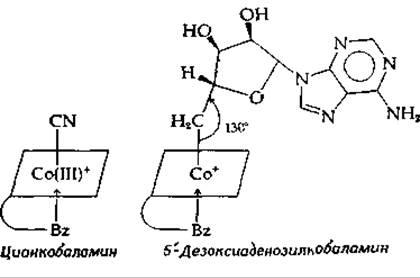
In these formulas, squares denote the cyclic corrin system, and the symbol Bz represents dimethylbenzimidazole coordinated to the cobalt atom on the lower side of the corrin ring.
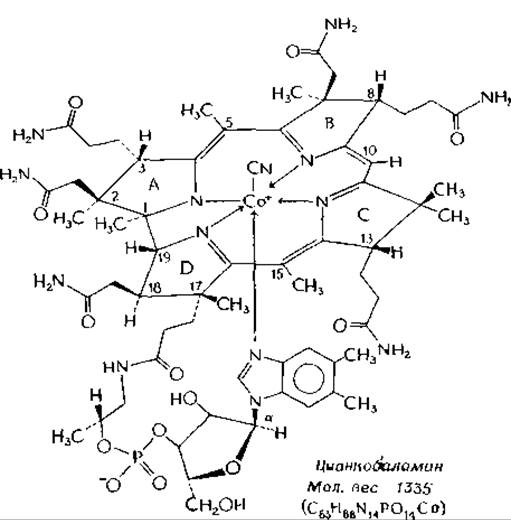
The most striking structural feature is the Co—C σ-bond, with a length of 2.05 Å. Thus, the coenzyme is an alkylcobalt—the first compound of this type discovered in nature. Until 1961, all alkylcobalts were believed to be unstable. Although the bond in 5'-deoxycobalamin is covalent, the Co—C—C angle is 130°, indicating a partially ionic character for the Co—C bond [160]. The oxidation state of cobalt is 3+, and one can imagine that cyanocobalamin is formed by replacing one of the hydrogens within the corrin ring with Co3+ plus CN-. However, it should be borne in mind that the other three nitrogen atoms of the corrin ring and the nitrogen of dimethylbenzimidazole also form bonds with cobalt. Each nitrogen atom donates an electron pair to form the covalent bonds of the chelate complex. In the formula given in Supplement 8-L, this is indicated by arrows to emphasize the formal difference between these bonds and the other Co—N bond. However, owing to Resonance in the conjugated double-bond system of corrin, all four ring Co—N bonds are approximately equivalent, and the positive charge is delocalized over all the nitrogen atoms surrounding the cobalt.
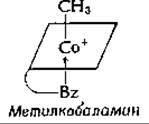
In both Bacteria and Liver, the 5'-deoxyadenosyl coenzyme is the predominant form of vitamin B12. However, methylcobalamin is also present in smaller amounts. A number of other naturally occurring coenzyme analogues have also been isolated. For example, pseudovitamin B12 contains adenine instead of dimethylbenzimidazole, which, like dimethylbenzimidazole, is linked to ribose by an unusual a-linkage. A compound called factor A is a vitamin B12 analogue containing 2-methyladenine. A whole set of other factors has been isolated from sources such as activated sewage sludge, which abounds in anaerobic bacteria. It is suggested that plants may contain vitamin B12-like Materials that are unable to support bacterial growth. Thus, it is quite possible that not all alkylcobalt coenzymes have yet been discovered.
Supplement 8-L
Cobalamin (vitamin B12)
The History of Vitamin B12a began with research into pernicious anemia, a disease that affects mainly older people, though it is occasionally observed in children.
Until 1926, this disease was incurable and typically fatal. In this condition, the body produces abnormally large, underdeveloped, and fragile erythrocytes, and their total count is significantly reduced (1×10⁶–3×106 mm-3 instead of 4.5×10⁶–6×106 mm-3). Apparently, mitosis in the Bone Marrow is blocked and DNA Synthesis is suppressed. The disease also affects other rapidly dividing Tissues, such as the gastric mucosa (resulting in the cessation of HCl secretion) and nervous tissues. Demyelination of the Central Nervous system is frequently observed, accompanied by impaired coordination (ataxia) and psychotic disorders.
In 1926, Minot and Murphy discovered that pernicious anemia could be managed by consuming raw or slightly seared liver at a rate of 1/4 kg per day—a Treatment not met with enthusiasm by all patients. It was not until 22 years later that vitamin B12 was isolated (as a crystalline derivative, cyanocobalamin) and shown to be the curative agent. Its concentration in the liver is approximately 1 mg/kg, or ~10-6 M. Although numerous attempts were made to obtain concentrated liver extracts to treat pernicious anemia, the lack of assay Methods other than treating human patients slowed progress in this direction.
In the early 1940s, studies on the Nutrition of young animals fed a diet deficient in animal Proteins and protected from contact with their own feces (which contain vitamin B12) demonstrated a requirement for the “animal protein factor,” which was soon identified as vitamin B12. Animal experiments also showed that spent streptomycete fermentation broths, such as those used to produce streptomycin and Other Antibiotics, are extremely rich in vitamin B12. Progress in isolating vitamin B12 was greatly facilitated by the recognition of its role as a growth factor for the strain Lactobacillus lactis. The vitamin concentration that supported half-maximal growth rate was a mere 0.013 µg/L (10-11 M).
Another line of research crucial to understanding The Role of vitamin B12 was The Study of the unusually high cobalt requirement of ruminants. This requirement is likely due to the necessity of vitamin B12 for rumen microorganisms. In Regions of the world where soil cobalt content is low, such as Australia, cobalt deficiency in sheep and cattle is a major problem.
In 1948, red cobalt-containing crystals of vitamin B12 were produced almost simultaneously by two major pharmaceutical companies. Following the adsorption of vitamin B12 from liver extracts with activated charcoal, alcohol elution and numerous other fractionation techniques were employed. It was later found that liquid fermentation broths could serve as a richer source of the vitamin.
Structure. Chemical studies showed that the new vitamin has a very high molecular weight, contains a single phosphorus atom that can be cleaved off as Pi, a molecule of Dg-1-amino-2-propanol, and a dimethylbenzimidazole ribofuranoside with an unusual a-configuration. Note that the structure of dimethylbenzimidazole is related to the ring system of riboflavin (Supplement 8-I). Hydrolysis can also release several ammonia molecules from the amide bonds of cobalamin. However, all attempts to reversibly remove cobalt from the vitamin molecule proved unsuccessful.
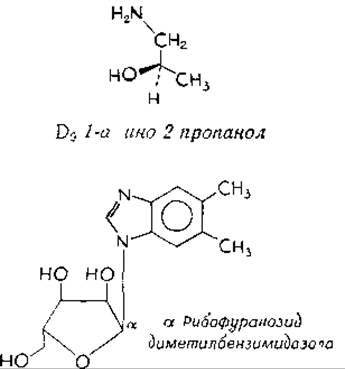
The structure of vitamin B12 was determined by Dorothy Hodgkin and her coworkers in 1956 using X-ray diffractionb. At the time, this was the largest organic molecule whose structure had been elucidated by X-ray crystallographic analysis. Total laboratory synthesis was completed in 1972c.
The cyclic system of vitamin B12 is similar to the porphyrin ring system (Fig. 10-1); it consists of four pyrrole rings whose biosynthetic relationship to the corresponding porphyrin rings is evident. In addition, a number of “extra” methyl groups are present. The corrin ring of vitamin B12 has a less extensive system of conjugated double bonds than Porphyrins, and As a result, A large number of chiral centers are located around the periphery of the rings, projecting somewhat out of the plane of the macrocycle.
The initially isolated form of vitamin B12, cyanocobalamin, contains a cyanide ion occupying one of the coordination positions of the cobalt atom. The content of this form in natural materials is negligible (if it is present at all), but cyanocobalamin is formed when cyanide ions are added during the isolation process. In nature, hydroxo- or aquacobalamin (B12a) exists, containing OH- rather than CN-. However, the predominant forms are the Coenzyme forms of B12, in which CN- is replaced by an alkyl group.
Daily requirement. The intramuscular administration of as little as 3—6 µg of crystalline vitamin B12 is sufficient to induce remission in a patient with pernicious anemia, and a dose of 1 µg per day suffices to maintain treatment outcomes (aquacobalamin is most frequently administered biweekly for this purpose). The required oral dose is substantially (2 to 50 times) larger, though it is usually effortless to meet this requirement through a regular diet. Vitamin B12 is unique in that it is synthesized primarily by bacteria, whereas most plants contain it in small amounts or not at all. Consequently, symptoms of pernicious anemia are occasionally observed in strict vegetarians.
Pernicious anemia is usually caused not by a dietary deficiency of vitamin B12, but by its poor absorption. Absorption depends on the presence of the so-called "intrinsic factor"—a mucoprotein (or mucoproteins) secreted by the gastric mucosa. Individuals with pernicious anemia often have a hereditary predisposition to reduced Synthesis of the intrinsic factor. Gastrectomy (which decreases The amount of synthesized intrinsic factor) and infection with the broad fish tapeworm (which competes for available vitamin B12 and impairs its absorption) can also trigger the disease.
The normal Blood level of vitamin B12 is ~2∙10-10 M or slightly higher, although in vegetarians this level may drop below half of this value. Folic acid deficiency can likewise cause megaloblastic anemia, whereas a large excess of folic acid may somewhat alleviate anemia in patients suffering from pernicious anemia. The concern that high intakes of folic acid could obscure the Diagnosis of pernicious anemia while simultaneously precipitating severe neurological disorders led the U.S. Food and Drug Administration (FDA) to rule in 1960 that the folic acid content in multivitamin tablets must not exceed 25 mg. However, this amount of folic acid appears inadequate during physiological states associated with a high demand for this vitamin, such as the final trimester of Pregnancy. Several authoritative experts believe that the risk of folic acid masking a vitamin B12 deficiency has been greatly exaggerated.
a The history of the discovery of vitamin B12 is discussed in [161].
b Hodgkin D. H. (1965). Science, 150, 979—988.
c See the report in Science, 179, 266—267 (1973).
Last update: 06/08/2026
Editorial and Educational Adaptation: This material has been compiled based on the primary/original source text. The project team performed an editorial review, corrected technical inaccuracies, structured sections, and adapted the content for an educational format.
What was processed:
- elimination of formatting defects (OCR errors, structural breaks, corrupted characters);
- editorial organization of content;
- standardization of terminology in accordance with academic sources;
- verification of factual statements against the original source text.
All mentions of the author, publication year, and origin of the primary text have been preserved in accordance with the source.