Biochemistry - The Chemical Reactions of Living Cells, Volume 2 - D. Metzler 1980
Coenzymes are specialized natural reagents
Coenzyme forms of vitamin B12
Reduction of cyanocobalamin and synthesis of alkylcobalamins
Cyanocobalamin can be reduced in two stages, with one electron being added at each stage [163, 167].
Class="center">
The cyanide ion is lost in The First stage (stage a), which can be carried out using chromium(II) acetate at pH 5 or via catalytic hydrogenation. The reaction product at this stage is a brown paramagnetic compound, B12r, which is a tetragonal low-spin cobalt(II) complex. In the second stage (stage b), another electron is added—for instance, from sodium borohydride or chromium(II) acetate at pH 9.5—yielding grey-green, highly reactive B12s. The latter is believed to be in equilibrium with a cobalt(III) hydride, as shown in the following scheme (stage a):

The hydride is unstable and slowly decomposes into H2 and B12r (stage b) [168].
Vitamin B12 readily reacts with alkyl iodides (such as methyl iodide or the 5'-chloro derivative of adenosine) via a nucleophilic substitution mechanism to form alkylcobalt forms of vitamin B12:
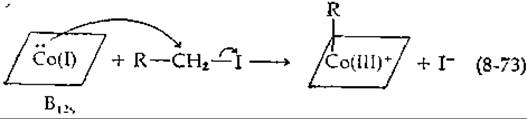
These reactions provide a convenient method for synthesizing isotope-labeled alkylcobalamins, including selectively 13C-enriched cobalamins of interest for NMR studies [169]. The Biosynthesis of 5'-deoxyadenosylcobalamin relies on the exact same type of reaction involving ATP as a substrate [170]. B12 adenosyltransferase catalyzes nucleophilic Substitution at the 5'-carbon of ATP to yield the coenzyme and inorganic tripolyphosphate.
Last update: 06/08/2026
Editorial and Educational Adaptation: This material has been compiled based on the primary/original source text. The project team performed an editorial review, corrected technical inaccuracies, structured sections, and adapted the content for an educational format.
What was processed:
- elimination of formatting defects (OCR errors, structural breaks, corrupted characters);
- editorial organization of content;
- standardization of terminology in accordance with academic sources;
- verification of factual statements against the original source text.
All mentions of the author, publication year, and origin of the primary text have been preserved in accordance with the source.