Biochemistry: The Chemical Reactions of Living Cells, Volume 2 - D. Metzler 1980
Coenzymes: specialized natural reagents
Hydrogen-transfer coenzymes
One of the most universal Biological Oxidation REACTIONS is the dehydrogenation of an alcohol to a ketone or an aldehyde:
Class="center">
At the beginning of this century, it was discovered that the two removed hydrogen atoms are transferred to hydrogen-carrying Coenzymes such as nicotinamide adenine dinucleotide (NAD)1), nicotinamide adenine dinucleotide phosphate (NADP), flavin adenine dinucleotide (FAD), and riboflavin 5'-phosphate (also known as flavin mononucleotide, FMN).
Upon the reduction of NAD, only one of the hydrogen atoms removed from the alcohol molecule is covalently bound to NAD, converting it into NADH, whereas the other becomes a free proton:

The Study of 2H-labeled alcohols and their NAD-mediated oxidation showed that dehydrogenases catalyze the direct transfer to NAD+ of the hydrogen attached to the carbon of the alcohol group. Furthermore, no hydrogen exchange with any protons of the medium was detected.
1) NAD was often called diphosphopyridine nucleotide (DPN), and NADP was called TPN. Many biochemists prefer these older names, and they still frequently appear in biochemical literature.
At the same time, the hydrogen attached to the oxygen of the alcohol is released into the medium as H+:

The observations mentioned above provide grounds for viewing these acts of biological oxidation (dehydrogenation processes) as the removal of a hydride ion H- together with a proton H+, rather than as the removal of two hydrogen atoms. Thus, NAD+ and NADP+ are generally regarded as hydride ion-accepting coenzymes. Nevertheless, It is important to keep in mind that it has proved impossible to establish definitively whether The transfer of the hydrogen atom to these coenzymes occurs before or after electron transfer, or whether the proton and electrons are transferred simultaneously, i.e., in the form of H-.
The picture is even less clear in the case of the Flavin Coenzymes FAD and riboflavin phosphate. However, whatever the true mechanism of the reaction, it is convenient to classify most acts of metabolic hydrogen transfer from the standpoint of the transfer of a hypothetical hydride ion. The hydride ion can be considered a nucleophile that can add to double bonds or be cleaved from substrates in the types of reactions already discussed and listed in Table 8-3. Although all reactions are presented in the direction of reduction, many of them are reversible, and some typically proceed in the direction opposite to that shown in the table.
Why are there four main hydrogen-transfer coenzymes (NAD+, NADP+, FAD, and riboflavin phosphate) rather than just one?
The answer lies partly in the fact that the reduced pyridine NUCLEOTIDES NADPH and NADH are stronger reducing agents than the reduced flavins (Table 3-7). Conversely, flavin coenzymes are stronger oxidizing agents than NAD+ and NADP+. Flavin coenzymes are built on The basis of the vitamin riboflavin, whereas pyridine nucleotides are based on nicotinamide. The structures of these two Vitamins have undoubtedly been selected by nature to impart the proper oxidation-reduction potentials to the coenzymes (Chap. 3, Sec. B). However, it is not quite that simple. NAD+ and NADP+ tend to exist in The Cell in free forms, diffusing from one enzyme to another. Flavin coenzymes, on the other hand, are usually firmly bound to Proteins and are immobile. Thus, they tend to accept hydrogen atoms from one substrate and transfer them to a second substrate while remaining attached to the same enzyme.
The oxidation-reduction potential of the pyridine nucleotide coenzyme system is determined by the standard oxidation-reduction potential of the free coenzyme combined with the concentration ratio of the oxidized and reduced forms of the coenzyme [NAD+]/[NADH] [Equation 3-64]. Consequently, the true potential of the NAD+ system within the cell can be determined. The oxidation-reduction potential may vary in different PARTS OF THE cell due to differences in the [NAD+]/[NADH] ratio, but within a given region of the cell, it remains constant. At the same time, the oxidation-reduction potentials of Flavoproteins vary widely. Because flavin coenzymes do not dissociate from the protein, two flavoproteins can operate at vastly different potentials even when located close to each other.
Table 8-3 Some Hydrogen Transfer Reactionsa
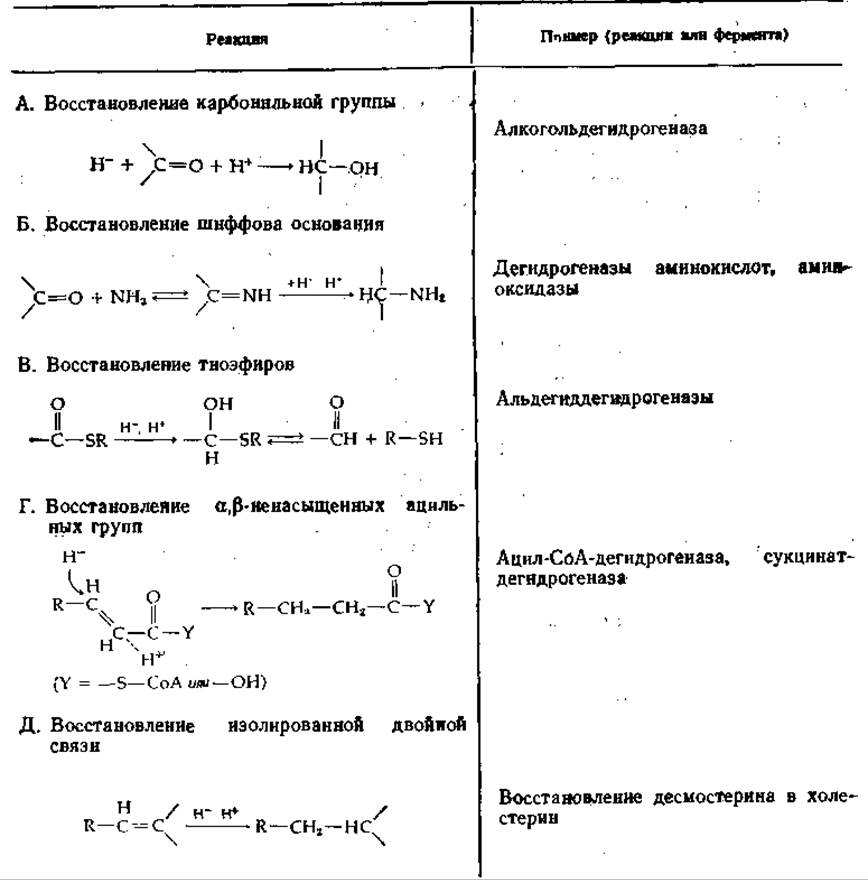
a Type 9 reaction (see Table 9-1): a hypothetical hydride ion H- is transferred to the substrate from a coenzyme with a suitable oxidation-reduction potential, such as NADH (DPNH), NADPH (TPNH), FADH, or reduced riboflavin 5'-phosphate. Enzymes are generally named after the reverse reactions (i.e., dehydrogenation reactions).
Why are there two pyridine nucleotides, NAD+ and NADP+, differing only in the presence or absence of an additional phosphate group in the nucleotide "handle"? The answer appears to be that they participate in two different oxidation-reduction systems which, although based on nicotinamide, operate independently of each other. Experimentally determined [NAD+]/[NADH] and [NADP+]/[NADPH] ratios differ markedly. Thus, the two systems appear to operate at different oxidation-reduction potentials within the same region of the cell. As for the function of these two coenzymes, NAD+ most frequently acts as an oxidizing agent in the removal of hydrogen atoms from substrates, whereas NADP+ is more commonly reduced to NADPH and plays The Role of a reducing agent in biosynthetic processes.
Last update: 06/08/2026
Editorial and Educational Adaptation: This material has been compiled based on the primary/original source text. The project team performed an editorial review, corrected technical inaccuracies, structured sections, and adapted the content for an educational format.
What was processed:
- elimination of formatting defects (OCR errors, structural breaks, corrupted characters);
- editorial organization of content;
- standardization of terminology in accordance with academic sources;
- verification of factual statements against the original source text.
All mentions of the author, publication year, and origin of the primary text have been preserved in accordance with the source.