Biochemistry - The Chemical Reactions of Living Cells, Volume 2 - D. Metzler 1980
Coenzymes – unique, specialized natural reagents
Pyridine nucleotide coenzymes and dehydrogenases
In 1904, Harden and Young demonstrated that Cell-free Yeast "juice"1) loses its ability to ferment glucose into alcohol and carbon dioxide after dialysis. Apparently, the Fermentation process depended on the presence of some low-molecular-weight substance capable of passing through the pores of the dialysis membrane. Fermentation could be restored by adding concentrated yeast-juice dialysate or boiled yeast juice (in which the enzyme Proteins had been destroyed). Eventually, it was established that the thermostable material, which Harden and Young called cozymase, was a mixture of inorganic phosphate, Thiamine diphosphate, and NAD. However, NAD was not fully characterized until 1935.
Pure NAD was isolated in 1934 from erythrocytes by Warburg and Christian, who were studying The oxidation of glucose-6-phosphate in these Cells [67]. These researchers showed that fermentation requires a dialyzable cofactor, which they characterized and named triphosphopyridine nucleotide (TPN), now officially designated as NADP+ (Fig. 8-10). Interestingly, nicotinamide was identified as a constituent of NAD even before its role as a vitamin essential for Human Nutrition was recognized.
Class="center">
FIG. 8-10. Hydrogen-transfer Coenzymes NAD+ (DPN+) and NADP+ (TPN+). Note that the Abbreviations NAD+ and NADP+ are used even though the overall net charge of the entire molecule at pH 7 is negative.
1) The juice was obtained by grinding yeast with sand and filtering. Buchner's discovery in 1899 that such yeast juice ferments sugar marked one of the starting points in The Development of modern biochemistry.
Warburg and Christian concluded that NADP is closely related to NAD and suggested that both compounds function as hydrogen carriers through alternating reduction and oxidation steps of the pyridine ring. They showed that these coenzymes can be reduced both enzymatically and non-enzymatically using sodium dithionite Na2S2О4:
S2О2-4- + NAD+ + Н+→ NADH + 2SО2.----------------------------------- (8-39)
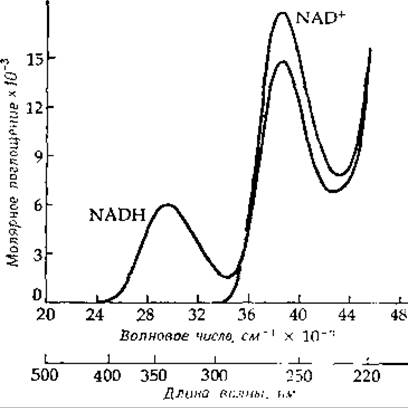
FIG. 8-11. Absorption spectra of NAD+ and NADH. The spectra of NADP+ and NADPH are very similar. The difference in absorption between the oxidized and reduced forms at 340 nm serves as the basis for what is perhaps the most widely used spectrophotometric method in biochemistry. Numerous Methods for determining enzyme activity rely on measuring the reduction of NAD+ or NADP+ or the oxidation of NADH or NADPH. If a pyridine nucleotide is not a substrate of the enzyme under study, "coupled assays" can often be used. For example, the Rate of Enzymatic ATP synthesis can be determined by adding glucose + hexokinase + glucose-6-phosphate dehydrogenase + NADP+ to the reaction mixture. As ATP is synthesized, it phosphorylates glucose (in a reaction catalyzed by hexokinase). Then NADP+ oxidizes the resulting glucose-6-phosphate to yield NADPH, the synthesis rate of which is monitored at 340 nm.
The reduced coenzymes NADH and NADPH are characterized by a new absorption band at 340 nm, which is absent in their oxidized forms; the latter exhibit an absorption maximum at 260 nm (Fig. 8-11). The reduced forms are stable in air, although it has been established that they can be re-oxidized by the Introduction/43.html">Action of Certain "yellow Enzymes" (Flavoproteins).
Box 8-3
Nicotinic Acid and Nicotinamide
Nicotinic acid was first obtained in 1867 by the oxidation of nicotine. It was isolated from yeast and rice bran by Funk, and independently by Suzuki (1911–1912), though its vitamin nature was not suspected at the time. The Biological Significance of nicotinic acid was first established in 1935 when it was discovered that nicotinamide is a component of NAD+ (Euler and co-workers) and NADP+ (Warburg and Christian).

In 1937, Elvehjem and his colleagues described the cure of canine black Tongue using nicotinic acid, and later that same year, several research groups reported the successful Treatment of human pellagra. At the time, pellagra was a widespread disease in the United States, especially in the South. According to estimates by the U.S. Public Health Service, there were 100,000 victims of this disease annually between 1912 and 1916, resulting in 10,000 deathsa,b. (Pellagra is characterized by weakness, digestive disturbances, and loss of appetite, followed by dermatitis, diarrhea, mental disorders, and ultimately death).
Physical properties: Both forms of the vitamin are stable, colorless, and highly soluble in Water.
Daily requirement: about 7.5 mg for adults. This requirement decreases in the presence of dietary Tryptophan, which can be partially converted into nicotinic acid (Ch. 14, Sec. H). The biological activity of tryptophan is approximately 1/60 that of nicotinic acid itself. The historical prevalence of pellagra in the southern United States was a direct consequence of a diet relying primarily on corn (maize), the proteins of which are very low in tryptophan.
a Wagner A. F., Folkers K. (1964). Vitamins and Coenzymes, p. 73, Wiley (Interscience), New York.
b For reviews of two interesting books concerning The history of pellagra, see Rosenkrantz B. G. (1974). Science, 183, 949–950.
Last update: 06/08/2026
Editorial and Educational Adaptation: This material has been compiled based on the primary/original source text. The project team performed an editorial review, corrected technical inaccuracies, structured sections, and adapted the content for an educational format.
What was processed:
- elimination of formatting defects (OCR errors, structural breaks, corrupted characters);
- editorial organization of content;
- standardization of terminology in accordance with academic sources;
- verification of factual statements against the original source text.
All mentions of the author, publication year, and origin of the primary text have been preserved in accordance with the source.