Biochemistry - The Chemical Reactions of Living Cells, Volume 2 - D. Metzler 1980
Coenzymes - specialized natural reagents
Keto acids and other unusual electrophilic centers
Histidine and phenylalanine deaminases (ammonia-lyases)
Returning to stage a in equation (8-32), we should note the following: the substrate Structure is such that an easy elimination of the α-amino group could hardly be expected. Thus, it is not surprising that the enzyme L-Histidine ammonia-lyase features a distinct Active Site, much like L-phenylalanine ammonia-lyase. The latter eliminates the NH3 group along with the pro-S hydrogen at the β-position to yield trans-cinnamic acid:
Class="center">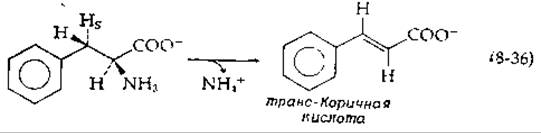
The latter is produced in Higher Plants and is converted into a staggering variety of derivatives (Box 12-B; Chapter 14, Section 3.6). When 2H is introduced into the β-position, no kinetic isotope effect is observed. Apparently, the rate-limiting step is the release of ammonia from the coenzyme group, meaning the enzyme must somehow significantly enhance The properties of the amino group as a leaving group.
Both Enzymes are inhibited by sodium borohydride as well as nitromethane. Evidence suggests that both enzymes contain N-terminal dehydroalanine residues, whose amino groups exist as Schiff bases, possibly formed with aldehyde groups generated by The oxidation of Serine side chains [65, 66]. A tentative METABOLISM/10.html">Mechanism of enzyme Action based on this assumption has been proposed, along with a suggested potential involvement of a transition metal [66a].
All the mechanisms described in this section should be regarded as purely hypothetical. Since they all involve the anomalous reactivity of bound keto acids, the actual situation is likely much more complex.
Last update: 06/08/2026
Editorial and Educational Adaptation: This material has been compiled based on the primary/original source text. The project team performed an editorial review, corrected technical inaccuracies, structured sections, and adapted the content for an educational format.
What was processed:
- elimination of formatting defects (OCR errors, structural breaks, corrupted characters);
- editorial organization of content;
- standardization of terminology in accordance with academic sources;
- verification of factual statements against the original source text.
All mentions of the author, publication year, and origin of the primary text have been preserved in accordance with the source.