Biochemistry of Amino Acids - A. Majster 1961
General Biochemistry and Physiology of Amino Acid Metabolism
Purine Biosynthesis
The potential role of Amino Acids as precursors in The Biosynthesis of the purine ring has been studied for quite some time. Experiments using labeled compounds revealed that despite their structural similarity to Purines, Histidine and Arginine do not serve as direct nitrogen sources for purine synthesis [669, 670]. At the same time, it was demonstrated that pigeon Liver slices synthesize hypoxanthine, and that The addition of glutamine or oxaloacetate to such tissue preparations increases The amount of hypoxanthine synthesized [671–673].
Isotope studies have greatly contributed to the successful investigation of Purine Biosynthesis, shedding light on THE ORIGIN OF nitrogen and carbon atoms within the purine ring. It was established that Glycine is the precursor of atoms C-4, C-5, and N-7 [674, 675], CO2 is the precursor of atom C-6 [674–676], formic acid is the precursor of atoms C-2 and C-8 [676], glutamine is the precursor of atoms N-3 and N-9 [677], and aspartic acid is the precursor of atom N-1 [677, 723]. These data are illustrated by the following scheme:
Class="center">
Experiments with pigeon liver extracts showed that The formation of one mole of hypoxanthine requires 2 moles of formic acid, 1 mole of CO2, and 1 mole of glycine [678]; it was later established that for each mole of glycine incorporated into hypoxanthine, There are two nitrogen atoms originating from the amide group of glutamine. Half of the amide nitrogen incorporated into the purine was found in the N-9 atom, and the other half in the shared nitrogen of the N-1 and N-3 atoms. When using N15-aspartic or N15-glutamic acid, the isotope labeled only the total N-1 + N-3 fraction [677]. These findings pointed to the possible role of the glutamine amide group as a source of the N-1 (or N-3) atom, and to the Water/144.html">Origin of the second of these atoms from the α-amino group. Subsequent work demonstrated that aspartic acid serves as the source of the N-1 atom [723].
In studies on inosinic acid synthesis in pigeon liver preparations (in the presence of glycine, formate, bicarbonate, ribose-5-phosphate, 3-phosphoglyceric acid, and leucovorin), it was found that the addition of L-asparagine or L-glutamine stimulates the synthesis of this acid [678]. Glutamic and aspartic acids exert a lesser effect, while several Other Amino Acids show no effect at all. The addition of glutamic acid to glutamine, or aspartic acid to asparagine, did not lead to any significant enhancement of inosinic acid synthesis compared to synthesis in the presence of the amides alone. However, the addition of aspartic acid to glutamine—and to a slightly lesser extent, glutamic acid to asparagine—substantially increased the yield of inosinic acid. These data indicate that the simultaneous presence of C4- and C5-aminodicarboxylate derivatives is required, one of which must bear an amide group at the ω-position. Such results can be explained by the formation of glutamine from glutamic acid and ammonia released during the Enzymatic Hydrolysis of asparagine.
The fact that inosinic acid acts as a precursor of hypoxanthine in pigeon liver enzyme preparations provided grounds to suspect the formation of ribonucleotides at Cytology/cytology/16.html">Early stages of the purine biosynthesis pathway [679]. Further research conducted in the laboratories of Greenberg [679–683, 718–720] and Buchanan [684–690, 721–723] helped elucidate The Mechanism of purine synthesis. It was found that in the presence of glutamine, adenosine triphosphate, glycine, and 5-phosphoribosylpyrophosphate, a pigeon liver protein fraction synthesizes glycinamide ribonucleotide. The initial step in the reaction chain appears to be the formation of 5-phosphoribosylamine from glutamine and 5-phosphoribosylpyrophosphate [683, 718]. Glycinamide ribonucleotide is converted into formylglycinamide ribonucleotide by attaching a formyl group. The latter reacts with glutamine to yield formylglycinamidine ribonucleotide, which is presumably converted via ring closure into aminoimidazole ribonucleotide. In the presence of CO2 and aspartic acid, this compound forms 5-amino-4-imidazolecarboxamide ribonucleotide, which subsequently accepts a formyl group and undergoes cyclization to yield inosinic acid. These reactions can be represented as follows:
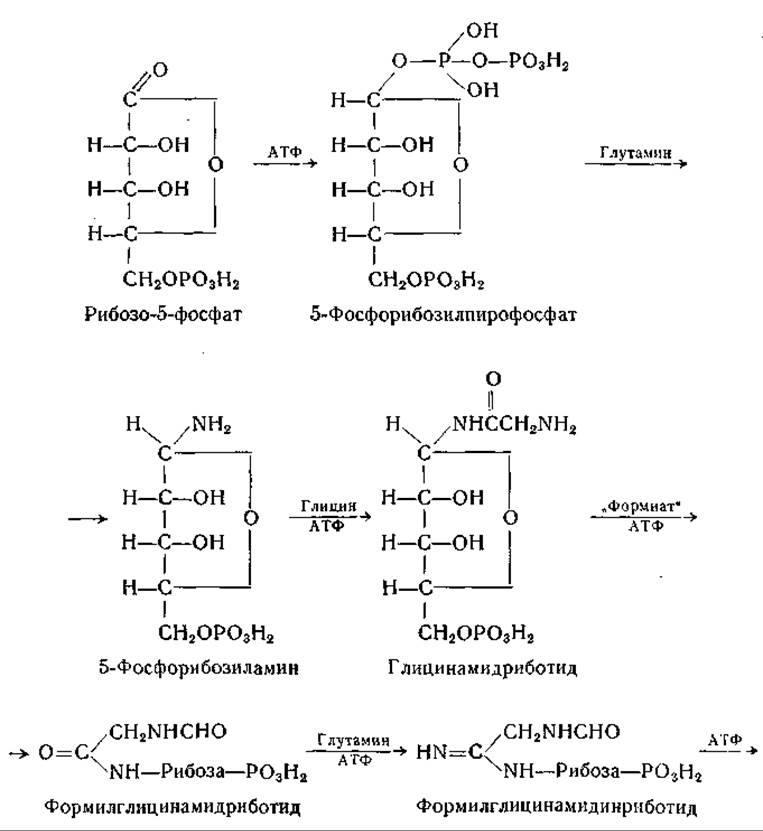

Data on the accumulation of 4-amino-5-imidazolecarboxamide riboside and its corresponding ribonucleotide in Escherichia coli cultures upon growth inhibition by sulfonamides were of great significance [691–694]. These observations prompted the aforementioned studies on the formation of acyclic ribonucleotides. Free 4-amino-5-imidazolecarboxamide had previously been isolated from E. coli cultures grown in the presence of sulfonamides [691–692]. It is likely that the inhibition of bacterial growth and purine synthesis by sulfonamides is related to the disruption of cofactor synthesis derived from p-aminobenzoic acid. Competitive inhibition of The conversion of formylglycinamide ribonucleotide to formylglycinamidine ribonucleotide by azaserine has also been described. In the presence of this antibiotic, which appears capable of inhibiting tumor growth (p. 46), glycinamide ribonucleotide accumulates [687]. Azaserine also causes competitive inhibition of the reaction between glutamine and 5-phosphoribosylpyrophosphate, which leads to the formation of 5-phosphoribosylamine [721].
It was found that leucovorin (p. 327) or a related Folic acid derivative participates in the incorporation of formate into the purine ring at positions 2 and 8, as well as in the exchange reaction between formate and the C-2 atom of inosinic acid [695].
Several details of the reactions involved in purine biosynthesis remain unclear. However, judging by the rapid progress currently being made in The Study of this process, many related questions are expected to be resolved in the near future1.
1 A summary of more recent data on the mechanism of purine biosynthesis is given in a review by J. M. Buchanan and S. C. Hartman, Advances Enzymol. 21, 199 (1959); for the pyrimidine biosynthesis pathway, see the review by P. Reichard, Advances Enzymol. 21, 263 (1959). — Ed. note.
Last update: 06/08/2026
Editorial and Educational Adaptation: This material has been compiled based on the primary/original source text. The project team performed an editorial review, corrected technical inaccuracies, structured sections, and adapted the content for an educational format.
What was processed:
- elimination of formatting defects (OCR errors, structural breaks, corrupted characters);
- editorial organization of content;
- standardization of terminology in accordance with academic sources;
- verification of factual statements against the original source text.
All mentions of the author, publication year, and origin of the primary text have been preserved in accordance with the source.