Biochemistry of Amino Acids - A. Majster 1961
Intermediary Metabolism of Amino Acids
Phenylalanine and Tyrosine
Other Tyrosine Metabolism Reactions
Besides breaking down via the pathways described above, Tyrosine is converted in the Organism into A number of Other Compounds, such as adrenaline, noradrenaline, Melanins, and iodinated derivatives (thyroxine, etc.). Gurin and Delluva [992] demonstrated that in the rat body, phenylalanine labeled with deuterium or tritium is converted into adrenaline, with the original side chain remaining intact during ring oxidation. It was later shown that both labeled Phenylalanine and Tyrosine serve as precursors of adrenal adrenaline [993]. Udenfriend and Weingarten [994] found that in rats, 3,4-dihydroxyphenylalanine, like tyrosine and phenylalanine, is converted into adrenaline and noradrenaline, whereas tyramine and phenylethylamine do not undergo this transformation.
According to available data, the primary adrenergic substance is noradrenaline rather than adrenaline [995]. In vivo experiments on rats using isotope tracers have established that 3,4-dihydroxyphenylethylamine is also a precursor of adrenal adrenaline [1138]. The likely pathway for The formation of these adrenergic substances is as follows:
Class="center">
The oxidation of tyrosine to DOPA is catalyzed by tyrosinase [996–998], which is present in both PLANT AND ANIMAL Tissues. The decarboxylation of DOPA occurs in tissues of both animal and plant origin. The hydroxylation of tyrosine has not been studied in detail. It is known that the methyl group is introduced into adrenaline via Transmethylation (p. 370).
The scheme presented above has not yet been fully confirmed experimentally. Data have been obtained indicating the possible existence of alternative pathways for adrenaline Biosynthesis. For instance, the formation of noradrenaline was observed when guinea pig Kidney mince was incubated under anaerobic conditions with dihydroxyphenylserine [945].
There are indications of the presence of an isopropyl analogue of adrenaline in nature: chromatographic data have been published suggesting the presence of "isoprenaline" in saline extracts of monkey, cat, and human Adrenal Glands [1139].

Tyrosine is converted into melanin via DOPA and 5,6-dihydroxyindole. Raper [996, 999] and Mason [997] substantiated the following pathway for melanin formation:
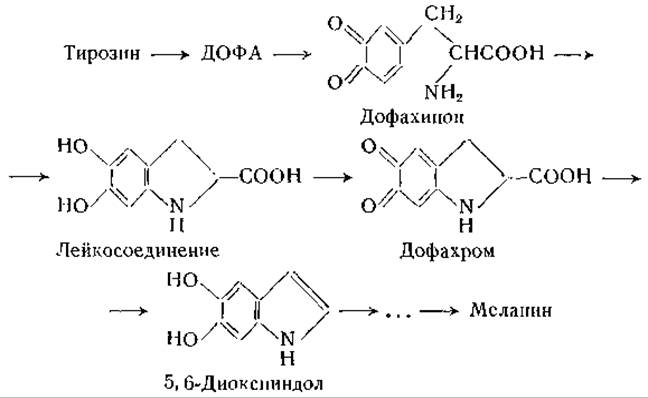
Based on studies of 5,6-dihydroxyindole polymerization, hypotheses regarding The Mechanism of this reaction have been put forward [1000, 1001].
Tyrosine plays The Role of a precursor in the formation of thyroxine, monoiodotyrosine, 3,5-diiodotyrosine, and 3,3',5-triiodothyronine. There is abundant evidence that labeled iodide ions are incorporated into the iodine of thyroxine and 3,5-diiodotyrosine in the organism, but the iodination mechanism remains unclear. Johnson and Tewkesbury [1002] and Harington [1003] studied the formation of thyroxine from diiodotyrosine. They proposed the following transformation scheme involving free radical formation:

The mechanism of thyroxine formation has been a subject of extensive Structure/133.html">Discussion [966, 1004]. With the discovery of 3,3',5'-triiodothyronine [1005, 1006], whose physiological activity is higher than that of thyroxine, the question of the true Nature of the thyroid hormone arose once again. The mechanism of 3,3',5-triiodothyronine formation is unknown; it may be formed from thyroxine via deiodination [1007]. An enzyme termed "tyrosine deiodinase" has been found in the thyroid and submandibular glands [1008]. This enzyme catalyzes the reversible reaction between tyrosine and free iodine to yield monoiodotyrosine.

Fig. 21. Summary scheme of phenylalanine and tyrosine transformations.
A similar enzyme system catalyzing the deiodination of diiodotyrosine and triiodothyronine is present in The Liver and Kidneys [1140]. It is possible that Other Enzymes of this type effect the interconversion of thyroxine and triiodothyronine [1009, 1010]. The breakdown of thyroxine and triiodothyronine apparently proceeds via Transamination reactions (as shown for 3,5-diiodotyrosine [1011]); the keto acids formed in this manner could undergo decarboxylation [1012].
Bacteria degrade tyrosine through a series of reactions resulting in products such as phenol, p-cresol, p-hydroxybenzoic acid, etc. [1013, 1014]. The conversion to phenol is mediated by β-tyrosinase1, which cleaves the side chain [555].
Tyrosine has been found in normal human urine as the corresponding phenolsulfuric acid (tyrosine O-sulfate) [1015]. It apparently occurs in this form in fibrinogen as well [1016]. The mechanism of tyrosine O-sulfate formation and the physiological significance of this derivative are unknown.
Last update: 06/08/2026
Editorial and Educational Adaptation: This material has been compiled based on the primary/original source text. The project team performed an editorial review, corrected technical inaccuracies, structured sections, and adapted the content for an educational format.
What was processed:
- elimination of formatting defects (OCR errors, structural breaks, corrupted characters);
- editorial organization of content;
- standardization of terminology in accordance with academic sources;
- verification of factual statements against the original source text.
All mentions of the author, publication year, and origin of the primary text have been preserved in accordance with the source.