Harper's Illustrated Biochemistry, Volume 1 - Murray R. 1993
Structure and Function of Proteins and Enzymes
Enzymes: Kinetics
Enzyme Inhibition
There are two Major Classes of enzyme activity inhibitors—Competitive and non-competitive—distinguished by whether their inhibitory effect diminishes (competitive inhibition) or remains unchanged (non-competitive inhibition) as the Substrate Concentration increases. In practice, many inhibitors do not exhibit the properties typical of purely competitive or purely non-competitive inhibition. Another approach to classifying inhibitors is based on The Nature of their binding site. Some bind to the enzyme at the same site as the substrate (the catalytic center), while others bind at a considerable distance from the active center (the allosteric center).
Competitive Inhibition by Substrate Analogs
Classical competitive inhibition is based on the binding of an inhibitor to the substrate-binding (catalytic) center. The Chemical Structure of a substrate analog acting as an inhibitor (I) is usually similar to that of the substrate (S). Consequently, the inhibitor can reversibly bind to the enzyme, forming an Enz—I complex instead of an Enz—S complex, i.e., an enzyme-inhibitor complex. When both the substrate and this type of inhibitor are present simultaneously in the reaction mixture, they compete for the same binding site on the enzyme's surface. One of the most thoroughly studied Examples of competitive inhibition is the inhibition of succinate dehydrogenase by malonate (I), which competes for the same site with the substrate succinate (S).
Succinate dehydrogenase catalyzes The formation of fumarate through the abstraction of a hydrogen atom from each of the two α-carbon atoms of succinate (Fig. 8.19). Malonate (OOC—CH2—COO) can bind to the dehydrogenase, forming an Enz—I complex. However, hydrogen abstraction cannot occur from the Ca atom of malonate. The Enz—I complex can only dissociate back into the free enzyme and the inhibitor. For this reversible reaction
Class="center">
the Equilibrium Constant Ki is equal to


Fig. 8.19. The succinate dehydrogenase reaction.
The action of Competitive Inhibitors can be represented by the following reactions:

The rate of product formation—which is typically the measured parameter—depends solely on the concentration of the Enz—S complex. Suppose that I binds very tightly to the enzyme (Ki is small). In that case, The amount of free enzyme (Enz) available to bind S and form the Enz—S complex (and subsequently Enz + P) will be very small. Thus, the reaction rate (product formation) will be low. Conversely, at the same concentration of a weakly binding inhibitor (Ki is large), the catalyzed reaction will not be significantly slowed down. Now suppose that increasing amounts of substrate S are added at a fixed inhibitor concentration I. This raises the probability of forming the Enz—S complex relative to the Enz—I complex. As the [Enz—S]/[Enz—I] ratio increases, the reaction rate will also increase. At a sufficiently high concentration of S, the concentration of the Enz—I complex becomes negligibly small. Under these conditions, the rate of the catalyzed reaction matches that observed in the absence of I (Fig. 8.20).

Fig. 8.20. Lineweaver–Burk plot for classical competitive inhibition. Note the complete absence of inhibitory effect at high [S] values (low 1/[S] values).
Graphical Evaluation of Competitive Inhibition Constants
Figure 8.20 illustrates a typical case of competitive inhibition presented in the form of a Lineweaver–Burk plot. The reaction velocity (v) is measured at various S concentrations and a fixed inhibitor concentration. The lines drawn through the experimental points intersect at a single point on the y-axis. The y-intercept is equal to 1/Vmax; this means that at an infinitely high S concentration (1/[S] = 0), v will be the same as in the absence of the inhibitor. However, the x-intercept (which determines the KM value) decreases in the presence of the inhibitor (-1/K'M < -1/KM). Thus, a competitive inhibitor increases the apparent KM value (K'M) for the substrate. For simple competitive inhibition, the x-intercept will be equal to

Once KM is determined in the absence of I, Ki can be calculated from this equation. If the concentration of added I significantly exceeds the Enzyme Concentration, [I] can be approximated as the concentration of the added inhibitor. The Ki values for a series of substrate analogs (competitive inhibitors) indicate which of them is the most potent. Inhibitors with the lowest Ki values can exert a strong inhibitory effect even at low concentrations.
Many clinically widely used drugs act as competitive inhibitors of crucial Enzymes that function in both microbial and animal Cells.
Reversible Non-Competitive Inhibition
As the name implies, there is no competition between S and I in this case. The inhibitor typically bears no structural resemblance to S and is presumed to bind to a different site on the enzyme. Reversible non-competitive inhibitors lower the maximum velocity achievable with a given amount of enzyme (decrease Vmax), but generally do not affect KM. Since I and S bind to separate sites, the formation of both the Enz—I complex and the Enz—IS complex is possible. The Enz—IS complex also breaks down to yield product, albeit at a lower rate than the Enz—S complex; therefore, the reaction slows down but does not stop. Consequently, the following competing reactions can take place:
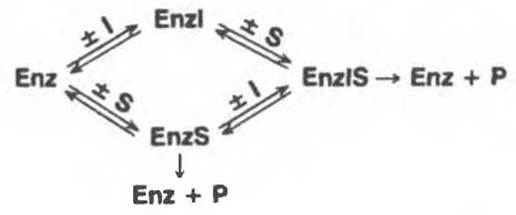
Figure 8.21 shows the dependence of 1/v on 1/[S] in the presence and absence of the inhibitor (assuming that the binding of I does not induce significant alterations in the Active Site function).
Irreversible Non-Competitive Inhibition
Enzyme activity can be diminished in the presence of numerous "poisons," such as iodoacetamide, heavy Metal Ions (Ag+, Hg2+), oxidizing agents, etc. The rate of Enzyme inactivation may decrease in the presence of one or more substrates or products. The kinetic analysis discussed here may prove insufficient to distinguish the action of enzyme poisons from that of reversible non-competitive inhibitors. Reversible non-competitive inhibition is relatively rare. Unfortunately, it is not always easily detected because both reversible and irreversible non-competitive inhibitions share similar kinetics.

Fig. 8.21. Lineweaver–Burk plot for reversible noncompetitive inhibition.
Last update: 06/08/2026
Editorial and Educational Adaptation: This material has been compiled based on the primary/original source text. The project team performed an editorial review, corrected technical inaccuracies, structured sections, and adapted the content for an educational format.
What was processed:
- elimination of formatting defects (OCR errors, structural breaks, corrupted characters);
- editorial organization of content;
- standardization of terminology in accordance with academic sources;
- verification of factual statements against the original source text.
All mentions of the author, publication year, and origin of the primary text have been preserved in accordance with the source.