Human Biochemistry, Volume 1 - Murray R. 1993
Bioenergetics and Metabolism of Carbohydrates and Lipids
Synthesis, Transport, and Excretion of Cholesterol
Cholesterol Biosynthesis — The Biosynthetic Pathway
Approximately half of the Cholesterol present in the Organism is produced via Biosynthesis (about 500 mg∙day-1), while the other half is obtained from diet. Cholesterol is synthesized mainly in the Liver (~ 50% of the total amount of cholesterol produced), the intestine (~ 15%), and the Skin (most of the remaining share).
All nucleated Cells are capable of synthesizing cholesterol. Cholesterol Biosynthesis takes place in the microsomes (Endoplasmic reticulum) and the Cytosol.
The source of all carbon atoms in the cholesterol molecule is acetyl-CoA. The biosynthetic pathway of the complex cholesterol molecule has been investigated in numerous studies, and current findings have established THE ORIGIN OF all fragments of the cholesterol molecule (Figs. 27.1, 27.2, and 27.3). The synthesis of this substance occurs in several stages. 1. Mevalonate, whose molecule contains 6 carbon atoms, is synthesized from acetyl-CoA (Fig. 27.1). 2. Upon the Cleavage of CO- from mevalonate, an isoprenoid unit is formed (Fig. 27.2). 3. Six isoprenoid units condense to form the intermediate compound squalene. 4. Squalene undergoes cyclization to yield the parent steroid lanosterol. 5. Through further transformations involving the removal of three methyl groups, lanosterol is converted into cholesterol (Fig. 27.3).
1. The formation of mevalonate via HMG-CoA (3-hydroxy-3-methylglutaryl-CoA) proceeds in the cytosol through the same sequence of reactions as ketone body biosynthesis in the Cell/35.html">Mitochondria (Chap. 28).
At The First stage of cholesterol synthesis, two molecules of acetyl-CoA are condensed by the cytosolic enzyme thiolase to form acetoacetyl-CoA. Alternatively, acetoacetate formed in the liver mitochondria via the ketogenesis pathway (see Chap. 28) diffuses into the cytosol, where it is converted into the active derivative acetoacetyl-CoA (a reaction catalyzed by acetoacetyl-CoA synthase in the presence of CoA and ATP). Another enzyme, HMG-CoA synthase, catalyzes the Condensation of acetoacetyl-CoA with acetyl-CoA to yield HMG-CoA.
Class="center">
Fig. 27.1. Biosynthesis of mevalonate. HMG — 3-hydroxy-3-methylglutaryl. HMG-CoA reductase is inhibited by cholesterol as well as by the fungal metabolites compactin and mevinolin, which compete with HMG-CoA.
Subsequently, HMG-CoA is converted into mevalonate via a two-step NADPH-dependent reduction catalyzed by the microsomal enzyme HMG-CoA reductase. This reaction is considered to be the rate-limiting step in the cholesterol synthesis pathway (Fig. 27.1).
2. Mevalonate is phosphorylated by ATP to form a series of active phosphorylated intermediates (Fig. 27.2). The resulting 3-phospho-5-pyrophosphomevalonate is decarboxylated to yield isopentenyl pyrophosphate—the active isoprenoid unit.
3. The next step involves the condensation of three molecules of isopentenyl pyrophosphate to form farnesyl pyrophosphate. The process begins with the isomerization of isopentenyl pyrophosphate (via a double bond shift) into dimethylallyl pyrophosphate.
The latter condenses with another molecule of isopentenyl pyrophosphate to form the ten-carbon intermediate geranyl pyrophosphate (Fig. 27.2), which then condenses with yet another molecule of isopentenyl pyrophosphate to yield farnesyl pyrophosphate. Two molecules of farnesyl pyrophosphate condense end-to-end via their pyrophosphate groups; initially, one pyrophosphate group is cleaved to form the intermediate presqualene pyrophosphate, which is then reduced by NADPH with the elimination of the remaining pyrophosphate group to form squalene. It should be noted that a side pathway, referred to as the «trans-methylglutaconate shunt», can also operate. Through this pathway, a significant fraction (20%) of dimethylallyl pyrophosphate is converted into HMG-CoA (via trans-3-methylglutaconate-CoA). This pathway presumably participates in the Regulation of the rate of cholesterol synthesis.
4. Squalene has a Structure similar to the steroid Nucleus (Fig. 27.3). Prior to the cyclization stage, squalene is converted in The endoplasmic reticulum into 2,3-squalene oxide by the action of squalene epoxidase, which belongs to mixed-function oxidases. During cyclization catalyzed by oxidosqualene–lanosterol cyclase, the methyl group at C14 is transferred to C13, and the methyl group at C8 is transferred to C14.
5. At The final stage (Fig. 27.3), lanosterol is converted into cholesterol in the endoplasmic reticulum membranes, accompanied by modifications in the steroid nucleus and side chain. The methyl group at C14 is oxidized to CO2, yielding 14-desmethyl-lanosterol. Similarly, two more methyl groups at C4 are removed to yield zymosterol. Next, through the relocation of the double bond from between C8 and C9 to between C8 and C7, ∆7,24-cholestadienol is formed. Further relocation of the double bond in ring B to the position between C5 and C6, characteristic of the cholesterol molecule, yields desmosterol, and finally, reduction of the side-chain double bond produces cholesterol. However, the reduction of the side-chain double bond can also occur at earlier stages of cholesterol biosynthesis. It should be noted that exact data on The sequence of some of the transformations described above are still lacking.
It is hypothesized that intermediates in The conversion of squalene to cholesterol are bound by a specific squalene- and sterol-carrier protein. This protein binds sterols and other insoluble Lipids, enabling them to participate in reactions occurring in the aqueous phase of The Cell. It is highly probable that cholesterol is converted into Steroid Hormones and Bile acids, and also participates in the formation of membranes and Lipoproteins while bound to the sterol-carrier protein.

Fig. 27.2. Biosynthesis of squalene, ubiquinone, and dolichol. HMG — 3-hydroxy-3-methylglutaryl. The farnesyl residue is a component of cytochrome c oxidase heme. The carbon atom marked with an asterisk occupies position C11 or C12 in the squalene molecule. Squalene synthase is a microsomal enzyme, whereas all Other Enzymes are soluble cytoplasmic Proteins. Cytokinins are represented by isopentenyladenine, a tRNA component.
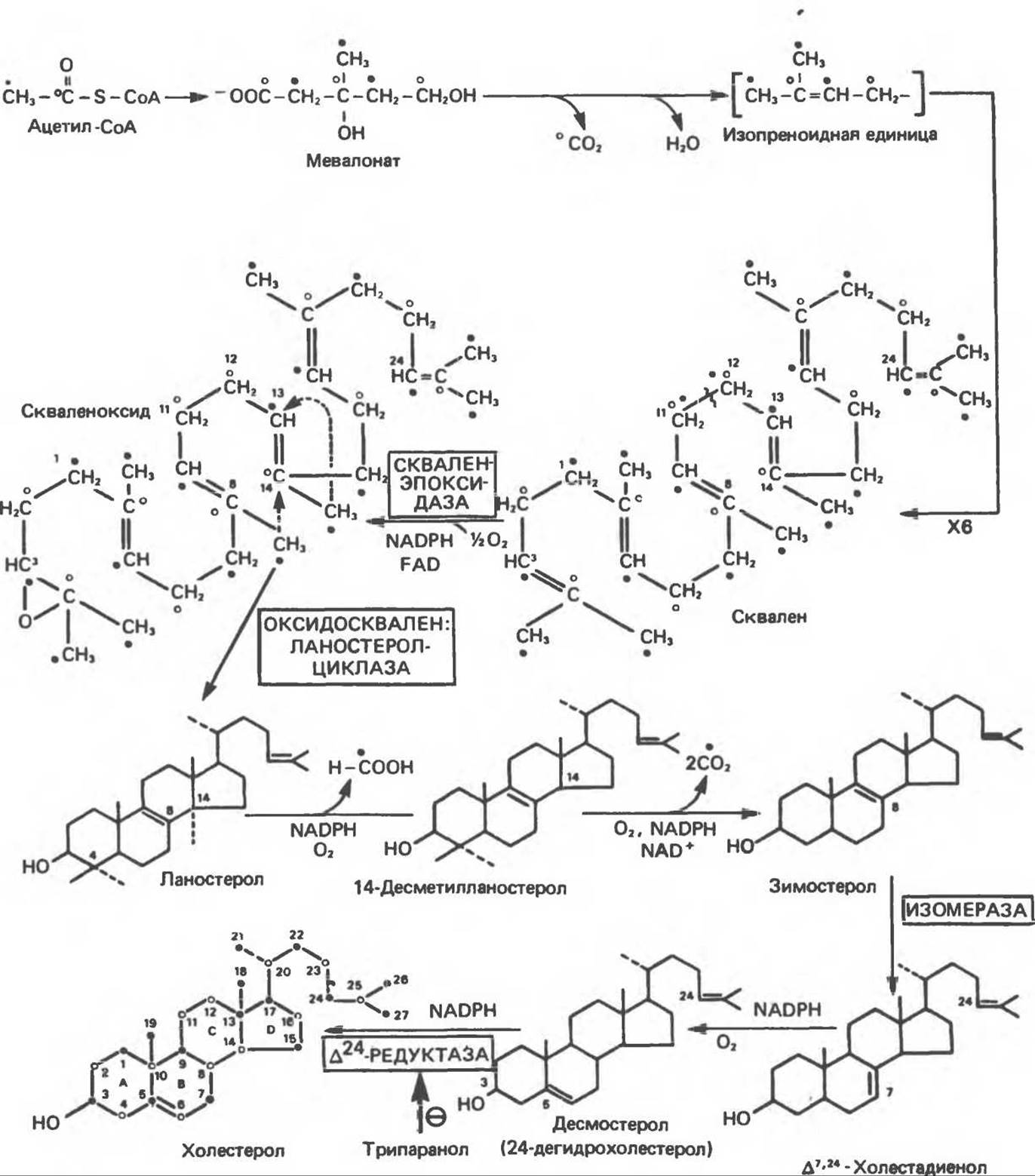
Fig. 27.3. Biosynthesis of Cholesterol. Carbon atoms are numbered as in the steroid nucleus. Asterisks denote the labels in squalene indicated in Fig. 27.2.
Synthesis of Other isoprenoid compounds
Farnesyl pyrophosphate serves as a precursor for other polyisoprenoids—dolichol and ubiquinone. The polyisoprenyl alcohol dolichol is formed by The addition of 16 more isopentenyl pyrophosphate residues, whereas the side chain of ubiquinone is formed by the addition of 3–7 isoprenoid units.
Last update: 06/08/2026
Editorial and Educational Adaptation: This material has been compiled based on the primary/original source text. The project team performed an editorial review, corrected technical inaccuracies, structured sections, and adapted the content for an educational format.
What was processed:
- elimination of formatting defects (OCR errors, structural breaks, corrupted characters);
- editorial organization of content;
- standardization of terminology in accordance with academic sources;
- verification of factual statements against the original source text.
All mentions of the author, publication year, and origin of the primary text have been preserved in accordance with the source.