Principles of Biochemistry Volume 2 - A. Lehninger 1985
Bioenergetics and Metabolism
Metabolism: An Overview
Catabolic pathways converge to yield only a small number of end products
Let us now examine Catabolism in more detail. The enzymatic breakdown of the primary nutrients that serve as The Cell's Energy Sources—namely, CARBOHYDRATES, fats, and Proteins—occurs gradually through a series of sequential enzymatic reactions. Aerobic catabolism involves three principal stages (Fig. 13-6). In Stage I, cellular macromolecules are degraded into their fundamental building blocks: Polysaccharides are broken down into hexoses or pentoses, fats into Fatty acids, glycerol, and other components, and proteins into 20 distinct types of Amino Acids.
All these diverse products formed in The First stage of catabolism are converted during Stage II into even simpler compounds, which are relatively few in number. Hexoses, pentoses, and glycerol are degraded to a common three-carbon intermediate, Pyruvate, and subsequently into a single two-carbon form: the acetyl group of acetyl-coenzyme A (acetyl-CoA). Fatty Acids and the carbon skeletons of Most amino acids undergo a similar transformation; their breakdown likewise culminates in the Formation of Acetyl groups in the form of acetyl-CoA. Thus, acetyl-CoA serves as the common end product of the Second Stage of catabolism.
Class="center">
Fig. 13-5. Energy relationships between Catabolic and anabolic pathways. Catabolic pathways supply chemical energy in the form of ATP and NADPH. This energy is utilized in anabolic pathways for The Biosynthesis of macromolecules from small precursor molecules.
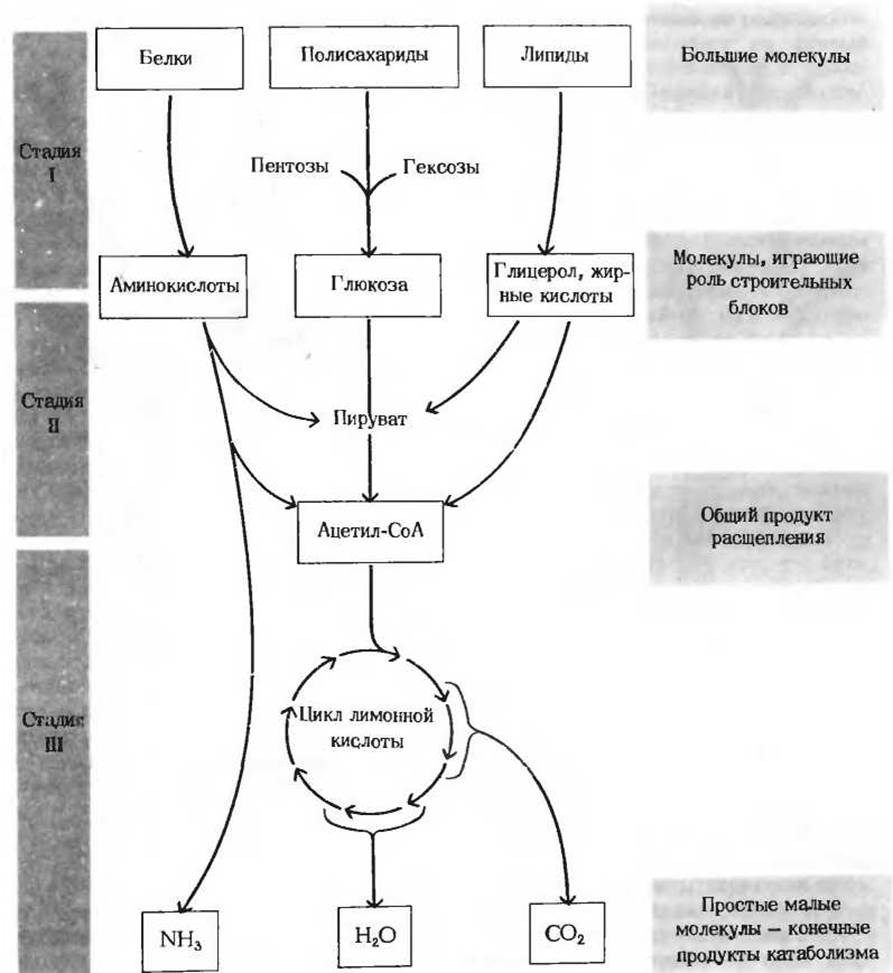
Fig. 13-6. The three stages of catabolic degradation of major cellular nutrients. In Stage I, hundreds of proteins and many types of polysaccharides and Lipids are broken down into their constituent building blocks. In Stage II, these building blocks are converted into a single common product: the acetyl group of acetyl-CoA. In Stage III, the various catabolic pathways converge into a single common pathway—The Citric Acid Cycle; all these transformations yield only three end products. The breakdown of Nucleic Acids also proceeds stepwise, but it is not shown here because its contribution to meeting the cell's energy demands is relatively small.
In Stage III, the acetyl group of acetyl-CoA enters The Citric Acid cycle—the common final pathway in which nearly all types of cellular "fuel" are ultimately oxidized to carbon dioxide. Water and ammonia (or other nitrogenous compounds) are also End products of METABOLISM.
It is important to note that catabolic pathways converge, funneling into this common pathway—the citric acid cycle—in Stage III. Whereas in Stage I dozens or even hundreds of different proteins are degraded into 20 types of amino acids, by Stage II all 20 Amino acids are converted predominantly into just acetyl-CoA and ammonia (NH3), and in Stage III the acetyl groups of acetyl-CoA are oxidized within the citric acid cycle to yield only two products: СО2 and Н2О. Similarly, many polysaccharides and Disaccharides are broken down in Stage I into a few simple sugars, which are ultimately converted in Stage II into acetyl-CoA and in Stage III into СО2 and Н2О.

Fig. 13-7. Convergence of catabolic pathways and divergence of anabolic pathways. The initial stage of catabolism involves many different cellular components, but eventually all pathways converge into a single metabolic route, resulting in a small number of end products.
The final pathway of catabolism can be likened to the lower reaches of a river, where it widens after having absorbed numerous tributaries upstream (Fig. 13-7).
Last update: 06/08/2026
Editorial and Educational Adaptation: This material has been compiled based on the primary/original source text. The project team performed an editorial review, corrected technical inaccuracies, structured sections, and adapted the content for an educational format.
What was processed:
- elimination of formatting defects (OCR errors, structural breaks, corrupted characters);
- editorial organization of content;
- standardization of terminology in accordance with academic sources;
- verification of factual statements against the original source text.
All mentions of the author, publication year, and origin of the primary text have been preserved in accordance with the source.