Biological Chemistry - Berezov T. T., Korovkin B. F. 1998
Metabolism of Complex Proteins
Nucleic Acid Metabolism
Biosynthesis of Purine Nucleotides
Purine bases formed during the Digestion of nucleic acids in the intestine are practically unused thereafter; consequently, their synthesis relies on low-molecular-weight precursors derived from carbohydrate and Protein METABOLISM. Pioneering studies by J. Buchanan and G. Greenberg experimentally proved the incorporation of several labeled atoms—specifically 15N- and 14C-Glycine, 15N-aspartate, 15N-glutamine, and others—into the purine ring of uric acid. By feeding these and other labeled compounds to birds, J. Buchanan mapped the sites of label incorporation into the purine ring; these findings were subsequently refined and confirmed by numerous other researchers. The results of these studies can be represented in the following scheme:
* Specific nucleoside phosphorylases active on nucleosides have been discovered in animal Tissues.
Class="center">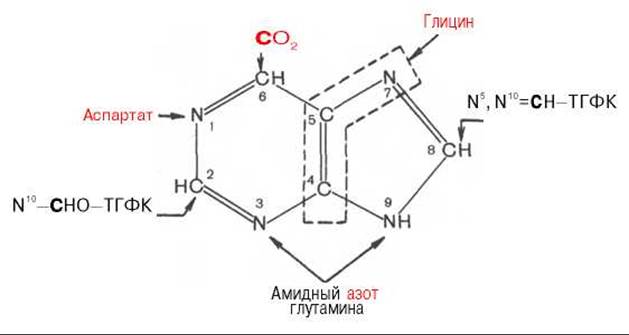
As seen from the scheme, the 4th and 5th carbon atoms and the 7th nitrogen atom of the ring originate from glycine. Two nitrogen atoms (N-3 and N-9) derive from the amide group of glutamine, one nitrogen atom (N-1) from the nitrogen of aspartic acid; carbon atom C-2 originates from the carbon of N10-formyl-THF, the carbon atom at position 8 comes from N5,N10-methenyl-THF, and finally, carbon C-6 originates from CO2.
Currently, thanks to the research of J. Buchanan, J. Greenberg, A. Kornberg, et al., The sequence of incorporation of the aforementioned substances into the purine ring has been fully elucidated, and The Nature of all intermediates and enzyme systems catalyzing these synthetic Chemical Reactions has been established. It is interesting to note the almost complete identity of the purine synthesis pathways in animal livers and microorganisms, specifically E. coli and Neurospora crassa. It should be emphasized, however, that the end product of this synthesis is not a free purine base, but a ribonucleotide—inosine monophosphate (IMP)—from which AMP and GMP are subsequently synthesized. The diagram illustrates the sequence of all 11 chemical reactions in this pathway, indicating the enzyme systems, Coenzymes, Energy Sources, and other currently known Cofactors (see p. 472).
As can be seen from the diagram, the synthesis of inosine monophosphate starts with D-ribose 5-phosphate, a well-known product of The pentose phosphate cycle, onto which a pyrophosphate group from ATP is transferred in an unusual reaction. The resulting 5-phosphoribosyl 1-pyrophosphate (PRPP) reacts with glutamine, the donor of the NH2 group, yielding ß-5-phosphoribosylamine, with a configurational shift (from α to ß) occurring during the reaction alongside the release of pyrophosphate and free glutamic acid. Thus, this step serves as the commitment reaction in Purine Biosynthesis. In the next step, the entire glycine molecule is attached to the free NH2 group of ß-5-phosphoribosylamine (an ATP-driven reaction) to form glycinamide ribonucleotide. Then, the chain is extended by The addition of a formyl group from N5, N10-methenyl-THF, producing formylglycinamide ribonucleotide. Next, the amide group of glutamine is transferred to the formyl group of the latter to synthesize formylglycinamidine ribonucleotide (this reaction also requires ATP energy). In the subsequent step, the five-membered imidazole ring closes to yield 5-aminoimidazole ribonucleotide, which can accept CO2 to form 5-aminoimidazole-4-carboxylate ribonucleotide.

In a subsequent two-step process involving aspartic acid and ATP, 5-aminoimidazole-4-carboxamide ribonucleotide is formed and fumaric acid is released. In these reactions, the nitrogen from aspartic acid is incorporated into position 1 of the future purine core. The final carbon atom of the pyrimidine moiety of the purine ring is introduced as a formyl group (derived from N10-formyl-THF), which attaches to the 5-NH2 group. Following this, a Water molecule is split off, and the second ring closes. This results in The formation of the first purine nucleotide—inosine monophosphate (IMP)—which serves as the precursor for purine NUCLEOTIDES found in Nucleic Acids.
AMP and GMP are synthesized from IMP, with the formation of each mononucleotide involving two distinct Enzymes operating through different mechanisms. The conversion of IMP into GMP is catalyzed by IMP dehydrogenase and GMP synthetase, whereas the synthesis of AMP from the same precursor proceeds via the sequential action of adenylosuccinate synthetase and adenylosuccinate lyase. The two-stage mechanism of AMP and GMP synthesis can be represented by the corresponding chemical reactions.

The enzymatic synthesis of AMP from IMP specifically requires aspartic acid, which serves as the donor of the NH2 group, and GTP as an energy source, with adenylosuccinate acting as an intermediate. Conversely, The biosynthesis of GMP begins with the dehydrogenation of IMP to yield xanthylate (xanthosine monophosphate), while the subsequent amination utilizes the amide nitrogen of glutamine exclusively.
The conversion of AMP and GMP into their respective nucleoside di- and triphosphates also takes place in two stages, mediated by specific nucleoside monophosphate and nucleoside diphosphate Kinases*:
GMP + ATP <=> GDP + ADP;
GDP + ATP <=> GTP + ADP.
* It is worth recalling that in living organisms, the primary mechanism for synthesizing ATP itself from ADP and inorganic phosphate is Oxidative Phosphorylation (see Chapter 9).
It is important to note the existence of a highly sophisticated regulatory mechanism governing purine nucleotide biosynthesis within Cells. Their synthesis is subject to feedback inhibition by the end products—specifically, through the inhibition of the initial step involving The transfer of the amino group from glutamine to PRPP. The enzyme catalyzing this step Functions as an allosteric regulatory enzyme. A second key feature of this regulatory mechanism is that an excess of GMP in The Cell allosterically inhibits exclusively its own biosynthetic pathway without affecting AMP synthesis; conversely, the accumulation of AMP suppresses its own production while leaving GMP synthesis unaffected.

Last update: 06/08/2026
Editorial and Educational Adaptation: This material has been compiled based on the primary/original source text. The project team performed an editorial review, corrected technical inaccuracies, structured sections, and adapted the content for an educational format.
What was processed:
- elimination of formatting defects (OCR errors, structural breaks, corrupted characters);
- editorial organization of content;
- standardization of terminology in accordance with academic sources;
- verification of factual statements against the original source text.
All mentions of the author, publication year, and origin of the primary text have been preserved in accordance with the source.