Biological Chemistry - Berezov, T. T., Korovkin, B. F. 1998
Carbohydrate Metabolism
Pentose Phosphate Pathway of Carbohydrate Oxidation
The Discovery of the direct carbohydrate oxidation pathway, commonly known as the Pentose Phosphate Pathway (or pentose phosphate cycle), is credited to O. Warburg, F. Lipmann, F. Dickens, and V.A. Engelhardt. The divergence between the carbohydrate oxidation pathways—the classical pathway (The Tricarboxylic Acid Cycle, or Krebs cycle) and The pentose phosphate pathway—begins at the hexose monophosphate stage. If glucose-6-phosphate is isomerized into fructose-6-phosphate, which is then phosphorylated a second time to yield fructose-1,6-bisphosphate, subsequent carbohydrate breakdown proceeds via the standard glycolytic pathway. This yields pyruvic acid, which is oxidized to acetyl-CoA and subsequently “burned” in the Krebs cycle.
If the second phosphorylation of hexose-6-monophosphate does not take place, the phosphorylated glucose can undergo direct oxidation to phosphopentoses. Under normal conditions, the quantitative contribution of the pentose phosphate pathway to overall glucose METABOLISM is relatively small; it varies across different organisms and depends on tissue type and functional state.
In mammals, The activity of the pentose phosphate pathway is relatively high in the Liver, Adrenal Glands, embryonic Tissues, and the Cytology/practical/135.html">Lactating mammary gland. The physiological significance of this pathway in metabolism is substantial. It supplies reduced NADPH, which is essential for the Biosynthesis of Fatty acids, Cholesterol, and other molecules. The pentose phosphate pathway accounts for approximately 50% of the body's NADPH requirements.
Another key function of the pentose phosphate pathway is supplying phosphopentoses for the synthesis of Nucleic Acids and numerous Coenzymes. Under various pathological conditions, the relative contribution of the pentose phosphate pathway to glucose oxidation increases significantly. The reaction mechanisms of the pentose phosphate pathway have been thoroughly elucidated.
Class="center">
Fig. 10.12. The Pentose Phosphate Pathway of Carbohydrate Oxidation.
The pentose phosphate pathway begins with The oxidation of glucose-6-phosphate, followed by The oxidative decarboxylation of the product (resulting in the Cleavage of the first carbon atom from the hexose phosphate). This represents the first, or oxidative, stage of the pentose phosphate cycle. The Second Stage involves the non-oxidative transformations of phosphopentoses, ultimately regenerating the starting glucose-6-phosphate (Fig. 10.12). The Reactions of the pentose phosphate pathway take place in The Cell Cytosol.
The first reaction involves the dehydrogenation of glucose-6-phosphate, catalyzed by the enzyme glucose-6-phosphate dehydrogenase with the coenzyme NADP+. The resulting 6-phosphoglucono-δ-lactone is an unstable compound that rapidly hydrolyizes—either spontaneously or via the action of 6-phosphogluconolactonase—to yield 6-phosphogluconic acid (6-phosphogluconate):

In the second—oxidative—reaction, catalyzed by 6-phosphogluconate dehydrogenase (decarboxylating), 6-phosphogluconate undergoes simultaneous dehydrogenation and decarboxylation. This yields a phosphorylated ketopentose, D-ribulose-5-phosphate, along with an additional molecule of NADPH:
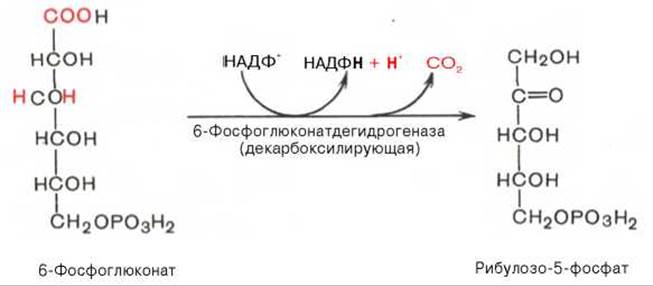
Driven by a specific epimerase, ribulose-5-phosphate can be converted into another phosphopentose, xylulose-5-phosphate. Furthermore, under The Influence of a specific isomerase, ribulose-5-phosphate is readily interconverted with ribose-5-phosphate. A state of dynamic equilibrium is established among these phosphopentose forms:

Under certain conditions, the pentose phosphate pathway can be completed at this stage. However, under other conditions, the so-called non-oxidative stage (phase) of the pentose phosphate cycle begins. The reactions of this stage do not involve oxygen consumption and proceed under anaerobic conditions. They yield compounds typical of the initial stage of Glycolysis (fructose-6-phosphate, fructose-1,6-bisphosphate, and phosphotrioses), as well as substances specific to the pentose phosphate pathway (sedoheptulose-7-phosphate, pentose-5-phosphates, and erythrose-4-phosphate).
The key reactions of the non-oxidative stage of the pentose phosphate cycle are transketolase and transaldolase reactions. These reactions catalyze the interconversion of isomeric pentose-5-phosphates:

Thiamine pyrophosphate (TPP) serves as the coenzyme in the transketolase reaction, acting as an intermediate carrier of a glycolaldehyde group from xylulose-5-phosphate to ribose-5-phosphate. This process produces the seven-carbon monosaccharide sedoheptulose-7-phosphate and glyceraldehyde-3-phosphate.
The transketolase reaction occurs twice in the pentose cycle. The second occurrence involves the Formation of fructose-6-phosphate and triose phosphate through the Interaction of a second molecule of xylulose-5-phosphate with erythrose-4-phosphate:

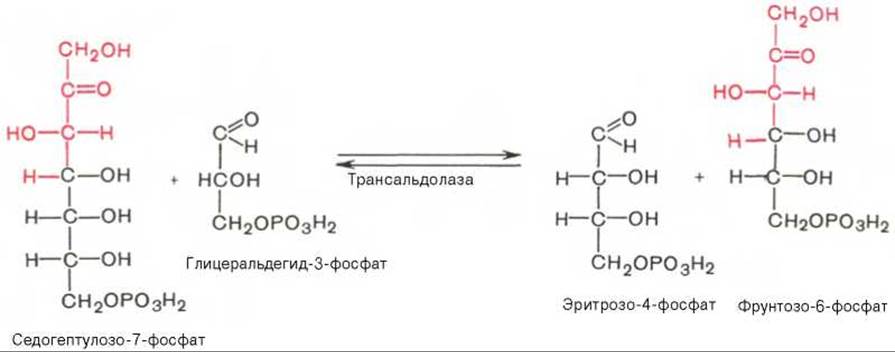
The enzyme transaldolase catalyzes The transfer of a dihydroxyacetone moiety (rather than free dihydroxyacetone) from sedoheptulose-7-phosphate to glyceraldehyde-3-phosphate:
Six molecules of glucose-6-phosphate entering the pentose phosphate cycle yield 6 molecules of ribulose-5-phosphate and 6 molecules of СО2, after which 5 molecules of glucose-6-phosphate are regenerated from the 6 molecules of ribulose-5-phosphate (see Fig. 10.12). However, this does not mean that the glucose-6-phosphate molecule entering the cycle is completely oxidized. All 6 molecules of СО2 are derived from the C-1 atoms of the 6 glucose-6-phosphate molecules.
The overall equation for the oxidative and non-oxidative Stages of the pentose phosphate cycle can be represented as follows:

or

The resulting NADPH is utilized in the cytosol for reductive syntheses and typically does not participate in Oxidative Phosphorylation occurring in Mitochondria.
In recent years, studies have emerged suggesting that in certain tissues The pathway of pentose phosphate Carbohydrate Metabolism is more complex than shown in Fig. 10.12. According to this more comprehensive scheme of the pentose phosphate pathway, the Initial Stages of conversion coincide with the previous scheme; however, some deviations begin after the first transketolase reaction (Fig. 10.13).
It is believed that the pentose phosphate pathway and glycolysis, both taking place in the cytosol, are interrelated and capable of shifting from one to the other depending on the concentration ratio of intermediate products generated within the cell (see Fig. 10.13).
Last update: 06/08/2026
Editorial and Educational Adaptation: This material has been compiled based on the primary/original source text. The project team performed an editorial review, corrected technical inaccuracies, structured sections, and adapted the content for an educational format.
What was processed:
- elimination of formatting defects (OCR errors, structural breaks, corrupted characters);
- editorial organization of content;
- standardization of terminology in accordance with academic sources;
- verification of factual statements against the original source text.
All mentions of the author, publication year, and origin of the primary text have been preserved in accordance with the source.