Biochemical Foundations of Human Vital Activity - Volkov, N.I., Nesen, E.N. 2000
Biochemistry of Sports
Biochemical changes in the body during exercise of varying intensity and duration
Biochemical changes in individual organs and tissues during muscular work
During muscular activity, The rate of METABOLISM/26.html">Energy Metabolism in The Heart Muscle (myocardium) changes. The heart muscle is permeated by a dense network of Blood capillaries that supply abundant oxygen, and it exhibits high activity of aerobic metabolism Enzymes, which is why aerobic energy reactions predominate within it. At rest, the primary Energy Sources for the myocardium supplied by the blood are Fatty acids, Ketone Bodies, and glucose. During intense muscular activity, the myocardium actively takes up and oxidizes lactic acid from the blood, leaving its Glycogen reserves almost untouched.
In the Brain, energy metabolism increases during muscular activity, which is reflected by an increased uptake of glucose and oxygen from the blood, a higher rate of glycogen and phospholipid turnover, enhanced protein breakdown, and the accumulation of ammonia. Like the heart, the brain relies on aerobic processes for its energy supply. During high-intensity or very prolonged work, the pool of high-energy phosphates in Nerve Cells may decrease, which is one of the contributing factors to fatigue.
Biochemical changes occurring in skeletal Muscles during exercise are typically assessed by measuring the levels of muscle metabolism products in the blood, urine, expired air, or directly within the muscles themselves (see Chapter 24).
Maximal oxygen uptake is frequently used as an indicator of the intensity and capacity of aerobic energy supply mechanisms. The extent toictions of Glycolysis contributing to muscular energy supply can be evaluated by measuring blood lactic acid levels During the first few minutes of recovery, whereas the creatine phosphokinase reaction can be assessed via blood levels of CrP breakdown products—Creatine and Creatinine. The involvement of fats in energy reactions can be judged by the blood concentrations of free Fatty Acids and ketone bodies. Acid-base balance parameters allow Conclusions to be drawn regarding the body's ability to withstand the Adverse effects of acidic anaerobic metabolites, and so forth.
However, the concentration of intermediary metabolic products in the blood depends on the rate of their production within cells, their diffusion across Cell membranes, and their utilization by various Tissues. Therefore, a given metabolic change measured in the blood or Liver will reflect tissue alterations with varying degrees of accuracy; for instance, blood glucose levels indicate the rate of mobilization of hepatic carbohydrate reserves. At the onset of exercise, as well as during short-term high-intensity work, blood glucose concentration generally rises, indicating an increased rate of glycogen mobilization and relatively low glucose utilization by muscles. During steady-state exercise, blood glucose remains close to resting levels because the rate of entry into the bloodstream and the rate of muscle utilization are roughly equal. During prolonged exercise, blood glucose concentration may drop below resting levels as hepatic glycogen reserves and their mobilization rate decline, while tissue demand for glucose remains high.
During intense glycolytic exercise, the lactic acid content in muscles increases sharply. It readily diffuses from working muscles into the bloodstream, where its levels rise steeply. Because its oxidation during strenuous exercise proceeds at a relatively slow rate, blood lactic acid concentration serves as a reliable indicator of its production rate in skeletal muscles. At rest, the concentration of lactic acid in the blood ranges from 1.1 to 2.2 mmol ⋅ l-1 (0.1—0.2 g ⋅ l-1).
During light and moderately heavy exercise (with an oxygen demand of about 50% VO2max), the increase in blood lactic acid concentration is modest (up to 0.4—0.5 g ⋅ l-1), whereas during prolonged exercise (with an oxygen demand of 50–85% VO2max), it rises to 1–1.5 g ⋅ l-1. Lactic acid concentration increases significantly within the first 2–10 minutes of exercise and then either plateaus or decreases. Thus, peak blood lactic acid concentrations are observed until a steady state is established, creating favorable conditions for its aerobic oxidation.
During exercise with an oxygen demand exceeding 85% VO2max, blood lactic acid concentration continually increases until it reaches maximal values. A lactic acid concentration of 2–2.5 g ⋅ l-1 in the blood is well tolerated by the Organism of a well-trained individual without causing harm. Any further increase exerts a detrimental effect on the body and inhibits glycolysis.
Lactic acid is a strong acid that dissociates to release a significant amount of hydrogen ions. Some of these ions can be buffered by cellular and Blood Buffer Systems, with the bicarbonate buffer playing the primary role in the blood, and protein buffers in the cells. Once the capacity of these buffer systems is exhausted, the active medium shifts toward acidosis. Other acids, such as carbonic, phosphoric, and pyruvic acids, also contribute to this acidification, but lactic acid plays the most prominent role. There is a pronounced inverse relationship between blood lactic acid concentration and pH. As shown in Fig. 147, peak blood lactic acid concentration during strenuous muscular activity reaches 20–25 mmol ⋅ l-1 or more, while pH drops from a resting value of 7.4 down to 6.9–6.8.
Class="center">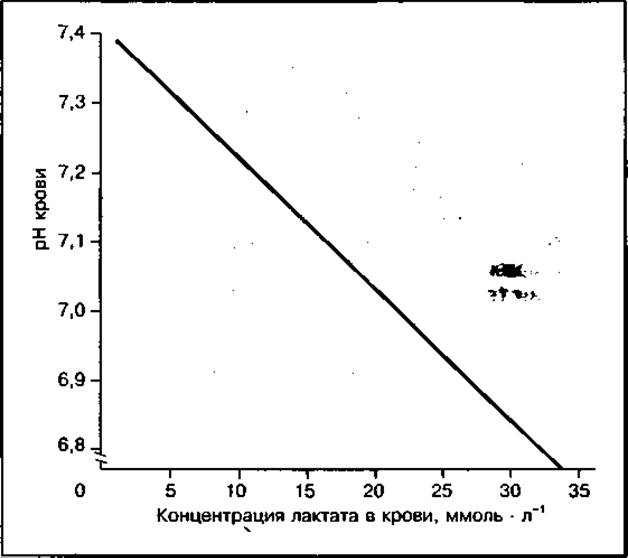
Fig. 147 Relationship between changes in blood pH and lactate concentration during strenuous muscular work
A decrease in pH by more than 0.2 compared to resting levels leads to a reduction in The activity of many enzymes, most notably Phosphofructokinase, which controls the key regulatory step of glycolysis; consequently, the overall rate of glycolysis declines. Body acidification also disrupts nerve cell activity, leading to protective inhibition, impairs neuromuscular transmission, reduces Myosin ATPase activity, and slows down the rate of ATP Cleavage. High concentrations of lactic acid in muscle fibers cause an increase in osmotic pressure, resulting in fiber Swelling and compression of nerve endings, which can manifest as muscle pain. Many athletes can tolerate a drop in blood blood pH down to 6.8 or even 6.5 (at exhaustion), though this is accompanied by nausea, dizziness, and severe muscle pain. A shift in blood pH toward alkalinity is possible up to 7.6, which the body can withstand without severe metabolic disruptions.
Excess lactic acid in the blood is buffered by the bicarbonate system, specifically its alkaline component (NaHCO3):

This interaction generates the so-called non-metabolic excess of carbon dioxide, which is unrelated to Biological Oxidation processes. It rapidly breaks down into CO2 and H2O. By measuring the fraction of non-metabolic CO2 in expired air, one can accurately estimate the degree of accelerated glycolysis in working muscles.
There is a definite ratio between the volume of carbon dioxide produced (VCO2) and oxygen consumed (VO2), known as the respiratory quotient (RQ = VCO2 / VO2), which depends on The Nature of the oxidized energy substrate. For carbohydrate oxidation, the respiratory quotient is 1.0 (6CO2 / 6O2 = 1.0); for fat oxidation, it is 0.70; for protein oxidation, it is 0.80; and on a balanced carbohydrate-fat-protein diet, it is approximately 0.75. Thus, the value of the respiratory quotient provides insight into the type of substrates being oxidized and the course of the oxidative process. However, during strenuous muscular work, the respiratory quotient may exceed 1.0 due to the appearance of excess lactic acid, which enhances the production and elimination of CO2.
Muscular work induces Changes in the blood levels of Proteins and their degradation products. There is an increase in plasma protein concentration (particularly enzyme proteins) due to their leakage from working muscles, as well as shifts in the ratios among various blood proteins. Additionally, the amounts of protein breakdown products—such as Amino Acids released from muscle cells and the liver, ammonia, and urea—are elevated. These alterations in Protein metabolism depend on the duration of exercise. For instance, during short-term work, the leakage of tissue proteins into the blood is negligible, whereas during prolonged exercise, when cell membrane permeability is significantly altered, proteins may cross the renal filtration barrier and appear in the urine. Blood ammonia levels rise particularly when a metabolic steady state is not achieved, as well as during prolonged, fatiguing muscular exertion. Prolonged exercise also leads to elevated blood urea concentrations.
Last update: 06/08/2026
Editorial and Educational Adaptation: This material has been compiled based on the primary/original source text. The project team performed an editorial review, corrected technical inaccuracies, structured sections, and adapted the content for an educational format.
What was processed:
- elimination of formatting defects (OCR errors, structural breaks, corrupted characters);
- editorial organization of content;
- standardization of terminology in accordance with academic sources;
- verification of factual statements against the original source text.
All mentions of the author, publication year, and origin of the primary text have been preserved in accordance with the source.