Protein Chemistry - Part 1 - General Protein Chemistry - Ashmarin I. P. 1968
Chemical reactions of proteins, determination of terminal and functional groups in proteins
Chemical reactions of proteins
Reactions for sulfhydryl and disulfide groups
Among the chemically active groups in Proteins, SH groups exhibit, in a certain sense, the widest reactivity. With few exceptions, Reagents used to identify or determine amino groups, aliphatic and aromatic hydroxyl groups, as well as imidazole and guanidine residues, react—often more vigorously—with available SH groups as well. Examples include dinitrofluorobenzene, iodoacetate, nitrous acid, phenyl isocyanate, mustard gas, and its analogs. This high reactivity of SH groups is not always convenient for their determination. On the one hand, it is clear that a multitude of reagents can be used for a rough estimation of SH groups; on the other hand, it is known that very few reagents at our disposal possess the Specificity required for the Quantitative determination of these groups. Such reagents may include certain oxidizing agents, A number of mercury and arsenic compounds, and alkylating agents such as iodoacetate and iodoacetamide.
Oxidation of SH groups. For The oxidation of SH groups, reagents such as porphyrindin, sodium tetrathionate, and iodosobenzoic acid are most commonly employed. The general form of the reaction equation is as follows:
Class="center">2R—SH + окислитель → RS—SR + восстановитель + 2Н+ + 2е-.
In this process, two SH groups can be replaced either within a single protein molecule (intramolecular oxidation) or across two different protein molecules (intermolecular oxidation). For the quantitative determination of SH groups, an excess of the oxidizing agent is frequently used, the remainder of which is determined after a specific time interval by iodometric titration or by the oxidation of ascorbic acid to dehydroascorbic acid. This approach relies on several underlying assumptions: 1) only SH groups react, and all of them are structurally accessible to the action of the oxidizing agent; 2) oxidation proceeds strictly to the disulfide stage; 3) the reaction does not generate substances that will interact with other protein groups or further oxidize the Disulfide Bonds. However, even aside from the steric hindrance of SH groups, none of the listed reagents fully satisfy these requirements. For instance, In addition to SH groups, porphyrindin also oxidizes Tyrosine hydroxyl groups, albeit slowly, while iodosobenzoic acid at pH 5 oxidizes SH groups past the disulfide stage, leading to overestimated values. Furthermore, during the iodometric titration of excess oxidizing agent, the iodine formed can interact with Tryptophan and tyrosine. All of this necessitates conducting the reaction at a neutral pH and adding the oxidizing agent in the minimal possible excess that remains on the verge of analytical precision for the given method. Consequently, mercury compounds are currently finding broader application for the quantitative Determination of protein SH groups.
Formation of mercaptides. Under mild conditions, mercury compounds combine very intensively with SH groups alone and can be readily removed by The addition of various thiols (e.g., Cysteine and Glutathione). One such specific reagent is p-chloromercuribenzoate. In contrast to oxidizing agents, which may react with other Functional groups of proteins, this reaction is stoichiometric in nature. Its equation is—
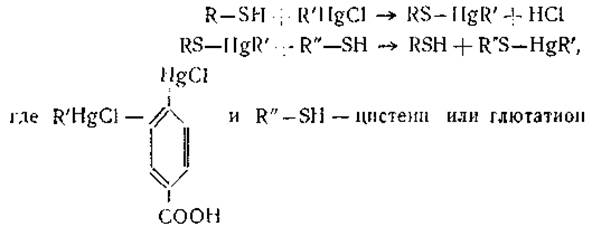
p-Chloromercuribenzoate is widely used to assess The Role of SH groups in The activity of various Enzymes or to protect these protein groupings during protein modification using Other reagents. When determining the quantity of protein SH groups, p-chloromercuribenzoate is taken in slight excess, and the remainder is converted by iodine into iodobenzoic acid. Iodine, in turn, is also taken in excess, and its residue is determined by titration with hyposulfite. Using the appropriate formulas, The amount of unreacted p-chloromercuribenzoate and, accordingly, the quantity of SH groups are calculated.
The reaction with mercury salts was utilized by Hughes to obtain a mercaptide from mercuric chloride and the serum albumin fraction containing one SH group per protein molecule. As demonstrated by ultracentrifugation, this mercaptide was a dimer and contained 1/2 atom of mercury per albumin molecule:

It was subsequently shown that ions of other metals (copper, zinc, etc.) can also selectively react with the SH groups of serum albumin, forming the corresponding mercaptides.
Alkylation of SH groups. To determine the sulfhydryl content in proteins or to inhibit various SH-containing enzymes, alkylating agents such as iodoacetate, iodoacetamide, iodoethanol, and others were previously quite widely used. However, it is now known that all of these agents can irreversibly bind to SH groups only under mild conditions (pH 7–8). The reaction proceeds According to the equation
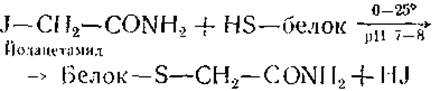
At a pH above 8.0, these reagents interact with a number of other functional groups (amino, phenolic, and indole groups).
Reduction of disulfide groups. The reduction of disulfide bonds is carried out in a neutral or slightly alkaline medium using an excess of a thio compound (cysteine, glutathione, β-mercaptoethanol, etc.). The reaction is highly specific and readily reversible; its progress can be monitored by determining the number of SH groups generated in the protein or the amount of the thio compound consumed.

This reaction has frequently been used to demonstrate the role of disulfide groups in the activity of enzymes or Hormones. For example, upon the reduction of all disulfide groups in Ribonuclease or Insulin, the biological activity of these substances completely disappears. Subsequent reversal of this process using mild oxidizing agents does not always restore the initial activity, because disulfide bonds sometimes form randomly, disrupting the native Tertiary Structure of the protein. An example is insulin, in which the regeneration of disulfide bonds results in the recovery of only 2% of its original activity. The disulfide reduction reaction differs from The process of SH group inactivation during oxidation in that the regeneration of initial activity upon reversing the reduction process is not always possible.
Interaction with mustard gas and similar chemical warfare agents. Over the past 20 years, extensive research has been conducted on the reactions of mustard gas and its analogs with Nucleoproteins and various enzymes. It was demonstrated that mustard gas and its derivatives enter into an irreversible interaction with SH groups, leading several authors to explain the toxic action of mustard gas by the inactivation of sulfhydryl enzymes. To protect such enzymes from the action of chemical warfare agents, compounds containing multiple SH groups were synthesized. One such compound is British anti-Lewisite (BAL), or 2,3-dimercaptopropanol

However, subsequent studies showed that mustard gas interacts not only with SH groups but also with amino, carboxyl, and imidazole groups. This lack of specificity makes mustard gas unsuitable for studying the functional role of sulfhydryl groups and complicates the question of the MECHANISM OF ACTION of certain chemical warfare agents.
Last update: 06/08/2026
Editorial and Educational Adaptation: This material has been compiled based on the primary/original source text. The project team performed an editorial review, corrected technical inaccuracies, structured sections, and adapted the content for an educational format.
What was processed:
- elimination of formatting defects (OCR errors, structural breaks, corrupted characters);
- editorial organization of content;
- standardization of terminology in accordance with academic sources;
- verification of factual statements against the original source text.
All mentions of the author, publication year, and origin of the primary text have been preserved in accordance with the source.