Chordate Zoology - textbook - Y. V. Tsaryk - 2013
Chapter 2. SUBPHYLUM TUNICATES, or UROCHORDATES, UNICATA, seu RQCHQRDATA
2.1. STRUCTURAL FEATURES
2.1.3. Class Appendicularia Appendiculariae
Appendicularians (Appendiculariae) are very small, transparent, free-swimming animals. Unlike other tunicates, they never form colonies. Appendicularian larvae do not undergo regressive metamorphosis. The adult appendicularian generally resembles an ascidian larva. The length of an appendicularian ranges from 0.5 to 2.0 mm, occasionally reaching 7 mm. However, the tail can be much longer. A notable structural feature is the constancy of the cellular composition of their Organs. The entire animal lives inside a "house" that is 5-15 times larger than its body, and up to 300 times larger in volume. The body consists of a trunk and a tail bent 90° downward from the trunk (Fig. 2.9). A notochord consisting of 20 large Cells runs along the entire length of the tail. At the anterior end of the trunk is the Mouth, which leads into a spacious Pharynx.
The appendicularian house is essentially a tunic. Like in other tunicates, it is formed by secretions of the epidermis, but contains Chitin instead of Cellulose. Using its tail, the appendicularian drives Water through the house; the water exits through an opening (Fig. 2.9, A, 5) and propels the entire Structure forward. On the side of the house facing the direction of movement, There are two mesh-covered openings at the top. The mesh acts as a filter for particles larger than 20-40 µm. Water containing food enters the house and reaches another filter, from which a funnel-shaped channel extends. The appendicularian attaches its mouth to the bottom of this channel. Appendicularians lack an atrium (peribranchial cavity). The pharynx opens directly to the exterior through two gill slits (stigmata) located at the ends of projections. An endostyle is located on the ventral side of the pharynx, and an elongated dorsal projection is on the dorsal side. The gut is U-shaped and consists of an Esophagus, a sac-like Stomach, and a hindgut that opens via the anus on the ventral side of the body. Appendicularians feed on flagellates, rhizopods, and Bacteria. At one point, the wall of the house has an escape hatch covered by a thin membrane, which the animal uses in case of danger. It can build a new house in just a few minutes (sometimes in less than a minute).
Class="center">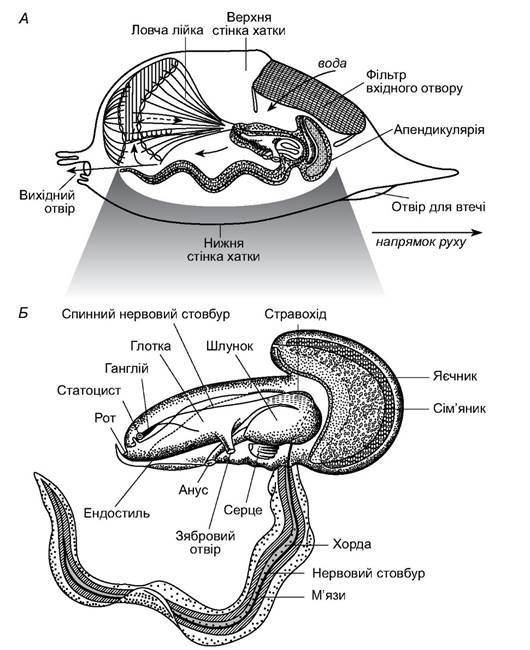
Fig. 2.9. Structure of an appendicularian: A - STRUCTURE OF THE house; B - body structure of the animal
The Circulatory system OF appendicularians has several unique features: in the ventral part of the body, beneath The Stomach, lies an elongated Heart that is closely appressed dorsally to the stomach. Ventral and dorsal Blood Vessels run from The Heart to the anterior part of the body. They are connected in the anterior region of the pharynx. A system of lacunae is present. Blood vessels also run along the dorsal and ventral sides of the tail. As in other tunicates, the heart periodically (once every few minutes) reverses the direction of its contractions. The contraction rate is quite high, reaching up to 250 beats per minute.
Appendicularians lack specialized excretory organs.
Appendicularians are hermaphrodites. The male and female Gonads occupy the posterior part of the trunk and are relatively large. Sperm is released from the Testes to the outside through a pore on the DORSAL SIDE OF the body, while eggs are released by the rupture of the body wall. Consequently, appendicularians die after spawning. An exception is the species Oikopleura dioica, which is dioecious.
The Nervous System of appendicularians consists of a large cerebral (suprapharyngeal) ganglion, from which a dorsal nerve cord extends backward to the tip of the tail. At the Base of the tail, the nerve cord swells into a small ganglion. Several such ganglia are located along the nerve cord throughout the length of the tail. A small organ, the statocyst, is closely appressed to the dorsal side of the ganglion, and There is a small pit on the dorsal side of the pharynx, which is considered an Olfactory Organ. Appendicularians have no other Sensory Organs.
Appendicularians are distributed throughout almost all seas and oceans. They occur mainly in the upper water layers, though they are sometimes found at depths of up to 3 km. During population blooms, they consume phytoplankton. They can compete with other filter-feeding planktivores. They serve as a food source for many fish species.
Last update: 19/08/2026
Editorial and Educational Adaptation: This material has been compiled based on the primary/original source text. The project team performed an editorial review, corrected technical inaccuracies, structured sections, and adapted the content for an educational format.
What was processed:
- elimination of formatting defects (OCR errors, structural breaks, corrupted characters);
- editorial organization of content;
- standardization of terminology in accordance with academic sources;
- verification of factual statements against the original source text.
All mentions of the author, publication year, and origin of the primary text have been preserved in accordance with the source.