Introduction to Molecular Biology: From Cells to Atoms - Anthony Rees, Michael Sternberg 2002
Cells and Molecules at Work
Transport of Substances Across Membranes
Class="center">Introduction/introduction.files/image102.jpg" width="640"/>
Fig. 38.1.
The Transport of substances across Cell/30.html">The Plasma Membrane is a fundamental process for all living Cells. A cell must be able to take up both energy-rich metabolites and nutrients while simultaneously expelling unwanted compounds. Cells of higher organisms possess yet another capability: they secrete specific active substances that can be crucial for the functioning of other Tissues or Organs. The mechanisms by which small molecules (such as glycerol and glucose) or ions (such as K+ and Cl-) cross the plasma membrane can be divided into three main types: diffusion, Facilitated Diffusion, and Active Transport.
DIFFUSION is a process in which molecules (or ions) cross a membrane from a region of high concentration to a region of low concentration As a result of Brownian motion. To understand why a concentration gradient across a membrane leads to a net movement of a substance toward the lower concentration, let us consider the situation shown in Fig. 38.2. The probability of a molecule moving from compartment A1 to compartment B1 is exactly equal to the probability of a molecule moving from compartment B1 to compartment A1. However, since the initial number of molecules in A1 is greater than in B1, more molecules will move from A1 to B1 in a given time than in the opposite direction. This net movement continues until the concentrations in A and B become equal—that is, when [A]2 = [B]2. The rate of movement is directly proportional to the concentration difference [A] — [B]. Hydrophobic substances diffuse through lipid membranes faster than hydrophilic ones. Molecules that are highly soluble in a hydrophobic environment (such as glycerol) cross the plasma membrane more readily than Water-soluble molecules. An exception to this rule is water, which, being a highly polar compound, would be expected to diffuse much slower than, say, glycerol. In reality, however, its diffusion rate is 7 times higher than that of glycerol, and for natural cell membranes this ratio can reach up to 100. These observations indicate that (a) Proteins influence lipid behavior and (b) in some cases, water can behave as if it were a lipophilic substance.
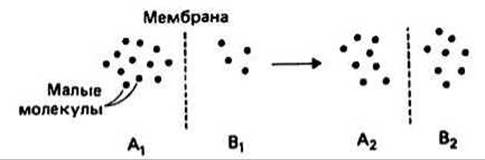
Fig. 38.2.
Simple diffusion is a process by which uncharged molecules cross a membrane from a region of high concentration to a region of low concentration. The rate of transfer is described by Fick's law

according to which the flux of a substance (J) across a membrane is proportional to the concentration gradient (dc/dx) of the molecules on either side of the membrane. D is a constant called the diffusion coefficient, with dimensions of cm2 ∙ s-1. The rate of simple diffusion decreases as the hydrophilicity of the molecule increases.
Ionic diffusion is a process whereby charged ions cross the membrane. This is a passive process and, as with simple diffusion, it depends on the presence of a transmembrane concentration gradient. However, because electrical neutrality requires that the total number of positive and negative charges on each side of the membrane must remain equal at equilibrium, an additional term must be introduced into Fick's equation. Consider a cell containing polyanionic (negatively charged) proteins, placed in a KCl solution. Ions will diffuse down their concentration gradient into The Cell, but since the proteins cannot escape and are negatively charged, more K+ ions will enter than Cl-. As a result, an unequal distribution of ions is established, generating a transmembrane electrochemical gradient. The modified Fick equation, known as the Nernst–Planck equation, includes a term that accounts for this gradient:

where A is a constant for a given ion, and dy/dx is the transmembrane charge gradient.
Facilitated diffusion refers to processes in which molecules move from a region of high concentration to a region of low concentration with the help of carrier proteins located in the plasma membrane. The process is passive in the sense that transport occurs down a concentration gradient, and it is characterized by the fact that it
1) is specific for certain molecules;
2) proceeds faster than simple diffusion;
3) exhibits saturation kinetics.
Specific carriers exist for many molecules, such as glucose, lactose, Amino Acids, NUCLEOTIDES, glycerol, etc. This selectivity is due to the presence of a stereospecific binding site on the carrier (for example, the glucose transporter transports only D-glucose, not L-glucose).
Upon binding of the specific molecule to the carrier, a conformational change occurs in the protein, resulting in the translocation of the small molecule across the membrane. Consequently, the rate of movement across the plasma membrane significantly exceeds that of simple diffusion. This mechanism presumably evolved to transport hydrophilic molecules that would otherwise diffuse across the membrane far too slowly to meet the cell's metabolic needs. Any given cell has a finite number of carriers for a specific molecule or ion, and once all of them are occupied, the transport rate reaches its maximum. Therefore, the process exhibits saturation, and its transport kinetics are virtually identical to those of simple Enzymes (Ch. 13). The higher the concentration of the transported substance on one side of the membrane, the more carriers on that side are occupied, resulting in net transport to the other side of the membrane. When the concentration difference is zero, the carriers continue to function, moving molecules into and out of the cell at equal rates, so no net diffusion is observed. Certain Hormones (Ch. 41), such as Insulin and epidermal growth factor, can stimulate an increase in carrier-mediated diffusion beyond normal baseline levels.
ACTIVE TRANSPORT refers to processes in which ions (or molecules) are moved across a cell membrane against a concentration gradient. Because transport occurs in a thermodynamically unfavorable direction, this process requires an external input of energy. In higher organisms (such as humans), such active processes consume a significant portion of the body's Energy Expenditure—approximately 30–40%. The sodium-potassium ATPase [(Na+ + K+)-ATPase, molecular mass 250,000] is one of the most thoroughly studied active transport systems. Most cells maintain different concentrations of
Na+ and K+ ions inside and outside the cell. The concentration ratio for each of these ions can reach 10–15. Typically, the intracellular concentration of K+ is high and Na+ is low, whereas the reverse situation is observed extracellularly (Ch. 36). Since the membrane is permeable to charged ions—albeit very slightly—a small "leak" occurs, and the concentrations of these two ions across the membrane tend to equilibrate. The (Na+ + K+)-ATPase actively transports ions precisely to counteract this equilibration. To maintain the unequal concentrations of Na+ and K+, 3 Na+ ions and 2 K+ ions are transported across the membrane per transport cycle.
PINOCYTOSIS (sometimes referred to as endocytosis) is a mechanism by which proteins and other macromolecules in the fluid phase are taken up into the cell. It is typically observed only in Eukaryotic cells. Small Regions of the membrane can be seen invaginating and ultimately pinching off to form intracellular spherical vesicles that detach from the membrane. Extracellular proteins bound to the membrane at the site of invagination are thus trapped inside these vesicles. Frequently, these vesicles subsequently fuse with Lysosomes containing hydrolytic enzymes, which degrade the internalized protein. An example of hormone internalization is described in Ch. 41.
PHAGOCYTOSIS is a process analogous to pinocytosis, in which large macromolecular complexes, Bacteria, Viral Particles, and other large entities are taken into the cell and digested within large vesicles, or vacuoles. In unicellular amoebas, this process plays a major role in supplying the cell with nutrients. In multicellular higher organisms, phagocytosis is performed primarily by specialized phagocytic cells (such as macrophages), which destroy invading substances before they can cause cellular damage.
Last update: 13/08/2026
Editorial and Educational Adaptation: This material has been compiled based on the primary/original source text. The project team performed an editorial review, corrected technical inaccuracies, structured sections, and adapted the content for an educational format.
What was processed:
- elimination of formatting defects (OCR errors, structural breaks, corrupted characters);
- editorial organization of content;
- standardization of terminology in accordance with academic sources;
- verification of factual statements against the original source text.
All mentions of the author, publication year, and origin of the primary text have been preserved in accordance with the source.