Introduction to Molecular Biology: From Cells to Atoms - Anthony Rees, Michael Sternberg 2002
Carbohydrates and Lipids
Lipids: 1
Class="center">Introduction/introduction.files/image083.jpg" width="640"/>
Fig. 32.1.
Lipids are Water-insoluble organic molecules found in all living Cells and Tissues. Although they comprise a diverse array of families, lipids share common distinctive properties rooted in their underlying hydrocarbon structures. Based on their biological Functions, lipids are divided into three main groups: 1) structural and receptor components of Membranes and Cell surfaces; 2) energy stores; and 3) biological signal transducers. Groups 1 and 2 are typically characterized by having Fatty acids as their primary component, whereas Group 3 includes Vitamins and Steroid Hormones, which form a structurally distinct group of molecules. In this section, we examine various types of Fatty Acids and glycerol-based lipids (functional groups 1 and 2). Chapter 33 will explore Examples of lipids built upon a sphingosine backbone (functional groups 1 and 2). In addition, the Structure and function of certain simple, or non-saponifiable, lipids (functional group 3) will be discussed.
Fatty acids are long hydrocarbon chains terminating in a carboxyl (—COOH) group. These Hydrocarbons may be either saturated or partially unsaturated.
Saturated fatty acids contain a terminal methyl group (—CH3), a variable number of methylene groups (—CH2—), and a terminal carboxyl group. Depending on the Organism, their chain length ranges from C14 to C22, with C16 (palmitic) and C18 (stearic) fatty acids being the most common. The number of carbon atoms is always even in saturated fatty acids of land plants, Bacteria, and animals, but it may be odd in some marine organisms. Bacteria contain Branched-Chain Fatty Acids as well as hydroxy acids, such as polymers of hydroxybutyric acid.
Unsaturated fatty acids contain one (monoenoic) or more (polyenoic) double bonds, which are almost always in the cis conformation (Chapter 34). Among monounsaturated acids, C16 (palmitoleic) and C18 (oleic) acids are the most frequent, whereas C18 (linolenic) is common among triunsaturated acids. Fatty acids with more than one double bond are absent in bacteria yet widely distributed in plants and animals. When only a single double bond is present, it is invariably located between carbon atoms 9 and 10 of the fatty acid, with the terminal carbon atom of the carboxyl group designated as position 1. Additional double bonds are situated between carbon atom 10 and the methyl-bearing end of the chain, with at least one —CH2— group intervening between each pair of double bonds.
The names of unsaturated fatty acids are derived according to one of two carbon-numbering systems. In fatty acids, carbon atoms are numbered either from the COOH- end (the $\Delta$-numbering system) or from the CH3- end (the $\omega$-numbering system). Let us illustrate this with a specific example of an unsaturated fatty acid:
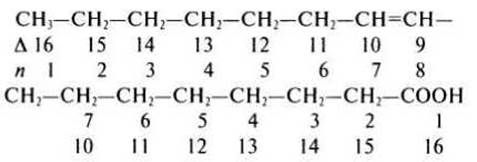
Trivial name: palmitoleic acid. $\Delta$-Name: 16:1 $\Delta^9$; this indicates that the double bond is located 9 carbon atoms away from the COOH group.
«-Name: 16:1 « — 7; this means that the double bond is located 7 carbon atoms away from the CH3-end.
Natural fatty acids are of both animal and plant origin. Animal fats, such as those present in butter, lard, etc., are primarily a mixture of saturated fatty acids (40–60%) and monounsaturated ones (30–50%), with trace amounts of polyunsaturated fatty acids. Animal fats almost always occur in the form ofacylglycerols (i.e., lipids), the most typical being triacylglycerols (see below). Plant fats, or more precisely, oils, generally contain fewer saturated fatty acids (10–20%) and are rich in unsaturated ones (80–90%). The COMPOSITION OF THE unsaturated fraction depends on the plant; for instance, olive oil consists of 79% oleic acid, whereas sunflower oil contains 75% linoleic acid. Thus, a diet is considered rich in polyenes if it contains a high amount of sunflower oil (or similar oils). The main component of this oil, linoleic acid, is an essential fatty acid. Fatty acids are typically stored in the body in the form of triacylglycerols, as free fatty acids are toxic at high concentrations. Most fatty acids can be obtained from food, but they are not strictly essential: Eukaryotic cells can synthesize them on their own. However, There are two exceptions.
The main Essential Fatty Acids are linoleic and linolenic acids. Their absence in the human diet can lead to a deficiency disease characterized by Skin scaling, Hair loss, and stunted growth.
Lipids are formed through the Esterification of fatty acids by compounds containing OH groups; these are typically the trihydric alcohol glycerol and the amino alcohol sphingosine. In addition to fatty acids, other groups such as amino groups, acids, and CARBOHYDRATES can be attached to the alcohol component. This diversity gives rise to a multitude of different lipids with varied properties.
Glycerol is a three-carbon molecule with a hydroxyl (OH) group attached to each carbon atom. A fatty acid can esterify any of the three OH groups, forming a monoacylglycerol. Esterification of two or three hydroxyl groups with fatty acids yields di- or triacylglycerols, respectively. Most of the energy stored by animals as "fat" is held in these exact forms. Acylglycerols are neutral lipids, meaning they lack polar HEAD groups. In higher plants, a six-carbon sugar is frequently attached via a glycosidic bond to the third carbon atom of diacylglycerol; galactosyldiacylglycerol is a prime example of this. When a polar head group (such as galactose) is attached to one of the three carbon atoms in glycerol, such a lipid is referred to as amphipathic.
Amphipathic Lipids are characterized by a long hydrophobic tail and a polar head group, which may be either charged or uncharged. The specific ability of these compounds to simultaneously engage in both hydrophilic and hydrophobic interactions makes them ideal components of Biological Membranes (Chap. 34). This property can be illustrated by an experiment in which amphipathic lipids are placed in an aqueous solution at either a high or low water-to-lipid ratio. In the presence of excess water, lipids form micelles (shown in cross-section in Fig. 32.2), in which the hydrophobic fatty acid tails reside inside the spherical droplet, while the polar heads are located on its surface, in contact with the polar solvent, water. When the lipid is in excess, the reverse occurs: the polar head groups form the central region of the sphere, which also traps water, while the fatty acid chains are positioned on the outside. Such "inverted micelles" form an emulsion, which results from the aggregation of micelles driven by hydrophobic interactions between them. The primary class of amphipathic acylglycerols is phosphoglycerides.
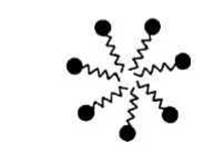
Fig. 32.2.
Phosphoglycerides are formed when one of the hydroxyl groups of glycerol is esterified with phosphoric acid, and one or both of the remaining OH groups are esterified with fatty acids (Fig. 32.1). Frequently, a nitrogenous base is attached to the phosphate group, forming a dual-charged polar head (+ and −) which, although polar, can be electrically neutral at physiological pH values. The most common groups of this type among membrane-forming Phospholipids are phosphorylcholine, phosphorylserine, and phosphorylethanolamine. Phospholipids are rarely found outside of membranes.
Last update: 13/08/2026
Editorial and Educational Adaptation: This material has been compiled based on the primary/original source text. The project team performed an editorial review, corrected technical inaccuracies, structured sections, and adapted the content for an educational format.
What was processed:
- elimination of formatting defects (OCR errors, structural breaks, corrupted characters);
- editorial organization of content;
- standardization of terminology in accordance with academic sources;
- verification of factual statements against the original source text.
All mentions of the author, publication year, and origin of the primary text have been preserved in accordance with the source.