GENERAL MICROBIOLOGY - T.P. Pyrog - 2004
18. PHOTOTROPHIC BACTERIA AND PHOTOSYNTHESIS
18.3. PHOTOSYNTHETIC PROCESSES
18.3.1. Oxygenic Photosynthesis
Primary photosynthetic processes take place in thylakoids—flat, closed membrane vesicles found in cyanobacteria Cells, as well as in the METABOLISM/14.html">Chloroplasts of Algae and green plants.
Thylakoid membranes and light-harvesting pigments (antenna pigments). The thylakoid membrane contains pigment molecules (chlorophyll a, chlorophyll b, and carotenoids), electron carriers, and Enzymes. The overwhelming majority of chlorophyll molecules (over 99%), along with accessory pigments (carotenoids, phycobiliproteins), are responsible for Light absorption and energy distribution, forming the antenna system. Only a minor fraction of chlorophyll a Functions as the photochemical reaction center where the photochemical redox reaction actually takes place.
Antenna pigments (light-harvesting pigments) capture light and transfer energy to the chlorophyll of the reaction center:
Class="center">
Photoreactions. Photoreactions belong to the Primary processes of Photosynthesis. They occur within reaction centers. A reaction center consists of several components, the most crucial being the primary electron donor (a chlorophyll-protein complex) and the primary electron acceptor. These two components represent redox systems. The donor system (P/P ) has a positive potential, whereas the acceptor system (X/X ) has a negative potential. Driven by light energy, The transfer of a single electron occurs

Alternatively, this can be written as

Thus, the first photoreaction can be expressed as

Similarly, the photoreaction in purple Bacteria can be represented as

As a result of the photoreaction, the donor loses one electron, creating a "hole" (electron deficit). Such holes must be filled by electrons, which can be supplied via cyclic or non-Cyclic electron transport. In non-cyclic transport, electrons originate from an exogenous external donor, whereas in cyclic transport, they return from the reduced acceptor (X) to the oxidized donor.
Cyclic electron transport results in A change in membrane charge, while non-cyclic transport also leads to the reduction of NADP.
Two photoreactions in Two Photosystems. In oxygenic photosynthesis, two photosystems (PS)—I and II—operate (Figure). Photosystem I is excited by light with wavelengths greater than 730 nm, whereas Photosystem II is driven by shorter-wavelength light (less than 700 nm).
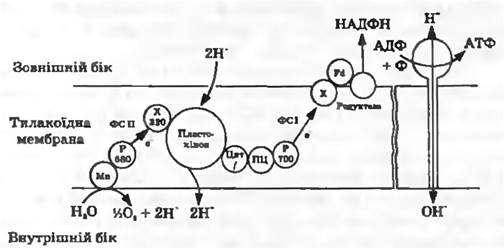
Diagram of the spatial orientation of The electron transport system in the thylakoid membrane
The photochemically active center of Photosystem I contains chlorophyll a (P700), which serves as the primary electron donor in the first photoreaction. The Redox Potential of P700 is approximately +0.5 V. Light energy absorbed by the light-harvesting pigments of the first photosystem is transferred to the reaction center, exciting P700, which is then oxidized and releases one electron. The acceptor of this released electron is X, an iron-sulfur protein with a redox potential of about -0.5 V. This acceptor, in turn, transfers the electron to ferredoxin, and from reduced ferredoxin to NADP and other acceptors, including P700 itself (non-cyclic electron transport). In the case of cyclic transport, the electron is transferred from X through plastoquinone, Cytochromes, and plastocyanin (PC) back to P700.
The reaction center of Photosystem II contains chlorophyll a1 (P680), which acts as the primary electron donor In the second photoreaction. Its redox potential is approximately +0.9 V. The electron acceptor is plastoquinone X320, which has a redox potential of about 0 V. Plastoquinone is thereby reduced to semiquinone. The electron donor for this photosystem is Water: the electron "hole" created in P680 due to electron loss is filled by an electron released during The formation of O2 from water. The splitting of water occurs with the participation of manganese.
The two described photosystems are linked by an Electron Transport Chain, a crucial component of which is plastoquinone. Much like ubiquinone in the Respiratory Chain, plastoquinone is present in excess and acts as a specialized electron "pool".
As seen in the figure, the transfer of a single electron through both photosystems is accompanied by the translocation of two protons into the thylakoid lumen. Together with the electron transport chain, the two photosystems establish a directed flow of electrons from water (on the inner side) to NADP (on the outer side). Consequently, the photoreactions lead to the reduction of NADP and the generation of a membrane charge. In other words, the light reactions function as a light-driven proton pump that establishes a positive charge inside the thylakoid. As a result, the membrane accumulates energy in the form of a proton motive force, which is subsequently utilized for ATP synthesis.
Last update: 12/08/2026
Editorial and Educational Adaptation: This material has been compiled based on the primary/original source text. The project team performed an editorial review, corrected technical inaccuracies, structured sections, and adapted the content for an educational format.
What was processed:
- elimination of formatting defects (OCR errors, structural breaks, corrupted characters);
- editorial organization of content;
- standardization of terminology in accordance with academic sources;
- verification of factual statements against the original source text.
All mentions of the author, publication year, and origin of the primary text have been preserved in accordance with the source.