Fundamentals of Molecular Biology. Part 1: Molecular Biology of the Cell - A. N. Ogurtsov 2011
Proton-motive force generation and ATP synthesis
Electron transport along the respiratory chain
In the Cell/35.html">Mitochondria, each NADH molecule delivers two high-energy electrons to the Respiratory Chain. At the end of their relaxation pathway, these electrons reduce an oxygen atom, resulting in a Water molecule. Overall, this entire process can be written as
Class="center">
The relaxation of an electron from NADH to O2 is accompanied by a decrease in electron energy by 1.14 eV, which corresponds to 26.2 kcal/mol. Accordingly, for two electrons, the energy decrease is ≈ 53 kcal/mol. Most of this energy is converted into the proton-motive force.
Each of the four multi-Structure/178.html">Protein Complexes of the respiratory chain spans The inner mitochondrial membrane (acting as an integral membrane protein) and contains several distinct prosthetic groups—electron acceptors that participate in electron transport. These small non-protein molecules or Metal Ions are tightly and specifically bound to the multi-protein complexes (Table 9) and, unlike mobile electron carriers, do not move mechanically independently of the complexes.
Several types of Hemes—iron-containing prosthetic groups similar to those found in Hemoglobins and myoglobins (Figure 164)—are tightly bound or even covalently attached to mitochondrial Proteins, forming Cytochromes (designated as Cyt in Figure 162).
Table 9 - Electron-carrying prosthetic groups (electron-acceptor groups) in the respiratory chain
|
Complex |
Prosthetic (acceptor) groups |
|
I |
FMN, Fe-S |
|
II |
FAD, Fe-S |
|
III |
Heme bL, Heme bH, Fe-S, Heme c1 |
|
IV |
Cua2+, Heme a, Cu2+b, Heme a3 |
Iron atoms at the center of the heme accept and donate electrons (Oxidation and reduction of Fe) during The process of electron transfer along the respiratory chain:


Figure 164 - Heme structure: a - scheme of cytochromes bL and bH hemes; b - the porphyrin ring (cyclic tetrapyrrole) serves as the structural basis for any type of heme
In the respiratory chain, electrons are transferred via cytochromes in the sequence b, c1, c, a, a3 (Figure 162). Different cytochromes feature different hemes, which vary in the chemical groups attached to the perimeter of the porphyrin ring and in the surrounding amino acid microenvironment. Consequently, each cytochrome has a specific reduction potential. The set of reduction potentials for the various cytochromes uniquely determines the direction and required Sequence of electron transfer along the respiratory chain.
Because the porphyrin ring of heme in cytochromes consists of alternating double and single bonds (Figure 164), it is capable of numerous resonances, allowing an additional electron to bind to carbon or nitrogen atoms or to the iron ion. All cytochromes, except for cytochrome c, are integral parts of multi-protein complexes located on the inner mitochondrial membrane. Cytochrome c, although also a heme-protein complex, is a water-soluble protein that moves freely within the mitochondrial intermembrane space.
Iron-sulfur clusters (Fe-S) are iron-containing prosthetic groups in which an Fe atom is bound to inorganic S atoms and to Cysteine sulfur atoms from The amino acid environment of the prosthetic group (Figure 165).

Figure 165 - Dimeric iron-sulfur cluster
All Fe-S clusters can accept (and donate) a single electron. Within the clusters, some iron atoms carry a (+2) charge while others carry a (+3) charge, although the actual charge of an Fe atom lies between (+2) and (+3) because the outer-orbital electrons of the Fe atoms are delocalized to form a shared orbital. The electron added to the cluster likewise becomes shared among all Fe atoms comprising the cluster.
Coenzyme Q (CoQ), more commonly known as ubiquinone, is the only electron carrier in the respiratory chain in which the electron does not bind to a protein prosthetic group (Figure 166).

Figure 166 - Scheme of ubiquinone reduction to dihydroubiquinone
In reality, ubiquinone transfers not just a single electron, but two hydrogen atoms—that is, two electrons and two protons. First, the oxidized quinone form of CoQ accepts one electron to form an intermediate charged free radical, semiquinone, designated as (CoQ-●).
Then, upon The addition of another electron and two protons, the fully reduced form of ubiquinone, dihydroubiquinone (CoQH2), is formed (Figure 166).
Both forms of ubiquinone—both CoQ and CoQH2—are fat-soluble (lipophilic) and diffuse freely within the inner mitochondrial membrane. Ubiquinone receives electrons from both NADH-CoQ reductase (Complex I) (Figure 167) and succinate-CoQ reductase (Complex II) (Figure 168), transferring them to CoQH2-cytochrome c reductase (Complex III).
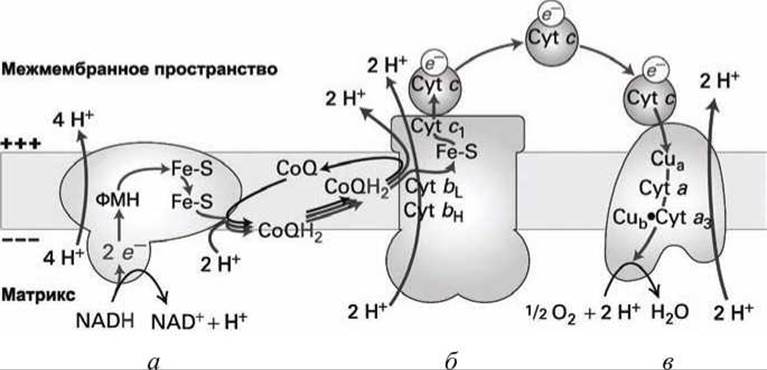
Figure 167 - Scheme of interaction between respiratory chain components: a - NADH-CoQ reductase (Complex I); b - CoQH2-cytochrome c reductase (Complex III); c - cytochrome c oxidase (Complex IV)
Importantly, the reduction and oxidation of ubiquinone (CoQ) is coupled with the pumping (translocation) of protons across the membrane from the mitochondrial matrix into the intermembrane space.
In total (Figure 167), ten Protons are pumped across the membrane for each pair of electrons derived from NADH.
The electron transport process in the matrix concludes with the enzyme cytochrome c oxidase generating a water molecule from molecular oxygen (Figure 167(b)).
During The oxidation of succinate to fumarate (Figure 168) and The transfer of electrons from complex (II) to ubiquinone, no protons are pumped across the membrane; however, the subsequent Electron Transport Chain through complexes (III) and (IV) is identical to that of NADH-derived electrons (Figure 167(b, c)). Therefore, for every pair of electrons transferred from succinate to O2, only six protons are translocated across the membrane.

Figure 168 - Scheme of electron transfer by ubiquinone CoQ from succinate-CoQ-reductase (complex II) to CoQH2-cytochrome c reductase (complex III)
Ubiquinone accepts electrons from the regions of complexes (I) and (II) that face the matrix (Figures 167 and 168). Reduced ubiquinone, CoQH2 (dihydroubiquinone), transfers its electrons to the intermembrane-space-oriented domain of complex (III), releasing the two protons bound to CoQH2 into the intermembrane space. Consequently, The transport of each pair of electrons by ubiquinone is invariably accompanied by the translocation of two protons from the matrix to the intermembrane space. This cyclic Circulation of ubiquinone, which enables complex (III) to transfer an additional two electrons, is known as the "Q-cycle".
Last update: 12/08/2026
Editorial and Educational Adaptation: This material has been compiled based on the primary/original source text. The project team performed an editorial review, corrected technical inaccuracies, structured sections, and adapted the content for an educational format.
What was processed:
- elimination of formatting defects (OCR errors, structural breaks, corrupted characters);
- editorial organization of content;
- standardization of terminology in accordance with academic sources;
- verification of factual statements against the original source text.
All mentions of the author, publication year, and origin of the primary text have been preserved in accordance with the source.