BIOTECHNOLOGY - N.M. Inshyna - 2009
CHAPTER 6. ENVIRONMENTAL BIOTECHNOLOGY
Biodegradation of Xenobiotics
One of the crucial challenges in protecting the biosphere is the biodegradation of xenobiotics—The breakdown of complex substances through the METABOLIC ACTIVITY OF living organisms.
Xenobiotics (from the Greek xenos, meaning "foreign") are unnatural, synthetic compounds. Most xenobiotics are toxic and exhibit mutagenic, carcinogenic, and allergenic properties. The elimination of xenobiotics from the environment is influenced by several factors: ambient pH, resistance of xenobiotics to degradation, Water solubility, volatility, permeability into microbial Cells, and structural similarity of xenobiotics to natural compounds susceptible to biodegradation. Detergents, plastics, and Hydrocarbons are among the most persistent and difficult compounds to break down.
In the mid-1960s, soil microorganisms capable of degrading xenobiotics (such as herbicides, pesticides, detergents, and Solvents) were discovered. Bacteria of the genus Pseudomonas are the most widespread microorganisms involved in the purification of water, air, and soil. Biochemical studies have demonstrated that various Pseudomonas strains can degrade over 100 Organic compounds. For instance, Pseudomonas putida degrades toluene and trichloroethylene. Trichloroethylene is a prevalent soil and water pollutant; it is widely used as a solvent and is known to be carcinogenic. Halogenated Aromatic Compounds serve as the primary components of many pesticides and herbicides. Upon exposure to bacterial action, these substances are converted into catechol, hydroquinone, or their halogenated derivatives. The rate of their degradation is inversely proportional to the number of halogen atoms in the parent molecule. Non-halogenated aromatic compounds are converted by bacteria into catechol and subsequently into intermediate metabolic products (pyruvic acid and acetaldehyde).
The ability of bacteria to decompose xenobiotics is attributed to specific intracellular Enzymes (such as oxidoreductases and hydroxylases) that oxidize hydrocarbons and aromatic compounds, including benzene, toluene, and xylene. The genes encoding these enzymes are typically located on Plasmids. Since no single microorganism can degrade all types of organic compounds, Introduction/32.html">Genetic Engineering techniques are employed to construct bacterial strains harboring multiple plasmids from different strains, thereby achieving a broad spectrum of activity.
In 1979, Professor Ananda Chakrabarty engineered the first bacterial strain with expanded catabolic capabilities. This strain was capable of breaking down most petroleum hydrocarbons and was dubbed the "superbug." It was created using plasmids, each encoding an enzyme that degrades specific hydrocarbons: the CAM plasmid confers degradation of camphor, OCT of octane and hexane, NAH of naphthalene, and XYL of xylene and toluene. The scheme for deriving a bacterial strain capable of utilizing petroleum is illustrated in Fig. 6.2.
The newly generated strain demonstrated a superior ability to grow on crude oil compared to the parental strains. In 1981, Chakrabarty was granted the first US patent for a genetically modified microorganism, a milestone that catalyzed the further development of biotechnology.
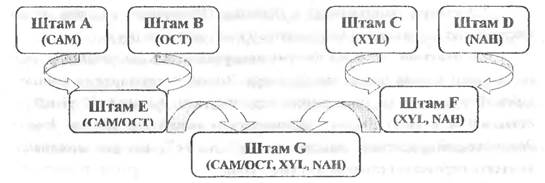
Class="center">Fig. 6.2. Derivation of a bacterial strain capable of utilizing petroleum
Today, microorganisms are widely employed for the bioremediation of oil spills resulting from industrial and technological disasters. It is estimated that approximately 6 million tons of oil enter the oceans annually. To enhance remediation efficiency, microemulsions are formulated containing bacterial strains and capsules filled with a mixture of nitrogen, phosphorus, and potassium compounds. The addition of these nutrients stimulates bacterial proliferation. Biopreparations based on Pseudomonas species effectively degrade crude oil and petroleum products (such as fuel oil, diesel, and gasoline) across a broad Temperature range (8–35°C) and pH spectrum (3.5–10).
Studies have shown that microbial consortia are more effective in biodegrading xenobiotics than individual species alone. Certain microorganisms can modify a xenobiotic molecule in such a way that it becomes a viable energy source for other microbes (a process known as cometabolism). In some cases, chemical modifications of xenobiotics—such as phosphorylation, methylation, or Acetylation—result in the reduction or complete loss of their toxicity.
EDTA (ethylenediaminetetraacetate) is considered one of the most hazardous environmental pollutants. This compound is extensively used as a detergent in synthetic cleaning products. EDTA chelates heavy Metal Ions and promotes their accumulation in the soil. Bacteria belonging to the genera Pseudomonas and Bacillus are capable of degrading Fe-EDTA complexes. Consequently, these bacteria are utilized in the Treatment of municipal wastewater and detergent-contaminated soils.
In addition to Pseudomonas and Bacillus, biodegradation of xenobiotics is carried out by Representatives of the genera Acinetobacter, Alcaligenes, Flavobacterium, Sphingomonas, Rhodococcus, Nocardia, and Arthrobacter. Furthermore, certain bacteria produce the enzyme cyanide hydratase, which facilitates the breakdown of cyanides.
Researchers at the Biotechnology Institute in Leipzig, Germany, have isolated bacterial strains capable of absorbing and sequestering mercury within their cells.
Iron-oxidizing bacteria, of which over 20 species are currently known, are used to remove iron from water. According to sanitary standards, the iron content in drinking water should not exceed 0.3 mg/L, whereas natural river or pond water typically contains between 0.01 and 1 mg/L. Iron bacteria efficiently oxidize Fe2+ to Fe3+, facilitating the removal of insoluble iron compounds from the water.
In addition to bacteria, xenobiotics are biodegraded by Fungi belonging to genera such as Penicillium, Aspergillus, Trichoderma, Fusarium, and Phanerochaete. Research indicates that fungi often utilize xenobiotics more efficiently than bacteria. Certain fungi are capable of breaking down persistent aromatic compounds such as pentachlorobenzene and pentachlorophenol. In one experiment, 10,000 tons of soil from a wood-Processing facility contaminated with these compounds was treated with fungi. The initial pentachlorophenol concentration in the soil was 700 mg/kg. After one year, it dropped to 10 mg/kg, which is within the permissible limit. Thus, within a single year, the fungi reduced the concentration of xenobiotics in the soil 70-fold. By contrast, native soil bacteria would have required 4–5 years to achieve the same level of remediation. Fungi degrade aromatic hydrocarbons extracellularly and remain active even during the winter months. Estimates show that while the overall cost of fungal and bacterial soil remediation is comparable, The Use of fungi significantly shortens the time required for xenobiotic biodegradation.
Thus, microorganisms are widely utilized for the efficient and economically viable breakdown of toxic chemical wastes. The primary advantage of microbiological remediation over chemical Methods is that it does not introduce new polluting agents into the environment.
Last update: 11/08/2026
Editorial and Educational Adaptation: This material has been compiled based on the primary/original source text. The project team performed an editorial review, corrected technical inaccuracies, structured sections, and adapted the content for an educational format.
What was processed:
- elimination of formatting defects (OCR errors, structural breaks, corrupted characters);
- editorial organization of content;
- standardization of terminology in accordance with academic sources;
- verification of factual statements against the original source text.
All mentions of the author, publication year, and origin of the primary text have been preserved in accordance with the source.