Genetics - A. V. Sivolob 2008
Genetic Engineering and Molecular Genetics Methods
Methods of Genetic Engineering
Key Enzymes in Genetic Engineering
The primary tool for performing Introduction/32.html">Genetic Engineering operations consists of natural Enzymes that catalyze the degradation and synthesis of Nucleic Acids. A special place among them belongs to Restriction Endonucleases (restriction enzymes), which specifically cleave DNA molecules within certain nucleotide Structure/155.html">Sequence Motifs. Restriction enzymes (several hundred such enzymes exist) act as a defense mechanism in bacterial Cells against foreign bacteriophage DNA. These enzymes are named according to a specific convention: the first capital letter designates the genus of the microorganism, the two lowercase letters designate the species, and Roman numerals—sometimes followed by capital letters—indicate the serial number of the restriction enzyme among other such enzymes in that particular bacterium. For example, EcoRI is the restriction enzyme RI from Escherichia coli.
The nucleotide sequences recognized by restriction enzymes exhibit a high degree of diversity: restriction sites are typically short palindrome-like sequences (spanning 4, 6, or sometimes slightly more Base Pairs) that read identically in the 5'-to-3' direction on both strands (Fig. 9.1). Depending on the type of restriction enzyme, the two Cleavage cuts it makes may be situated directly opposite each other on the two strands, resulting in The formation of so-called blunt ends. More frequently, restriction enzymes leave mutually complementary 5'-terminal (and occasionally 3'-terminal) single-stranded overhangs known as sticky ends (Fig. 9.1).
Class="center">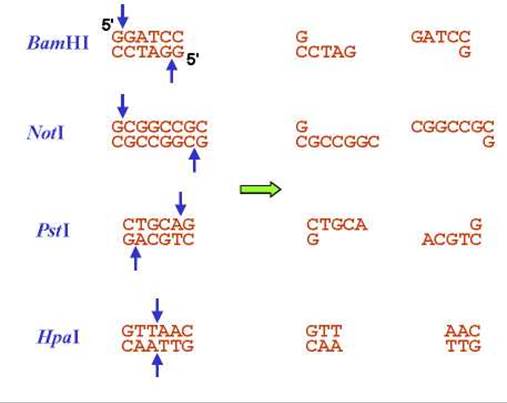
Fig. 9.1. Examples of restriction sites (left, with arrows indicating the cleavage sites) and restriction products (right). The restriction enzymes BamHI and NotI leave sticky ends with 5'-overhangs, PstI leaves 3'-overhangs, and HpaI produces blunt ends.
In addition, a variety of less specific Nucleases—enzymes that catalyze the Hydrolysis of nucleic acids—are frequently employed. Nucleases may act exclusively on DNA molecules (DNases) or RNA molecules (RNases); selectively hydrolyze single-stranded (nuclease S1) or double-stranded (exonuclease III) DNA molecules; or act specifically on hybrid RNA-DNA molecules (RNase H), among other Functions.
Another enzyme crucial to genetic engineering is DNA-dependent DNA polymerase (see Chapter 1). Most commonly, E. coli DNA polymerase I is utilized, which exhibits Three types of catalytic activity:
✵ polymerase activity, which drives the synthesis of a DNA strand in the 5'-3' direction on a single-stranded DNA template in the presence of four nucleoside triphosphates and a short DNA primer possessing a free 3'-hydroxyl group;
✵ 3'-exonuclease activity, which is responsible for excising NUCLEOTIDES from the 3'-end for proofreading and error correction;
✵ 5'-exonuclease activity, which facilitates the removal of nucleotides from the 5'-end of a polynucleotide chain.
By virtue of its first and third activities, DNA polymerase I can simultaneously catalyze polymerization and the hydrolysis of a nucleotide chain in the 5'-3' direction, starting from a single-stranded nick within a double-stranded DNA molecule. This process is known as nick Translation, during which the nick is shifted along the DNA strand in the 5'-3' direction over a distance of up to one thousand base pairs. Nick translation is used, among other Applications, for introducing radiolabeled nucleotides into DNA.
Using Trypsin or subtilisin, DNA polymerase I can be cleaved to yield a large fragment (the Klenow fragment) that retains only the polymerase and 3'-exonuclease activities. The absence of 5'-exonuclease activity makes the Klenow fragment particularly useful for "filling in" single-stranded 5'-overhangs generated by restriction enzyme Digestion.
Phage T4 DNA polymerase is also widely used. It possesses the same enzymatic activities as the Klenow fragment, but its 3'-exonuclease activity is 200 times higher. Consequently, this polymerase is employed for labeling restriction fragments with 3'-overhangs.
DNA ligase represents yet another vital tool in genetic engineering. It catalyzes the formation of a phosphodiester bond between the 5'-phosphate and 3'-hydroxyl termini at the site of a single-stranded break (nick) in a double-stranded DNA molecule. Phage T4 DNA ligase is most frequently utilized because, in the presence of ATP, it can join DNA fragments with sticky ends: two mutually complementary sticky ends form a double helix containing two nicks (Fig. 9.1), which are then sealed by the ligase.
For synthesizing DNA on an RNA template, RNA-dependent DNA polymerase—commonly known as Reverse Transcriptase—is used. The name of the enzyme reflects the fact that it catalyzes the reverse reaction of the initial step in Gene Expression (METABOLISM/31.html">Transcription), with the primary product being an RNA-DNA hybrid. In genetic engineering, reverse transcriptase derived from avian RNA Viruses is typically employed (see Chapter 5). It consists of two subunits and exhibits at least two distinct activities: DNA polymerase activity (utilizing either single-stranded RNA or DNA AS A template) and RNase H activity (which degrades the RNA moiety within an RNA-DNA hybrid while leaving single-stranded free RNA untouched). Thus, the enzyme synthesizes a complementary DNA molecule (cDNA) using an RNA template.
Among other diverse enzymes utilized in genetic engineering, terminal deoxynucleotidyl transferase deserves mention, as it can add nucleotides sequentially to the 3'-end of a single-stranded DNA molecule. It can be used to "blunt" DNA ends (when the 3'-end is shorter) or to elongate single-stranded 3'-overhangs via template-independent DNA Synthesis using nucleotides present in the reaction mixture.
Last update: 11/08/2026
Editorial and Educational Adaptation: This material has been compiled based on the primary/original source text. The project team performed an editorial review, corrected technical inaccuracies, structured sections, and adapted the content for an educational format.
What was processed:
- elimination of formatting defects (OCR errors, structural breaks, corrupted characters);
- editorial organization of content;
- standardization of terminology in accordance with academic sources;
- verification of factual statements against the original source text.
All mentions of the author, publication year, and origin of the primary text have been preserved in accordance with the source.