Anatomy, Physiology, and Pathology of the Organs of Hearing, Vision, and Speech - A.G. Shvetsov 2006
Anatomy, Physiology, and Pathology of Speech
Speech Pathology
General speech underdevelopment refers to a form of speech pathology characterized by impaired development of all Components of the speech system—vocabulary, grammar, and pronunciation—despite normal Hearing and relatively intact non-verbal intelligence. This systemic impairment of speech activity manifests in typical ways: late onset of expressive speech, severely limited vocabulary, pronounced agrammatism, articulation and phoneme production defects, specific impairments in word syllable Structure, and underdeveloped coherent speech, thereby reflecting a unified pathological pattern across all three components of the speech system.
The etiological (causal) factors underlying speech disorders are complex and polymorphic. Among the causes of speech disorders, a distinction is made between biological and social risk factors.
Biological, hereditary factors play a significant role in the Etiology of childhood speech disorders. They often act as predisposing conditions that manifest as speech pathology under METABOLISM/18.html">The Influence of adverse environmental factors. However, in some cases, hereditary factors serve as the primary cause of speech pathology, such as a family history of speech disorders (associated with left- and right-handedness). Most commonly, we observe a combination of genetic predisposition, an unfavorable environment, and impaired maturation and functioning of the CNS.
Hereditary factors in the onset of speech disorders typically act in combination with exogenous-organic and social factors.
Exogenous-organic factors refer to various adverse influences (such as cerebral Hypoxia, infections, trauma, intoxication, etc.) on the child's Central Nervous system and overall Organism.
Depending on the timing of their impact, pathologies are classified as prenatal (intrauterine), intranatal (at birth), or postnatal (after birth). Prenatal pathology is often combined with damage to the child's nervous system during labor and the first days of life (perinatal pathology). The consequences of these adverse factors can be central organic (affecting the Brain) or peripheral organic (disrupting the morphological Development of the peripheral speech apparatus).
Perinatal pathology (embryopathies) can be caused by maternal viral infections during Pregnancy, medication use, ionizing radiation, vibration, maternal alcoholism and smoking, certain bacterial infections, toxicoses, as well as various obstetric complications (such as a narrow pelvis, prolonged or precipitous labor, Premature Rupture of membranes, umbilical cord entanglement, fetal malpresentation, etc.). Obstetric interventions during delivery (such as The Use of forceps or a vacuum extractor) can also play a role by potentially damaging the fetal nervous system.
Class="center"> 
Fig. 23. Prognathism

Fig. 24. Progenia
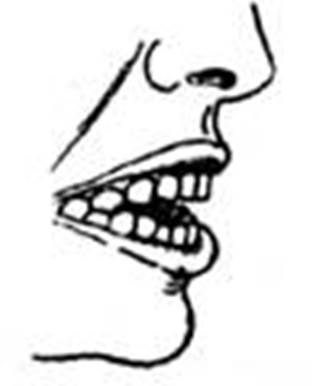
Fig. 25. Anterior open bite

Fig. 26. Posterior open bite
Children with resulting brain anomalies and malformations often exhibit cranial Asymmetry, palatal anomalies (high-arched "Gothic" palate, flat palate, cleft lip and palate), and developmental defects or underdevelopment of the Maxilla and Mandible, leading to malocclusions (progenia, prognathism, anterior or posterior open bite — Figs. 23-26), as well as dental arch abnormalities (widely spaced Teeth, missing teeth, deformed tooth edges, etc.). An example of a speech disorder resulting from a congenital cleft palate is open rhinolalia; all developmental defects of the jaws, as well as abnormal tooth structure and alignment, are accompanied by pronunciation difficulties, most commonly in the form of lisping (sigmatism).
Birth trauma and fetal asphyxia (oxygen deprivation) during delivery can lead to intracranial Hemorrhage and the death of Nerve Cells from "suffocation." These cellular lesions can affect the speech areas of the Cerebral Cortex, resulting in The Development of alalia. Fetal alcohol syndrome has been described, characterized by physical, speech, and mental retardation, along with craniofacial deformities, and The Role of chronic maternal alcoholism in its etiology has been well documented. In such cases, speech development delay is directly linked to concomitant hearing impairment in the child.
Pathological influences in the late stages of pregnancy do not typically cause severe Congenital Malformations, but they do lead to delayed maturation of The Nervous System and impaired myelination of its structures, often manifesting later as speech production difficulties of central-cortical origin.
Speech disorders can also arise from various adverse Factors affecting the child's brain during subsequent Selection/3.html">Stages of development. The structure of these speech disorders varies depending on the timing of the harmful exposure and the localization of the brain lesion. Early organic brain lesions, when combined with unfavorable upbringing and environmental conditions During the first years of life, play a particularly significant role.
Socio-psychological risk factors are primarily associated with the psychological deprivation of children. Emotional deprivation—the lack of positive emotional contact and verbal communication between the child and adults—is of particular importance. Negative impacts on speech development can also stem from requiring a young preschool child to acquire two language systems simultaneously, overstimulation of speech development, inappropriate parenting styles, and educational neglect. As a result of these factors, a child may exhibit developmental impairments in various aspects of speech.
Functional speech disorders also include those associated with adverse general effects on the child's body: general physical weakness; immaturity due to prematurity or prenatal pathology; internal organ diseases; Rickets; Metabolic Disorders, etc., since any general or neuropsychiatric illness in a child, especially during the first years of life, is typically accompanied by impaired speech development. Therefore, it is reasonable to distinguish between defects in speech acquisition and defects in fully formed speech, considering the age of three as a conventional dividing line.
The Essence of atypical development in children with hearing, visual, or speech impairments lies in the fact that the primary biological cause (the sensory or speech defect) determines the disruption of the child's social status, leading to atypical psychological development. This ultimately manifests as functional impairments, such as speech underdevelopment and Specific characteristics of thinking, attention, memory, perception, and mental representation.
Impaired speech activity leaves its mark on the development of children's sensory, intellectual, and affective-volitional spheres. There is a notable instability of attention and limited capacity for its distribution. While semantic and logical memory remain relatively intact, verbal memory is reduced, and the productivity of memorization suffers. These children lag behind in the development of verbal-logical thinking and, without specialized instruction, struggle to master analysis, synthesis, comparison, and generalization.
Last update: 11/08/2026
Editorial and Educational Adaptation: This material has been compiled based on the primary/original source text. The project team performed an editorial review, corrected technical inaccuracies, structured sections, and adapted the content for an educational format.
What was processed:
- elimination of formatting defects (OCR errors, structural breaks, corrupted characters);
- editorial organization of content;
- standardization of terminology in accordance with academic sources;
- verification of factual statements against the original source text.
All mentions of the author, publication year, and origin of the primary text have been preserved in accordance with the source.