HUMAN MEDICAL BIOLOGY, ANATOMY, PHYSIOLOGY AND PATHOLOGY - Ya.I. Fedoniuk 2010
ANATOMY, PHYSIOLOGY, PATHOLOGY
SECTION 3. ANATOMICAL AND PHYSIOLOGICAL ASPECTS OF BODY FUNCTION SELF-REGULATION
MAJOR PATHWAYS OF THE BRAIN AND SPINAL CORD
2. MOTOR PATHWAYS
Motor pathways are divided into two groups:
1) pyramidal pathways (corticospinal and corticonuclear), which conduct impulses from the Cerebral Cortex to the motor Neurons of the Spinal Cord and Medulla Oblongata;
2) extrapyramidal pathways, which belong to the extrapyramidal system.
The pyramidal (corticospinal) pathway originates from the giant pyramidal Cells (Betz cells) of the precentral gyrus, where The Cell body of the first neuron is located (Fig. 3.34). The processes of the first-neuron cells pass through the internal capsule, cerebral peduncles, Pons, and pyramids of the medulla oblongata. Here, a portion of the fibers decussates, forming the lateral corticospinal tract, while the non-decussating fibers constitute the anterior corticospinal tract. The lateral corticospinal tract descends within the lateral funiculus of the spinal cord and terminates on the Cells of the anterior horn of the Gray matter of the spinal cord, where the cell bodies of the second neurons are located. The processes of the second-neuron cells extend to the Muscles. The anterior corticospinal tract decussates segmentally in the region of the white commissure of the spinal cord.
Class="center">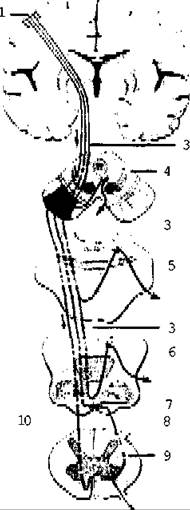
Fig. 3.34 Pyramidal pathway
The corticonuclear pathway begins in the lower third of the precentral gyrus, passes through the genu of the internal capsule, and terminates on the cells of the motor cranial nerve nuclei of the opposite side. The processes of the motor nuclei cells form the motor component of the corresponding nerve.
The extrapyramidal motor pathways include the rubrospinal tract (Fig. 3.32 c) originating from the red Nucleus of the Midbrain, the tectospinal tract originating from the nuclei of the superior and inferior colliculi of the midbrain tectum (associated with auditory and visual perceptions), and the vestibulospinal tract originating from the vestibular nuclei of the Rhomboid fossa (associated with maintaining body balance).
Last update: 08/08/2026
Editorial and Educational Adaptation: This material has been compiled based on the primary/original source text. The project team performed an editorial review, corrected technical inaccuracies, structured sections, and adapted the content for an educational format.
What was processed:
- elimination of formatting defects (OCR errors, structural breaks, corrupted characters);
- editorial organization of content;
- standardization of terminology in accordance with academic sources;
- verification of factual statements against the original source text.
All mentions of the author, publication year, and origin of the primary text have been preserved in accordance with the source.