BOTANY WITH BASICS OF HYDROBOTANY (AQUATIC PLANTS OF UKRAINE) - B.Ye. Yakubenko - 2011
X. SEED PLANTS
Rose Family (Rosaceae)
Trees, shrubs, and herbs with simple or compound leaves bearing stipules fused to the leaf base. Phyllotaxy is alternate. Stems are erect, climbing, or creeping. Flowers are actinomorphic, most commonly pentamerous, with a double perianth, and occasionally with an epicalyx. Stamens are numerous, typically twice as numerous as the perianth parts, and arranged cyclically. The receptacle (hypanthium) is cup-shaped, flat, concave, or convex. Carpels range from one to many, free or fused. The Ovary is superior, inferior, or semi-inferior. All floral Organs except the gynoecium are attached to the rim of the receptacle. Floral formula: *K5C5A∞G1,∞,(∞). Fruits include follicles, drupes, achenes, nuts, or capsules. Fruits may be aggregate or simple, true or accessory.
A large family comprising up to 100 genera and 3,000–3,350 species distributed worldwide, though primarily growing in temperate and subtropical Regions of the Northern Hemisphere. The practical importance of the family is exceptionally high. It includes major temperate fruit crops, as well as ornamental and medicinal plants. In Ukraine, it is represented by 40 genera and about 290 species. Based on floral type, receptacle Structure, and fruit characteristics, the family is divided into seven subfamilies, of which only four have representatives characteristic of the flora of Ukraine: Spiraeoideae, Rosoideae, Maloideae, and Prunoideae.
Marsh cinquefoil (Comarum palustre L.). A perennial herbaceous plant with long creeping rhizomes (Fig. 132). Leaves are 3–10 cm long, pinnately compound with an odd terminal leaflet, featuring oblong segments with serrate margins.
Inflorescences are terminal, corymbose. Sepals are ovate, acute, green on the outside, and dark red on the inside. Petals are red, ovate-lanceolate, 3–5 mm long. The plant serves as food for leaf beetles, weevils, geese, ducks, and beavers.
Class="center">Water/water.files/image133.jpg" width="195"/>
Fig. 132. Marsh cinquefoil
Grows in bogs and marshes within the Polissya and Forest-Steppe zones, and occasionally in the Steppe.
Water avens (Geum rivale L.). A perennial herbaceous plant, 25–70 cm tall; uliginosophyte, entomophil, barochore, epizoochore, hydrochore (Fig. 133).
ROOT system is taproot-like, with a thickened main root. Stem is erect, scabrous, and glandular toward the top. Phyllotaxy is alternate; a basal rosette of larger, long-petiolate leaves develops at the Base of the stem. The leaf blade is pubescent with rough hairs, interrupted-pinnate; the upper and largest terminal lobe is rounded and Kidney-shaped at the base, while the lateral lobes decrease in size toward the leaf base. Stipules are 2–3 mm long.
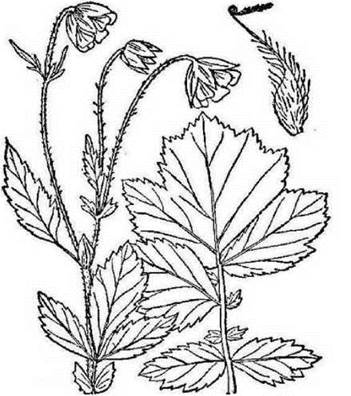
Fig. 132. Water avens
Flowers are bisexual, solitary or paired on drooping pedicels. The perianth is double; the calyx (with an epicalyx) and corolla are pentamerous. Sepals are erect, brownish-red, 10–15 mm long. Petals are emarginate, obovate, with long claws, yellowish with red Veins, equaling the calyx in length. The pistil style is feathery-pubescent, persisting on the fruit. Fruits are achenes gathered in ovoid heads. Blooms in May–June.
Propagates vegetatively and by seeds.
The plant is consumed by beavers.
Grows along the banks of water bodies, in bogs, and in alder swamps throughout Ukraine, except for the Steppe and Crimea.
Meadowsweet (Filipendula denudata (J. et C. Presl) Fritsch, F. ulmaria (L.) Maxim.). A perennial herbaceous plant, 50–120 (150) cm tall; euhoxophyte, entomophil, autochore, anemochore, hydrochore (Fig. 134). Rhizome is shortened and thickened. Stem is erect, branched, densely leafy; phyllotaxy is alternate. Leaves are 12–15 cm long and 5–6 cm wide, interrupted-pinnate, with 2–5 pairs of broadly ovate, doubly serrate leaflets; the terminal leaflet is larger, 3–5 lobed. Leaves are green above, silvery beneath due to arachnoid pubescence, rarely glabrous.
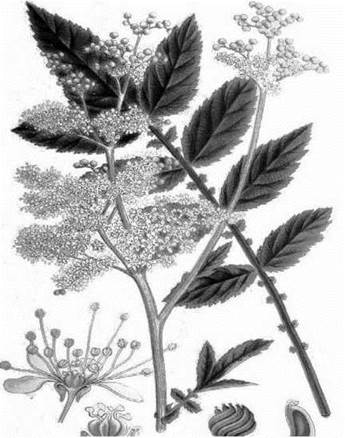
Fig. 134. Meadowsweet
Inflorescence is large, up to 20 cm long, corymbose-paniculate. Peripheral axes of the inflorescence are elongated, while central ones are shortened, giving the inflorescence a concave shape. Flowers are bisexual, small, up to 6 mm in diameter, actinomorphic. Petals and sepals number five each. Petals are yellowish- or creamy-white. Fruits are spirally twisted aggregate follicles. Blooms in June–August. Propagates vegetatively and by seeds.
A food, vitamin-rich, honey-producing, medicinal, oil-yielding, and tannin-producing plant. It serves as feed for weevils and beavers.
Grows in damp meadows, along riverbanks, among shrub thickets, and in wet forests almost throughout Ukraine, except for the southern Steppe; rarely found in the Crimean foothills.
Last update: 07/08/2026
Editorial and Educational Adaptation: This material has been compiled based on the primary/original source text. The project team performed an editorial review, corrected technical inaccuracies, structured sections, and adapted the content for an educational format.
What was processed:
- elimination of formatting defects (OCR errors, structural breaks, corrupted characters);
- editorial organization of content;
- standardization of terminology in accordance with academic sources;
- verification of factual statements against the original source text.
All mentions of the author, publication year, and origin of the primary text have been preserved in accordance with the source.