BOTANY WITH BASICS OF HYDROBOTANY (AQUATIC PLANTS OF UKRAINE) - B.Ye. Yakubenko - 2011
X. SEED PLANTS
Family Buttercup Family (Ranunculaceae)
Annual, biennial, and perennial herbs, less commonly shrubs, subshrubs, or lianas. These include both terrestrial and aquatic plants. Leaves are simple or palmatifid/pinnatifid, without stipules; some species possess only basal leaves, while others have both basal and stem leaves. Basal leaves typically feature long petioles and broad sheaths, whereas stem leaves have shorter petioles, with the blade often transitioning into a sheath. The predominant leaf type in the family has a cordate base, palmately lobed into coarse Teeth or incisions. Smaller leaves are generally rounded, while larger ones are Kidney-shaped. When a leaf is simple or divided into shallow lobes, its margin is typically toothed or crenate. Phyllotaxy is mostly alternate. Flowers are actinomorphic or zygomorphic, with acyclic, cyclic, or hemicyclic arrangement of floral parts on the receptacle. In most species, flowers are bisexual, though some are unisexual. They develop singly at the stem apex, in leaf axils, or in racemes. The perianth is simple or double, with gradual transitions from simple to double; with an indefinite or definite number of members (a typical flower features a 5-merous perianth). Stamens are mostly numerous, pistils few to many, rarely solitary. The gynoecium is most commonly apocarpous. The Ovary contains one or more ovules. Fruits vary in Structure—aggregate follicles or achenes, less commonly berries or capsules.
Scientists believe that even today, this family is undergoing a process of intensive speciation. Alongside the primitive flower type with an indefinite number of all floral parts and an acyclic arrangement, one can observe all transitions toward a more advanced type. Flowers evolved from a small number of simple perianth parts to a 5-merous double perianth, from actinomorphy to zygomorphy, and from apocarpy to syncarpy.
This is a large family comprising over 66 genera and about 2,000 species, distributed mainly in temperate and cold regions. In Ukraine, there are 25 genera and around 140 species. The family includes many plants that are toxic and dangerous to animals and humans, containing various Alkaloids, Glycosides, and Other Compounds. Some species are known as medicinal and ornamental plants.
Marsh Marigold (Caltha palustris L.). A perennial plant, uliginosophyte, entomophilous, hydrochorous, 15-50 cm tall (Fig. 107). Rhizome shortened, hypogeogenous, with well-developed adventitious roots. Stem branched, ascending, glabrous, with alternate phyllotaxy. Leaves dark green, petiolate, simple, with crenate margins, shiny; lower leaves Heart-shaped, upper ones kidney-shaped. Basal leaves enlarge significantly by fruiting time, reaching up to 10-12 cm in diameter.
Class="center">Water/water.files/image108.jpg" width="254"/>
Fig. 107. Marsh marigold
Flowers are bisexual, hemicyclic, 2.5-3 cm in diameter, grouped in clusters of two to five at SHOOT apices. The perianth is simple, petaloid, consisting of 5 golden-yellow, oval or ovate, rarely nearly round segments, 15-22 mm long. Androecium is multi-membered, gynoecium is complex apocarpous, consisting of 5-12 carpels. Floral formula: P5A∞G5-12. Fruit is an aggregate follicle formed by 5-12 follicles. Mature follicles are recurved outward, spreading, gradually narrowing into a straight beak, 1
mm long. Blooms in April - May. Propagates by seeds.
Grows in bogs, marshy meadows, along water bodies, in alder swamps, and damp places throughout Ukraine.
An ornamental and medicinal plant (used externally as a pain-relieving and anti-inflammatory agent). This species serves as a food source for aphids, dipteran insects, pygmy moths, narrow-winged moths, and beavers.
Water Crowfoot (Batrachium aquatile (L.) Dumort.). A perennial plant, entomophilous, hydrochorous, ornithochorous. Rhizome plagiotropic, up to 10 cm long. Stems of the aquatic form up to 50-100 cm tall, 2 mm thick. Stems of the terrestrial form shortened, 5-10 cm tall, highly branched. Exhibiting pronounced heterophylly: submerged leaves nearly sessile, dissected into thread-like segments; floating leaves semicircular or kidney-shaped in outline, 3-, 5-, or 7-lobed, or 3- to 5-divided. The terrestrial form is homoblastic, with dissected leaves.
Flowers are bisexual, 1-1.5 cm in diameter, with a double perianth. Petals 6-10 mm long, white, with a yellow rounded nectar pit. Receptacle globular, stamens and pistils numerous; gynoecium is complex apocarpous, formed by 30-35 carpels. Immature carpels are pubescent, with pubescence disappearing as they mature. Floral formula: *K5C∞A∞G∞. Fruit is an aggregate achene, individual nutlet up to 2 mm long and 1.4 mm wide. Blooms above the water surface in June - August. Seed reproduction predominates.
The plant is consumed by gastropod Mollusks (pond snails, bithyniids) and crayfish.
Grows in standing and slowly flowing water bodies at a depth of 50-100 cm; forms a terrestrial form when water levels drop. Occurs sporadically throughout Ukraine.
Threadleaf Water Crowfoot (Batrachium trichophyllum (Chaix) Bosch). A perennial herbaceous aquatic plant that forms a terrestrial form when water bodies dry out (Fig. 108). Entomophilous, hydrochorous, barochorous. Rhizome plagiotropic, slender. Stem of the aquatic form 30-80 (100) cm tall, terrestrial form up to 10 cm. Homophyllous species. Leaves sessile, somewhat rigid, dark green, with curling segments that do not collapse out of water. Leaf blade kidney-shaped in outline, typically triternate, middle leaf segment shorter than lateral ones. Sheths broad, hairy. The entire plant is pubescent, especially in the upper part.
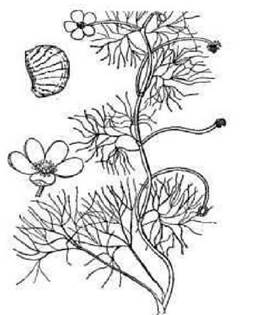
Fig. 108. Threadleaf water crowfoot

Fig. 109. Water crowfoot
Flowering shoots are more or less equal to the leaves, not exceeding them. Flowers are solitary. Petals 3.5-5.5 mm long, white with a yellow claw. Nectaries sickle-shaped. Carpels 25-30, densely bristly-hairy. Fruit is an aggregate achene consisting of 15-35 (40) loosely arranged, bristly-pubescent nutlets, 1.5 mm long, 1 mm wide. Blooms above the water surface in June-August. Floral formula: *K5C5A^G^. Seed reproduction predominates. Seeds are capable of germination after a short dormancy period in the year of formation (August-September). The plant is poisonous.
Grows in slowly flowing water bodies, lakes, bogs, and ditches at a depth of 40-200 cm. Found occasionally throughout Ukraine.
Carinate Water Crowfoot (Batrachium carinatum Schur.). A perennial herbaceous plant (Fig. 109). Stems glabrous, thickened, up to 50 cm long. Leaves sessile or nearly sessile, with 5- to 6-fold three-divided segments that lose turgor out of water. Inner segments shorter than lateral ones. Pedicel length twice exceeds leaf length. Flowers large, up to 1.8 cm in diameter. Floral formula: K5C5A9-13G∞. Blooms in May-August. Nutlets are asymmetric.
Grows in wet and waterlogged locations, marshes, along the banks of water bodies, and in boggy meadows throughout Ukraine, excluding Crimea.
Rion's water-crowfoot (Batrachium rionii (Lagger) Nym.). A perennial herbaceous plant, entomophile, hydrochore. Rhizome weakly developed, sometimes absent. Stems slender, branched, 15-60 cm tall. Homophyllous species. Leaves submerged in water, petiolate, blades semi-circular, 2-3 cm long, width exceeding length, twice to thrice ternate into wheel-shaped lobes that do not collapse out of water, middle lobe shorter than lateral ones.
Peduncles longer than leaves. Flowers small, petals white, 4.5 mm long. Nectaries crescent-shaped. Stamens 6-16, fruitlets numerous (5080), small, 1-1.2 mm long, almost glabrous. Flower formula - K5C5A10-12G∞. Fruit an aggregate of achenes. Blooms above the water surface in June-August. Propagates by seeds.
Grows in standing, sluggishly flowing, predominantly brackish water bodies that sometimes dry up In the second half of summer. In Ukraine, it is distributed in the eastern part of the Forest-Steppe and the Steppe.
Fennel-leaved water-crowfoot or circinate water-crowfoot (Batrachium foeniculaceum (Gilib.) V. Krecz., Ranunculus circinatum Sibth.) A perennial herbaceous plant, entomophile, hydrochore, ornithochore. Rhizome plagiotropic, slender. Stem glabrous, 20-100 (up to 200) cm tall with internodes 4-6 (10) cm long. Homophyllous species. Leaves submerged, sessile, rounded, 1.2.5 cm long, stem-clasping, with pubescent sheaths, thrice-dissected into somewhat rigid, spreading-branched, setaceous segments lying in a single plane, with lobes drooping out of the water. Leaves sit almost perpendicular to the stem.
Flowers rise above the water surface on pedicels that are many times longer than the leaves. Receptacle pubescent, cylindrical. Perianth double, pentamerous. Petals white, 6-10 mm long, with a crescent-shaped nectar pit. Stamens numerous (15-21). Nectaries falcate. Gynoecium complex, apocarpous. Flower formula - K5C5A9-13G∞.. Blooms above the water surface in June-August. Fruit an aggregate of achenes, formed from 2030 fruitlets (achenes), up to 2 mm long, 1.2 mm wide. Seed reproduction predominates.
The plant is poisonous. However, it is consumed by gastropod mollusks of the family Mieniidae.
Grows sporadically in bogs, rivers, and lakes throughout Ukraine.
Floating water-crowfoot (Batrachium fluitans (Lam.) Wimm.). A perennial herbaceous plant. Leaves 9-16 cm long, with lobes drooping out of the water. Receptacle glabrous or nearly glabrous. Blooms in June - August. Flower formula - K5C5A9-12G∞.
Grows in slow-flowing waters in the Carpathians. Food source for lepidopteran larvae.
Spreading water-crowfoot (Batrachium divaricatum (Schrank) Schur). A perennial herbaceous plant with slender, glabrous stems. Leaves 3-4 cm long, light green, petiolate, tri-ternate, with hairy lobes that partially lose turgor out of the water. All lobes are equal. Peduncles slightly exceed the leaves. Flowers up to 1 cm in diameter, stamens 9-13. Flower formula - *K5 C5A9_13Gœ. Blooms in June-September.
Grows sporadically in standing and slow-flowing waters throughout Ukraine.
Kauffmann's water-crowfoot (Batrachium kauffmannii (Clerc) V. Krecz.). A perennial herbaceous plant with glabrous and non-thickened stems. Leaves 7-10 cm long, petiolate, repeatedly up to four to five times ternate into hairy, delicate lobes that collapse extremely when taken out of the water. Peduncles equal to the leaves or slightly exceeding them. Flowers 1.2-1.5 cm in diameter with obovate petals. Stamens 10-12. Blooms in May-August. Flower formula - K5C5A9-12G∞.. Fruitlets obliquely elliptical.
Grows infrequently in slow-flowing waters throughout Ukraine.
The genus Buttercup (Ranunculus) is large and quite widespread in nature, numbering up to 600 species, of which about 40 are found in Ukraine (growing mainly in damp meadows, bogs, grassy slopes, in forests, along the banks of water bodies). Aquatic and terrestrial perennial, less often annual, herbaceous plants with palmatifid, less often pinnatifid or entire leaves and actinomorphic flowers with a double perianth, solitary or gathered into inflorescences. Sepals five, petals five, with a honey or amber pit at the base, mostly covered by a scale. Stamens and carpels usually numerous. Flower formula - *K5C5A∞G∞. Fruit an aggregate of achenes or follicles.
Almost all buttercup species contain the acrid, pungent, volatile camphor anemonin, making freshly gathered plants poisonous and dangerous to animals (during drying, the toxin is destroyed, and hay mixed with buttercups is harmless).
Multileaf buttercup (Ranunculus polyphyllus Waldst et Kit. ex Willd.). A perennial herbaceous aquatic or semi-aquatic plant, (30) 50-100 cm tall; entomophile, hydrochore, ornithochore. Heteroblastic species: forms exist with Two Types of leaves – floating cuneate or lanceolate and submerged filiform; or with filiform only, or cuneate only. Stem orthotropic, branched, 5-60 cm long. Lower filiform leaves (6 cm long) arranged in whorls or opposite. Upper, floating leaves with long petioles, alternate, blades ranging from entire to trilobed, elongated-cuneate in shape. Terrestrial form homoblastic, with shortened stems and trilobed leaves.
Flowers solitary or in few-flowered cymose inflorescences, small, actinomorphic, up to 5 mm in diameter. Perianth double, mostly trimerous, petals yellow. Pedicels elongated and arcuate-curved at fruit maturation. Fruit an aggregate of achenes, individual fruitlets nearly spherical, with a short straight beak. Achenes nearly spherical, smooth. Blooms in June-July. Propagates vegetatively and by seeds.
Grows in water bodies, bogs, along river banks, in and near water. In Ukraine, it is sporadically distributed in Transcarpathia, Polissia, the Forest-Steppe, and the Steppe.
Greater spearwort (Ranunculus flammula L.). A perennial plant, 10-40 cm tall; uliginosophyte, entomophile, barochore, hydrochore, ornithochore (Fig. 110). Rhizome slender, creeping. Stems ascending, prostrate, or creeping, with adventitious roots at the lower nodes. Leaves petiolate, narrowly to broadly lanceolate, distantly toothed, 2-6 cm long, 5-12 mm wide.
Flowers bisexual, solitary on pedicels up to 5 cm long or in few-flowered cymose inflorescences. Perianth double, pentamerous, petals yellow, 3-6 mm long. Fruit an aggregate of achenes. Blooms in June-July. Propagates vegetatively and by seeds.
Distributed in forest and forest-steppe regions in damp locations and bogs.
A medicinal plant (infusions are used externally in folk medicine), poisonous (causes Skin irritation and blisters on human hands or in the mouths of animals that graze on it), fed upon by leaf-mining flies.
Greater spearwort / Tongue-leaf buttercup (Ranunculus lingua L.). A perennial herbaceous plant, 50-100 cm tall; hemicryptophyte, uliginosophyte, helophyte, heliosciophyte, acidophile, mesotroph, halophobe, entomophile, hydrochore, zoochore (Fig. 111). Rhizome plagiotropic, club-shaped, up to 15-80 cm long; roots not thickened.
A plant with long subterranean shoots, appressed-pubescent. Stem erect, hollow, sparsely branched. Phyllotaxy alternate. All leaves sessile, lanceolate, acute, with sparse small teeth, entire-margined, 8-12 cm long and 1.0-1.5 cm wide. This is the largest plant among the buttercups of our flora. Flowers relatively large, 3-4 cm in diameter, bisexual, solitary or 2-3 at the shoot apices, hemicyclic. Perianth double, actinomorphic, pentamerous, androecium numerous, gynoecium complex, apocarpous. Petals bright yellow, broadly obovate, receptacle oval, glabrous. Fruit an aggregate achene, smooth, with a curved beak. Blooms in June-August. Propagates vegetatively and by seeds.
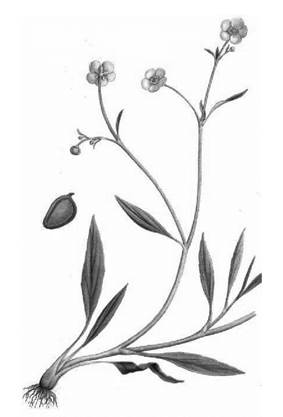
Fig. 110. Greater spearwort (Ranunculus lingua)
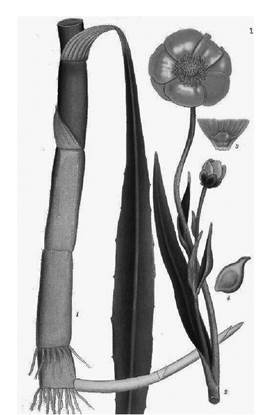
Fig. 111. Greater spearwort
It grows in shallow waters, marshy meadows, along the banks of rivers and lakes, and in bogs throughout Ukraine, except for Crimea.
An indicator of moderately overgrown, waterlogged reservoirs, sandy-peaty and silty deposits, and tall-herb vegetation areas with alluvial river sediments. Reduced moisture levels inhibit its development.
A promising ornamental, medicinal, and bank-protection plant. It serves as a food source for beavers.
Creeping buttercup (Ranunculus reptans L.). A perennial herbaceous plant, 10–30 cm tall (Fig. 112). Leaves are extremely narrow, almost thread-like, with entire margins. Stems are creeping, thread-like, branched, pubescent (rarely glabrous), and ROOT at the nodes. Leaves are linear or lanceolate, gradually tapering into a petiole. Flowers are pale yellow, small, 1 cm in diameter. It blooms from June to August.
It grows in damp meadows, bogs, and along the banks of water bodies, occasionally in Polissia.
Celery-leaved buttercup (Ranunculus sceleratus L.). An annual plant, 30–50 (80) cm tall; uliginosophyte, entomophile, hydrochore, ornithochore (Fig. 113). The Root System develops through the intensive growth of adventitious roots. Stems are orthotropic or ascending, hollow, glabrous, and branched. Leaves are slightly fleshy. Basal leaves form a rosette, ternately or palmately divided with incised lobes, on long petioles. Stem leaves are alternate, with petiole length gradually decreasing toward the apex of the shoot. Upper leaves are sessile, three-lobed, or entire.
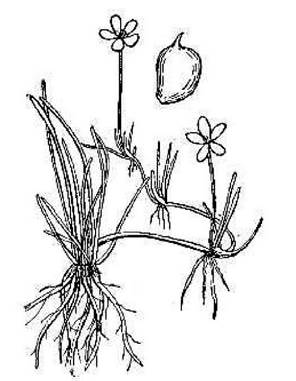
Fig. 112. Creeping spearwort

Fig. 113. Cursed buttercup
Flowers are small, 5–7 mm in diameter. Petals are light yellow, and the receptacle is convex. The fruit is an aggregate of 50–100 (150) achenes, each up to 1 mm long. It blooms from May to July. It propagates vegetatively and by seeds.
It grows along the banks and in shallows of freshwater, enclosed or slowly flowing water bodies, in bogs, and on waterlogged meadows across Ukraine, less commonly in the Steppe zone, and is absent in the Carpathian highlands.
Narrow-leaved meadow-rue (Thalictrum lucidum L.). A perennial herbaceous plant, 50–80 (150) cm tall with a short rhizome; hemicryptophyte. The stem is erect, glabrous, ridged-sulcate, and unbranched. Leaves are glossy and dark green on the upper surface, paler and slightly hairy underneath, bi- to tripinnate; leaflets are narrow, linear, sometimes oblong in lower leaves (but no wider than 0.8 mm), entire or divided into three lobes. Stipules are absent.
The inflorescence is a dense ovate or corymbose panicle. Flowers are bisexual, actinomorphic, and fragrant. The perianth is simple, consisting of four yellowish tepals. Stamens are numerous, erect, longer than the perianth, with blunt anthers 1 mm long. Pistils are numerous. Floral formula: *K4A^Ga,. It blooms in June and July. The fruit is an ovoid achene with 8–10 Ribs.
The plant is consumed by cyst-forming nematodes.
It grows in lowlands, damp and mineral-rich habitats, bogs, and waterlogged peat meadows in the Carpathians, Polissia, and the Forest-Steppe zone; rare in the Steppe.
Last update: 07/08/2026
Editorial and Educational Adaptation: This material has been compiled based on the primary/original source text. The project team performed an editorial review, corrected technical inaccuracies, structured sections, and adapted the content for an educational format.
What was processed:
- elimination of formatting defects (OCR errors, structural breaks, corrupted characters);
- editorial organization of content;
- standardization of terminology in accordance with academic sources;
- verification of factual statements against the original source text.
All mentions of the author, publication year, and origin of the primary text have been preserved in accordance with the source.