BOTANY WITH BASICS OF HYDROBOTANY (AQUATIC PLANTS OF UKRAINE) - B.Ye. Yakubenko - 2011
VIII. BASICS OF PLANT MORPHOLOGY AND ANATOMY
Features of Reproduction in Angiosperms
Flower Morphology and Anatomy
A flower is a modified, shortened, unbranched spore-bearing SHOOT adapted for The production of spores and Gametes, the execution of the sexual process, and The Development of fruit and seeds. The flower is The Organ of seed reproduction. It is characteristic of the highest-organized vascular plants — angiosperms. A fully developed flower consists of a pedicel, receptacle, perianth (calyx, corolla), stamens (androecium), and pistil (gynoecium) (Figs. 80, 81).
The pedicel is a thin stalk that Supports the flower. If the pedicel is absent, flowers are referred to as sessile (plantain, sunflower).
The receptacle, or torus, is the upper expanded part of the stem formed by meristematic tissue, from which develop
all floral elements. A flower arises on the main or lateral shoots emerging from the axil of a leaf called a covering leaf, or bract.
Modified covering leaves that arise on the pedicel are called bracteoles. Monocotyledons have one bracteole, dicotyledons have two, and some plants have more.
The perianth comprises the outer protective and attractive elements of the flower. When the perianth is differentiated into a calyx and corolla, it is called double, or complex; when formed only by petals or only by sepals, it is called simple, specifically corolla-like or calyx-like (tulip, stinging nettle, hemp, columbine, marsh marigold, larkspur).
Water/water.files/image082.jpg" width="299"/>
Fig. 81. Flower:
1 - bilabiate flower; 2-3 - ligulate flowers of Asteraceae; 4 - ligulate and tubular flowers of Asteraceae in an inflorescence; 5 - spurred flower; 6 - diagram of a cereal spikelet: at the bottom two glumes, нкл and вкл - lower and upper lemmas (paleas), л - lodicules, т - stamens, м - pistil; 7 - cereal flower: т - stamens, пр - stigma, л - lodicules, з - Ovary
The calyx forms the outer whorl that protects the inner PARTS OF THE flower. It is formed by sepals. In most plants, they are green and additionally perform the function of Photosynthesis. The calyx can be polysepalous (dialysepalous), formed by free sepals, or gamosepalous, formed by fused sepals. The fused part of the calyx forms the tube, and the free, unfused upper part forms the limb. In some plants, besides the single whorl of sepals, There is a second one that forms the epicalyx (strawberry, mallow).
The corolla consists of colored petals. They can be free or fused, forming polypetalous and sympetalous corollas, respectively. The fused part of the floral corolla is called the tube, and the upper free part is the limb. Fused-petal flowers are particularly characteristic of Caryophyllaceae. On the inner side of the corolla between the tube and the limb is the throat, which may bear appendages in the form of Teeth or scales. Together they form a corona. In some plants (such as carnation), the lower part of the petal is called the claw, and the upper
expanded part is the blade. Sympetalous corollas vary in shape: funnel-shaped (bindweed), rotate (potato), ligulate (sunflower), tubular (tansy), bilabiate (sage). In some plants, the petals form spur-like outgrowths in which nectar accumulates (larkspur, columbine). The corolla acts as a signal for insects that perform cross-pollination, thereby ensuring a more viable progeny.
Flowers can be regular, or actinomorphic (several planes of Symmetry can be passed through them — buttercup, pheasant's eye) and irregular, or zygomorphic (only one plane of symmetry can be passed — violet). If no plane of symmetry can be passed through a flower, it is called asymmetrical (canna, garden violet).
Stamens (microsporophylls) collectively form the androecium. A stamen consists of a filament, an anther, and a connective, which is the continuation of the filament within the anther. A flower may contain one, two, three, or many stamens. They form a free or fused androecium. Stamens can be fused by their filaments into a tube (pea, vetch, bean) or by their anthers (sunflower, potato). They are termed monadelphous when all are fused together, diadelphous when some stamens are fused and the rest are free, and polyadelphous when several groups of stamens remain unfused with each other. In some plants, stamens are fused in pairs (Cucurbitaceae) or in groups (Malvaceae).
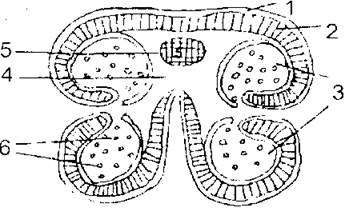
Fig. 82. Diagram of anther Structure: 1 - epidermis, 2 - fibrous layer, 3 - pollen sacs,
4 - connective parenchyma, 5 - vascular bundle, 6 - pollen
An important part of the stamen is the anther, where pollen is formed. A mature anther is tetrasporangiate, consisting of two bisporangiate halves (thecae) connected by a connective (Fig. 82). Each anther locule is a microsporangium. The anther is externally covered by a single-layered epidermis. Beneath it lies the fibrous layer, formed by dead mechanical Cells with fibrous thickenings. The fibrous layer facilitates the opening of the anther from the inner side. In some plants, an endothecium-like layer is noticeable. The bulk of the anther is occupied by pollen sacs filled with pollen. Pollen develops from mother Cells of the sporogenous tissue (archesporium). Between the anther locules lies the connective parenchyma, the central part of which is occupied by a vascular bundle.
The haploid pollen grain begins to germinate while still in the anther. Here it divides by mitosis to form two unequal naked cells: a larger vegetative Cell and a smaller generative cell. They are surrounded by two walls: an outer cutinized exine and a pectin inner intine. In this state, the pollen grain is transferred to the stigma of the pistil. The pistil occupies a central position in the flower and consists of carpels, the number of which can vary. All the carpels of the flower form the gynoecium. It can be apocarpous, when each pistil is formed by a single carpel (buttercup), and coenocarpous, if the pistil is formed by the fusion of several carpels (onion).
The pistil is differentiated into the ovary, style, and stigma. Inside the expanded ovary are mega-sporangia (ovules), from which seeds develop.
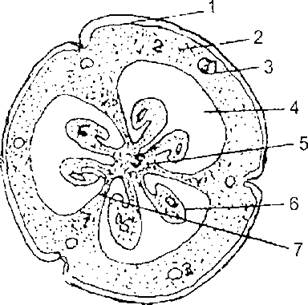
Fig. 83. Diagram of ovary structure: 1 - epidermis, 2 - parenchyma of ovary walls, 3 - vascular bundles, 4 - ovary locules,
5 - central Placenta, 6 - ovule, 7 - locule septum
Three types of Ovaries are distinguished: superior, inferior, and half-inferior. An ovary that is positioned above the insertion point of the floral elements and whose walls are not fused with the receptacle is called superior (wintercress). If the floral elements are located above the ovary, and the ovary itself is embedded in the receptacle and fused with its walls, it is called inferior (apple). In a half-inferior ovary, the floral elements or the receptacle are fused up to the middle of the ovary (elderberry).
A pistil lacking a discernible style is called sessile (poppy).
The stigma of the pistil can be entire, lobed, stellate, etc. It secretes growth stimulants and thereby promotes
pollen germination.
Ovules are located within the ovary. The site of their attachment to the ovary walls is called the placenta. Placentation is central or parietal (Fig. 83).
Last update: 07/08/2026
Editorial and Educational Adaptation: This material has been compiled based on the primary/original source text. The project team performed an editorial review, corrected technical inaccuracies, structured sections, and adapted the content for an educational format.
What was processed:
- elimination of formatting defects (OCR errors, structural breaks, corrupted characters);
- editorial organization of content;
- standardization of terminology in accordance with academic sources;
- verification of factual statements against the original source text.
All mentions of the author, publication year, and origin of the primary text have been preserved in accordance with the source.