BASICS OF PHYTOCENOLOGY AND PLANT GEOGRAPHY - T. P. Larkina - 2017
SECTION 1. BASICS OF PHYTOCENOLOGY
1.1. Phytocenosis as the subject of phytocenology. Main tasks of phytocenology
Plants in nature very rarely live in isolation. This occurs only when colonizing a new territory free from other plants: for example, on cooled volcanic lava, during the Initial Stages of desert irrigation, on sites cleared by forest fires, etc. Usually, under conditions of prolonged and stable existence, plants form communities consisting of A large number of species belonging to various taxonomic categories and life forms.
Any community may include various species of plants and other organisms, but in homogeneous plots under similar ecological conditions, similar complexes typically assemble. This gives communities a specific external appearance and distinctive structural features that make it relatively easy to distinguish one community from another. For example, a pine forest with an Abundance of bilberries differs noticeably from a pine forest where Lichens are strongly developed on the soil, or from a pine forest with green mosses and cowberries. It is very easy to notice the differences between coniferous and deciduous forests, and a meadow dominated by legumes differs from a feather-grass steppe meadow.
The Study of plant communities is the focus of a branch of botany known as phytocenology or geobotany. The term geobotany (phytocenology) was proposed in 1866 simultaneously and independently by the Russian botanist F. I. Ruprecht and the German botanist H. Grisebach. Geobotany is closely linked with plant ecology, especially its branch known as synecology. Synecology studies the ecology of plant communities governed by specific laws. The laws of synecology are widely applied in agricultural practice, for example, in selecting plant varieties that are most expedient to cultivate in a specific region with a particular manifestation of diverse ecological factors.
The entire plant kingdom is represented by a vast number of species (over 500 thousand) that grow in all climatic Zones of the globe in varying quantities and diverse combinations. The historically established aggregate of plant species growing in a given territory is called flora. One can study and analyze the flora of Russia, Australia, the Urals, etc.
The term vegetation or plant cover refers to the aggregate of plant communities growing in a specific territory. One can speak of the vegetation of bogs, steppes, forests, etc. Vegetation is formed under METABOLISM/18.html">The Influence of many ecological factors—climatic, historical, non-periodic, anthropogenic, etc. Vegetation makes it possible to divide the Earth's surface into various zones—for example: tropical, steppe, forest, etc.
The main object of study in geobotany is phytocenoses, or plant communities. A plant community, or phytocenosis, is generally understood as a stable system of plants coexisting in a certain area of the Earth's surface and creating, through themselves and their predecessors, their own phytocenotic environment (phytoclimate, metabolism, etc.). It is also permissible and logical to view a phytocenosis as a spatial contour within which, and in its various parts, the plant cover exhibits a certain similarity in floristic composition (the list of species inhabiting it), Structure, and interrelationships among cohabitants.
The most comprehensive definition of phytocenosis, adhered to by the majority of researchers, belongs to the prominent scientist Academician V. N. Sukachev: "A phytocenosis, or plant community, is an aggregate of plants growing together in a homogeneous territory, characterized by a specific composition, structure, constitution, and interrelationships of plants both with each other and with environmental conditions. The Nature of these interrelationships is determined, on the one hand, by the vital—otherwise ecological—Properties of the plants, and on the other hand, by The properties of the habitat, i.e., the character of the climate, soil, and the influence of humans and animals."
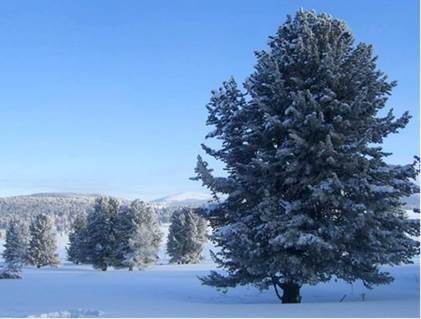
Can any combination of plants be considered a phytocenosis? If plants interact with each other and exert a noticeable influence on one another—for example, shading each other or aggressively claiming open soil patches—such proximity can be regarded as a phytocenosis. However, one or two trees or shrubs in an open clearing will not significantly alter the nature of a meadow phytocenosis nor create a forest phytocenosis component around themselves (Fig. 1).
Class="center">Figure 1. Solitary Siberian pine trees (Pinus sibirica) in a meadow
A phytocenosis represents an interacting complex of organisms involved in complex and diverse interrelationships. All possible types of biotic ties are broadly represented here: from mutually beneficial ones (e.g., Symbiosis) to mutually harmful ones (competition). Living together, the members of the community adapt to the influence of their neighbors, and this adaptation manifests in A number of traits: Anatomical and morphological structure, physiology, phenology, productivity, etc.
In the Cytology/cytology/16.html">Early stages of its establishment as a science, the main task of phytocenology was considered to be the study of natural plant communities. Modern phytocenology, in an age of rapid growth in industrial production, agriculture, and population, has a broader application. It deals with: 1) the investigation of natural phytocenoses and artificially created ones (agrophytocenoses); 2) the Study of the floristic composition and all Main parameters of phytocenoses; 3) the study of biotic ties in phytocenoses and agrophytocenoses; 4) issues of phytoindication of plant lands; 5) the study of succession and dynamics of phytocenoses under the Influence of Environmental factors; 6) the study of the Classification OF PHYTOCENOSES and vegetation types; 7) the elucidation of Ways to improve, rationally distribute, and utilize vegetation. It is fair to divide phytocenology into general and special. General phytocenosis, serving as a foundational science, studies the GENERAL PATTERNS OF plant cover formation. Special phytocenology aims to solve theoretical and practical problems of plant cultivation, forestry, meadow management, bog management, indicative geobotany, and other crucial branches of applied botany and agricultural production.
Last update: 07/08/2026
Editorial and Educational Adaptation: This material has been compiled based on the primary/original source text. The project team performed an editorial review, corrected technical inaccuracies, structured sections, and adapted the content for an educational format.
What was processed:
- elimination of formatting defects (OCR errors, structural breaks, corrupted characters);
- editorial organization of content;
- standardization of terminology in accordance with academic sources;
- verification of factual statements against the original source text.
All mentions of the author, publication year, and origin of the primary text have been preserved in accordance with the source.