Plant Physiology - Musienko M. M. 2001
Photosynthesis: Physiological, Biochemical, and Ecological Aspects
Photorespiration
Photorespiration is Respiration that occurs in the light, taking place simultaneously with Photosynthesis under steady-state conditions.
The divergence point of these processes lies at the level of RuBP carboxylase-oxygenase (Fig. 71). Under natural conditions, the dual function of RUBISCO results in one oxygenation event for every 2–3 carboxylation events. Oxygenase activity is an intrinsic property of all RUBISCO Enzymes, regardless of the plant's taxonomic position, and is also present in cyanellae and other phototrophic Bacteria. Oxygenation depends on the concentrations of CO2 and O2 at the carboxylation site.
The oxygenase reaction does not result in CO2 fixation; instead, it splits RuBP into PGA and phosphoglycolic acid. Phosphoglycolate is subsequently dephosphorylated and converted into glycolate, which is transported from the chloroplast to another organelle, the peroxisome. There, it reacts with oxygen and is oxidized to glyoxylate and H2O2. Hydrogen peroxide is immediately broken down into H2O and O2, while glyoxylate is converted into The amino acid Glycine.
Class="center">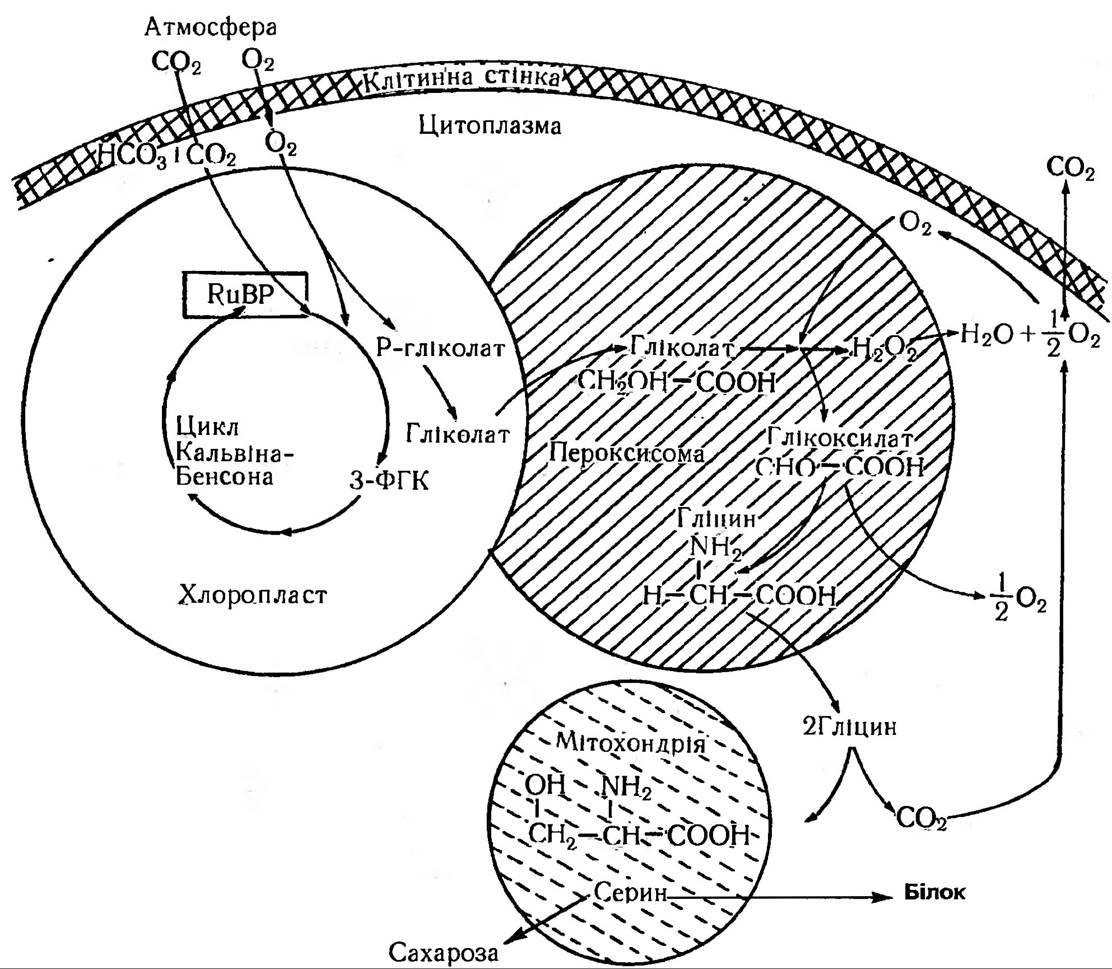
Fig. 71. Photorespiration
Next, in the Cell/35.html">Mitochondria, glycine is converted into Serine (which can be utilized for Protein Synthesis, among other Functions). Notably, this reaction consumes 2 molecules of glycine to produce one molecule of serine, releasing CO2 in the process. As a result, a portion of the carbon dioxide previously fixed in The Calvin Cycle is permanently lost without being used by the plant.
Thus, glycolate serves as the substrate for photorespiration. The specific Structural components of the glycolate pathway of photorespiration are localized within Peroxisomes. These Organelles are bounded by a single membrane enclosing a granular matrix. In addition to catalase, peroxisomes contain enzymes such as glycolate oxidase, hydroxypyruvate reductase, and serine-glyoxylate aminotransferase. Glycolate formation can proceed via two pathways:
·via The oxidation of the intermediate product formed from RuBP + CO2;
·via the oxidation of sugar monophosphates of the Calvin cycle.
Oxygen uptake during photorespiration can occur under the following conditions:
·during The formation of glycolate in METABOLISM/14.html">Chloroplasts;
·during the oxidation of glycolate to glyoxylate in leaf peroxisomes;
·in The process of serine formation from glycine in mitochondria.
Carbon dioxide emission during photorespiration is observed:
·during the decarboxylation of glycine in mitochondria;
·during The oxidative decarboxylation of glycolate in chloroplasts;
·in peroxisomes.
The fraction of released СO2 can reach 40-60% of photosynthetic СO2 fixation.
The question regarding The Role of photorespiration remains quite debatable; it may dissipate excess energy generated during the light-dependent stage and protect the plant from photodestruction under conditions of limited СO2 availability (such as drought or high temperatures). Photorespiration helps prevent the cessation of non-Cyclic electron transport due to a lack of electron acceptors, ensures the continuity of non-cyclic Photophosphorylation, and thus regulates the ATP to NADPH ratio. It is also possible that the glycolate pathway for the synthesis of Amino Acids such as glycine and serine plays a significant role in their metabolism. Presumably, the removal of glycolic acid during photorespiration is of great physiological importance because this process al-
so eliminates harmful oxygen radicals that accompany these processes. Some scientists believe that photorespiration offers no advantages to the plant in our current era.
This process does not occur with the same intensity in all plants. In C3 plants, it causes significant losses in the overall carbon balance, whereas in C4 plants, the released СО2 is refixed via an additional pathway operating in the leaf mesophyll Cells. The ability to regulate photorespiration holds great promise, as it could potentially double the yields of certain crops. However, the assumption that the photosynthetic productivity of crops can be drastically increased by inhibiting photorespiration using biochemical or Introduction/32.html">Genetic Engineering Methods has not yet been confirmed. It should be noted that in some plants (such as soybean), inhibiting photorespiration causes detrimental effects.
Last update: 07/08/2026
Editorial and Educational Adaptation: This material has been compiled based on the primary/original source text. The project team performed an editorial review, corrected technical inaccuracies, structured sections, and adapted the content for an educational format.
What was processed:
- elimination of formatting defects (OCR errors, structural breaks, corrupted characters);
- editorial organization of content;
- standardization of terminology in accordance with academic sources;
- verification of factual statements against the original source text.
All mentions of the author, publication year, and origin of the primary text have been preserved in accordance with the source.