Plant Physiology - Musienko M.M. 2001
Adaptation and plant resistance mechanisms
Stress physiology
H. Selye introduced METABOLISM/2.html">THE CONCEPT OF «stress» as the sum of all non-specific changes occurring in an animal Organism under The Influence of various factors (stressors), which involve the restructuring of the organism's defense reactions. P.O. Henkel (1983) was the first to coin the term phytostress to define a plant organism's reaction to unfavorable environmental conditions. Specifically, several Phases of the stress response are distinguished during phytostress. If The impact of the stressor does not reach threshold values, processes that foster organismal resistance may occur (the adaptation phase). After the cessation of the negative factor, the restoration of bodily Functions is possible (the restitution or recovery phase). Within lethal limits, the stress impact leads to organismal damage and death. The entire sequence of stress responses boils down to one goal: maintaining the Homeostasis of the plant organism under stressful conditions. This is ensured by a complex and not yet fully understood system of adaptation mechanisms aimed at mitigating the damaging effect of the stressor on the plant (Shmatko, 1992):
Class="center">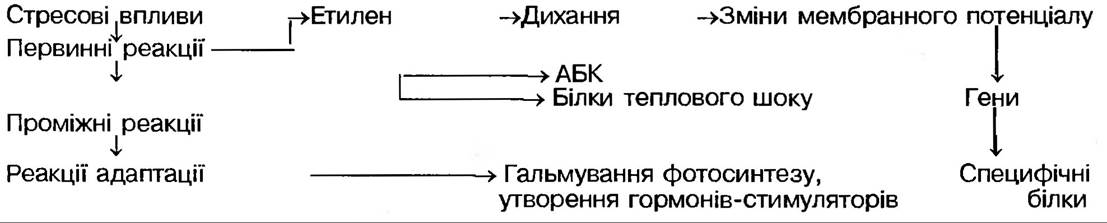
Primary stress responses include the activation of Respiration processes and the accumulation of Ethylene in Cells. Intermediate and rather short-term reactions comprise ABA synthesis and Changes in the functional state of Chromatin. Particularly important are the processes occurring at the transcriptional level (alteration of chromatin template activity, RNA polymerases, transport and Translation activation of messenger RNAs) and post-transcriptional level (formation of Polysomes, and changes in their Structural and functional state). Recently, significant attention has been paid to studies of genome expression, Protein Synthesis, the formation and Biological Role of stress granules, The Nature of enzymatic changes in Organelles and the Cytosol, and intracellular interactions between macromolecule Synthesis and degradation under stress conditions. All phenomena of the adaptation syndrome vary considerably in duration—ranging from seconds to many days.
According to V.V. Kuznetsov (1992), plants with pronounced constitutive resistance (resistant plants) are damaged at a higher stressor intensity compared to plants characterized by a strongly expressed inducible resistance (susceptible plants). In particular, this is typical of the plant's response to high and low temperatures, salinity, and heavy metal exposure. Below are the Components of the adaptive response in resistant and susceptible plants to adverse impacts:
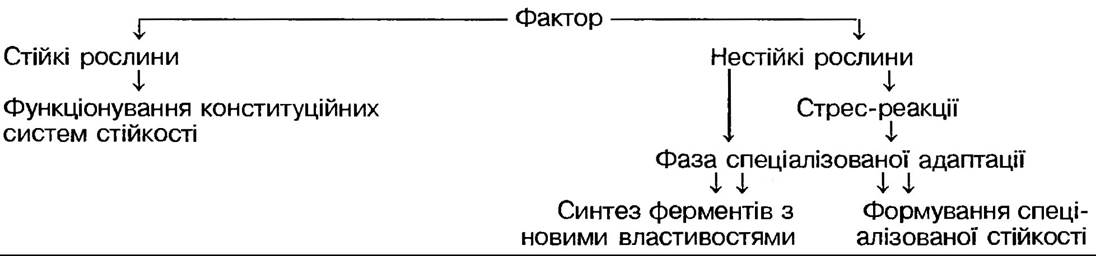
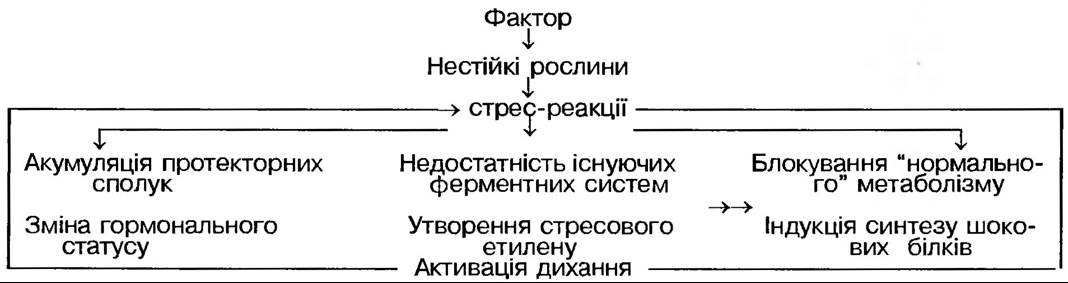
As can be seen, the stress response differs between plant groups with varying degrees of resistance. The response of susceptible plants is rapid and characterized by intensive changes in genome expression, mobilization and accumulation of protective compounds, the «blocking» of normal metabolism, Alterations in hormonal status, and the de novo formation of previously absent resistance systems:
In addition to cellular resistance mechanisms, a resistance regulation system also functions at the organismal level, playing a leading role during prolonged exposure to unfavorable factors. While stress responses are temporary and transient in nature, specialized resistance mechanisms are formed under prolonged action of the stressor.
All diverse factors capable of triggering stress responses in plant organisms are divided into physical (moisture deficit or excess, low and high temperatures, varying illumination, radioactive radiation), chemical (salts, gases, xenobiotics — herbicides, insecticides, fungicides), and biological (pathogens, pests, competition with other plants, etc.).
A conventional distinction is made between general (or non-specific) and specific resistance. The concept of non-specific resistance unites evolutionarily distinct types of organisms based on the nature of their reaction to a stress factor, whereas the concept of specific resistance is characteristic only of a certain species of organism and manifests itself under the influence of a clearly defined factor. These concepts often interchange as our understanding of the mechanisms underlying the studied processes evolves.
Last update: 07/08/2026
Editorial and Educational Adaptation: This material has been compiled based on the primary/original source text. The project team performed an editorial review, corrected technical inaccuracies, structured sections, and adapted the content for an educational format.
What was processed:
- elimination of formatting defects (OCR errors, structural breaks, corrupted characters);
- editorial organization of content;
- standardization of terminology in accordance with academic sources;
- verification of factual statements against the original source text.
All mentions of the author, publication year, and origin of the primary text have been preserved in accordance with the source.