MODERN BOTANY - P. RAVEN - 1990
SECTION IV. DIVERSITY
CHAPTER 14. UNICELLULAR PROTISTS: WATER MOLDS, SLIME MOLDS, CHYTRIDIOMYCETES, AND UNICELLULAR ALGAE
The oldest fossil eukaryotes are approximately 1.5 billion years old (Fig. 14-1); by that time, Bacteria had already existed for more than 2 billion years. For hundreds of millions of years, all eukaryotes were unicellular. The age of the first known multicellular eukaryotes is roughly 630 million years, although earlier origins of Multicellular Organisms are suggested by worm-like burrow cavities dating back about 700 million years. For at least 800 million years of eukaryotic existence on Earth, all of them likely belonged to The Kingdom Protista.
Class="center">Fig. 14-1. These three very distinct specimens of acritarchs coexisted approximately 700 million years ago in the region of the modern Grand Canyon in Arizona. Acritarchs, whose oldest remains are about 1.5 billion years old, were the first and, for hundreds of millions of years, the only eukaryotes. This highly diverse group probably comprised planktonic autotrophic organisms. Apparently, some of their later forms are related to green Algae.

A number of evolutionary lineages of multicellular organisms trace their origins back to Unicellular Eukaryotes, with multicellular representatives found in almost every protist phylum. Four of these fully or partially multicellular groups are photosynthetic. Among them, plants—which evolved from multicellular green algae—are so distinct that they are classified into a separate kingdom, described in Chapters 16, 17, and 18. The other three groups—green, brown, and red algae—although not directly related to one another, constitute phyla within the kingdom Protista and are discussed in Chapter 15. Chapter 14 is dedicated to the seven major phyla of unicellular protists formerly classified as plants or Fungi: Water Molds, slime molds, chytridiomycetes, and unicellular algae.
Protist groups traditionally classified as Protozoans (amoebas, Ciliates, etc.) are not covered in this book, as they are not typically studied by botanists.
Of the seven protist phyla discussed in this chapter, four comprise heterotrophic organisms and are traditionally studied by mycologists (specialists in fungi). Although many scientists now present evidence that these heterotrophs are not directly related to true fungi, they continue to be described using mycological terminology. For example, like certain fungi, these organisms are called "molds," their filaments are referred to as hyphae, and a mass of hyphae as a mycelium.
The other three phyla, like those described in the following chapter, consist mainly of photosynthetic organisms and are studied by phycologists (specialists in algae).
It is important to note that there is very little evidence of a direct phylogenetic relationship among any of the ten phyla of the kingdom Protista presented in this book. They are best viewed as separate eukaryotic evolutionary lineages. Their grouping into a single kingdom is based solely on their eukaryotic cellular Structure and the absence of specific features characteristic of plants, animals, or fungi.
Ecology of Unicellular Protists
In any body of water, one can find suspended microscopic photosynthetic Cells and tiny animals that together make up the plankton (from the Greek word for "wanderer"). Planktonic algae and cyanobacteria, collectively known as phytoplankton, form the Base of the food chain for most heterotrophic organisms inhabiting the depths of oceans or large freshwater bodies. Phytoplankton typically consist of unicellular forms—some very simple in structure, others intricately and elaborately shaped, occasionally forming colonies or filaments (Fig. 14-2). The smallest members of the plankton, nanoplankton, are so tiny that they usually pass right through standard plankton net meshes of 40 to 76 µm. These include algae and cyanobacteria, which also make a vital contribution to marine and freshwater productivity.
Fig. 14-2. Phytoplankton, showing dinoflagellates and filamentous or unicellular diatoms.
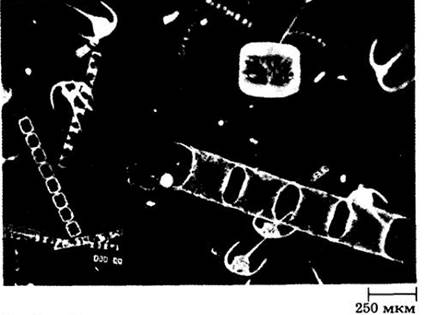
Heterotrophic plankton (zooplankton) consists mainly of tiny crustaceans, larvae of various animal groups, heterotrophic protists, and bacteria. In marine environments, small and even some large fish, as well as baleen whales, feed on phyto- and zooplankton. Thus, phytoplankton—sometimes referred to as the "vast pastures of the sea"—is directly analogous to terrestrial grasslands that sustain land-dwelling heterotrophs.
Of the four heterotrophic phyla discussed in this chapter, two comprise predominantly aquatic organisms: Oomycota (oomycetes, i.e., water molds and related organisms) and Chytridiomycota (chytridiomycetes). The other two phyla—Acrasiomycota (cellular slime molds) and Myxomycota (plasmodial slime molds)—are primarily terrestrial organisms. Water molds and chytridiomycetes produce motile spores; these protists are parasites or saprobes that absorb organic matter produced by other organisms. Slime molds, by contrast, actively engulf bacteria or small organic particles. Of all the organisms described in this book, they bear the strongest resemblance to animals.
Last update: 07/08/2026
Editorial and Educational Adaptation: This material has been compiled based on the primary/original source text. The project team performed an editorial review, corrected technical inaccuracies, structured sections, and adapted the content for an educational format.
What was processed:
- elimination of formatting defects (OCR errors, structural breaks, corrupted characters);
- editorial organization of content;
- standardization of terminology in accordance with academic sources;
- verification of factual statements against the original source text.
All mentions of the author, publication year, and origin of the primary text have been preserved in accordance with the source.