MODERN BOTANY - P. RAVEN - 1990
SECTION IV. DIVERSITY
CHAPTER 14. UNICELLULAR PROTISTS: WATER MOLDS, SLIME MOLDS, CHYTRIDIOMYCETES, AND UNICELLULAR ALGAE
Symbiosis and the Origin of Chloroplasts
In all oxygen-evolving photosynthetic organisms (cyanobacteria, Algae, and plants), this process involves chlorophyll a, which is located within METABOLISM/14.html">Chloroplasts (except in cyanobacteria, which lack them). The similarity of all chloroplasts implies a common origin, although various autotrophic groups differ so markedly in other respects that they clearly could not have evolved from a single photosynthetic ancestor. The uniformity of chloroplast biochemistry and Structure is attributed to the specific ways in which these Organelles originated.
Based on the Structural and Biochemical affinities between certain groups of Bacteria and chloroplasts (Chapter 2), the overwhelming majority of scientists believe that modern chloroplasts are the result of a series of independent evolutionary events involving various groups of photosynthetic bacteria.
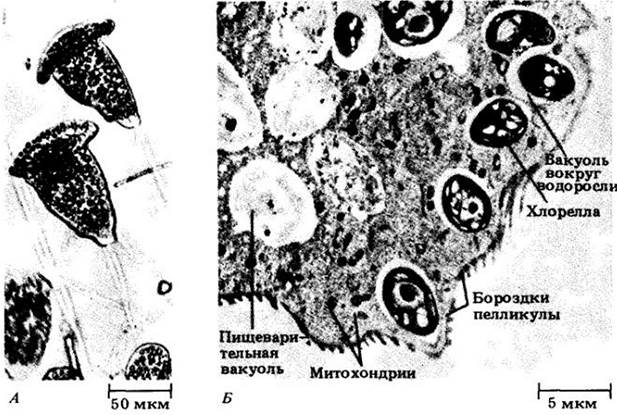
The ease and frequency with which such symbioses arise can be traced through the wide variety of similar relationships that exist today, for example, between algae and invertebrates, Fungi (mainly in lichens), other algae, vertebrates, bryophytes, and certain vascular plants (where algae grow within the cavities of stems, petioles, and leaves). Among invertebrates, about 150 genera from eight different phyla are known to have algae as intracellular symbionts (Fig. 14-3). The productivity of coral reefs depends largely on symbiotic dinoflagellates (photosynthetic protists). Other symbiotic associations are of no less ecological significance.
Class="center">Fig. 14-3. Symbiosis in algae, exemplified by the unicellular green alga Chlorella (for a more detailed Discussion, see Chapter 15). A. Each bell-shaped Cell of the protozoan Vorticella contains numerous Cells of a symbiotic alga. B. An electron micrograph of Vorticella containing Chlorella cells. Each algal cell is enclosed in a separate vacuole bounded by a single membrane. The protozoan protects the alga, which may synthesize CARBOHYDRATES utilized as food by the host cell.
Photosynthetic protists were traditionally considered to be closely related; only recently has it become clear that autotrophy was acquired quite independently by their various groups. Thus, all autotrophic eukaryotes distinct from plants were previously grouped together as "algae," filamentous heterotrophs as "fungi," and heterotrophs with a different structure as "Protozoa." However, species within these groups do not necessarily share a common ancestry; for example, some algae are closer to protozoa than to other algae, and vice versa.
Specifically, among the euglenoids (see further in this chapter), which comprise about 40 genera of aquatic unicellular organisms characterized, among other features, by a flexible, protein-rich envelope called a pellicle, about a third of the genera possess chloroplasts and are therefore sometimes considered "algae" or even plants. In all other respects, however, they are virtually identical to flagellates (phylum Zoomastigina), a very large and diverse group of protozoa. These chloroplasts are biochemically similar to those found in green algae, which differ from euglenoids in almost all other characteristics. This similarity may indicate that the ancestors of green algae and euglenoids independently entered into a symbiosis with bacteria (perhaps related to Prochloron). Thus, despite the resemblance of their chloroplasts, these organisms must be assigned to distantly related, distinct divisions of The Kingdom Protista.
An alternative hypothesis, which does not alter our understanding of the evolutionary relationships of euglenoids, suggests that they acquired green algal chloroplasts by entirely engulfing green algal cells. Subsequently, all structures of the symbiotic green algae were gradually lost, except for the chloroplasts and The Plasma Membrane. This hypothesis could explain why the chloroplasts of euglenoids are bounded by three membranes rather than two, as in green algae, even though these organelles are strikingly similar in other respects.
Last update: 07/08/2026
Editorial and Educational Adaptation: This material has been compiled based on the primary/original source text. The project team performed an editorial review, corrected technical inaccuracies, structured sections, and adapted the content for an educational format.
What was processed:
- elimination of formatting defects (OCR errors, structural breaks, corrupted characters);
- editorial organization of content;
- standardization of terminology in accordance with academic sources;
- verification of factual statements against the original source text.
All mentions of the author, publication year, and origin of the primary text have been preserved in accordance with the source.