MEDICAL BOTANY - A.G. Serbin - 2003
CHAPTER 2. MORPHOLOGY. REPRODUCTION
Morphology, or structural botany, studies the external forms and structures of PLANTS AND THEIR Organs, taking into account their evolutionary development and ecology. The primary task of morphology is to name and describe structures. An organ is a part of an Organism that has a specific Structure and performs definite Functions. In higher plants, we distinguish vegetative organs, which ensure life-support functions and vegetative renewal (ROOT and leaf-stem SHOOT), and Generative organs, which ensure sexual reproduction and plant propagation (strobilus, flower).
The general patterns common to all organs include polarity, Symmetry, polymerization, oligomerization, metamorphosis, and reduction. Polarity is manifested in the differences between the opposite poles of an organism, organ, or Cell. Symmetry refers to the arrangement of constituent parts relative to an axis of symmetry that divides the whole into two mirror-image parts. Radial symmetry (where multiple axes of symmetry can be drawn) and bilateral symmetry (where a single axis of symmetry can be drawn) are distinguished. Longitudinal symmetry, or metamerism, is the repetition along the organ axis of a series of elements that make up that organ (for example, an internode and a node of a shoot). Asymmetrical organs and parts do not allow a single axis of symmetry to be drawn. Polymerization is the increase, and oligomerization is the decrease in the number of identical organs or their parts during the course of evolution. Metamorphosis represents heritable structural modifications of organs or their parts. Reduction is the underdevelopment of an organ or its parts As a result of the loss of their primary functions.
MORPHOLOGY OF VEGETATIVE ORGANS
Vegetative organs—the leaf-stem shoot and the root—developed in higher plants during evolutionary progress as an adaptation to air-soil Nutrition. Axial vegetative organs include the stem and the root, as well as their metamorphoses (rhizome, tuber, root crop, root tuber, etc.), whereas the leaf serves as a lateral vegetative organ.
ROOT (RADIX)
The root, as an underground organ, originated in clubmosses, horsetails, and ferns. It is typically an orthotropic, radially symmetrical axial organ. The root performs the following functions: absorbs Water and mineral nutrients from the soil; anchors plants in the soil; stores nutrient reserves; synthesizes certain Organic compounds; ensures vegetative renewal in the presence of adventitious buds; and connects the plant with other soil organisms. The root differs from the stem in that it lacks leaves, nodes, and internodes; does not possess intercalary growth; and its apical growth cone—the root apex—is protected by a root cap.
Based on their origin and functions, primary (tap) roots, lateral roots, and adventitious roots are distinguished. The primary root develops from the embryonic radicle of the seed and exhibits positive geotropism. Typically, first-order lateral roots develop from its pericycle, followed by second-order lateral roots, and so on. Adventitious roots form on the stem, leaves, and their metamorphoses.
The entire set of a plant's roots constitutes its root system (Fig. 2.1, 1–3). Primary and lateral roots form a taproot system. It predominates in dicotyledonous and gymnosperm plants. However, if the primary root is underdeveloped or withers away early—which is characteristic of monocotyledonous plants—then adventitious roots form a fibrous root system. In some herbaceous dicots, all types of roots are sufficiently well developed, meaning The Root System is mixed.
Class="center">Fig. 2.1. Types of Root systems, root types, and their metamorphoses: 1–3 — root systems: taproot, fibrous, mixed; 4–6 — root crops (thickened roots and stem-roots) of sugar beet (4), fodder beet (5), and common beet (6); 7 — root tubers, or root cones; 8 — pneumatophores (respiratory roots); 9 — aerial roots of an epiphyte; 10 — aquatic roots; 11 — haustoria (parasitic absorbing roots); 12 — roots with nodule Bacteria; a — primary (tap) root; b — lateral roots; c — adventitious roots (fibers); d — HEAD; e — neck (crown)
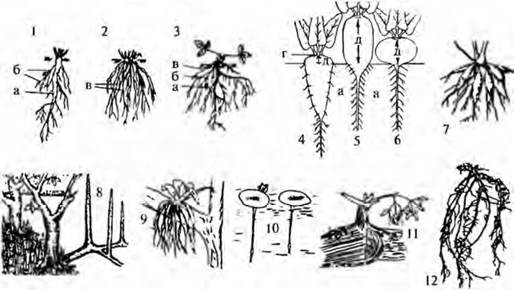
Roots are morphologically diverse and capable of modification depending on the performance of specific functions, transformations under the Influence of External factors, etc. (Fig. 2.1). Root metamorphoses that perform a storage function include root crops, stem-root crops, and root tubers.
Root crops and stem-root crops typically form in biennial plants and comprise three constituent parts of different origin and shape: the head, the neck, and the root proper. The head is a shortened stem bearing a basal rosette of leaves and leaf buds. Below the head lies the neck, which is the hypocotyl (subcotyledonary zone). The root proper forms the lower part of the root crop. In various plants, each of these constituent parts is modified, shortened, or thickened to a varying degree and assumes a specific shape. This depends on which part most intensively develops the storage tissue where nutrients are reserved (Fig. 2.1, 4–6).
Root tubers, or root cones, are thickened adventitious or lateral roots (Fig. 2.1, 7). Adventitious roots that remain in the air for some or a long time are called aerial roots. Plants growing in waterlogged, oxygen-depleted soils develop respiratory roots. Plants inhabiting ocean coasts within tidal zones develop stilt roots. To protect overwintering plant parts from drastic Temperature fluctuations, contractile roots pull them down into the soil. Higher parasitic and semi-parasitic plants are characterized by haustoria—absorbing roots or attachments that develop within the Tissues of the host plant. The Symbiosis of roots with Fungi that ensure nutrient absorption results in The formation of mycorrhiza, or fungus-root. Clusters of nitrogen-fixing bacteria on the roots of higher plants form nodules (Fig. 2.1, 12). They convert free nitrogen into soluble compounds, enriching the soil with nitrogen. The roots of many plants (valerian, marshmallow, ginseng, rhubarb, chicory, elecampane, sugar beet, kok-saghyz, tau-saghyz, etc.) are used for food, feed, and as raw Materials for the pharmaceutical, biotechnological, and other industries.
Last update: 07/08/2026
Editorial and Educational Adaptation: This material has been compiled based on the primary/original source text. The project team performed an editorial review, corrected technical inaccuracies, structured sections, and adapted the content for an educational format.
What was processed:
- elimination of formatting defects (OCR errors, structural breaks, corrupted characters);
- editorial organization of content;
- standardization of terminology in accordance with academic sources;
- verification of factual statements against the original source text.
All mentions of the author, publication year, and origin of the primary text have been preserved in accordance with the source.