BIOLOGY Volume 2 - A Guide to General Biology - 2004
15. HEALTH AND DISEASE
15.2. The Epidemiology of Diseases
When studying the Epidemiology of diseases—their distribution across different geographical regions and population groups—a striking contrast emerges between developed and developing countries. Fig. 15.1 compares mortality rates from various diseases among populations in industrialized nations and the Third World. In developing countries, the leading causes of death are infections and parasitic infestations, whereas in developed nations, cardiovascular diseases and Cancer predominate. For instance, measles still claims the lives of many children in developing countries (Table 15.1), although its incidence is declining rapidly thanks to the Introduction of vaccination programs (Section 15.2.1). Measles is a far more serious illness than most people realize. Beyond fever and a characteristic rash, the measles virus can cause Pneumonia, blindness, deafness, and encephalitis (inflammation of the Brain) (Table 15.3). Not so long ago, measles mortality was also high in developed countries (Fig. 15.2): in 1930, it caused 4,188 deaths in England and Wales, whereas by 1980, this number had dropped to just 26.
Class="center">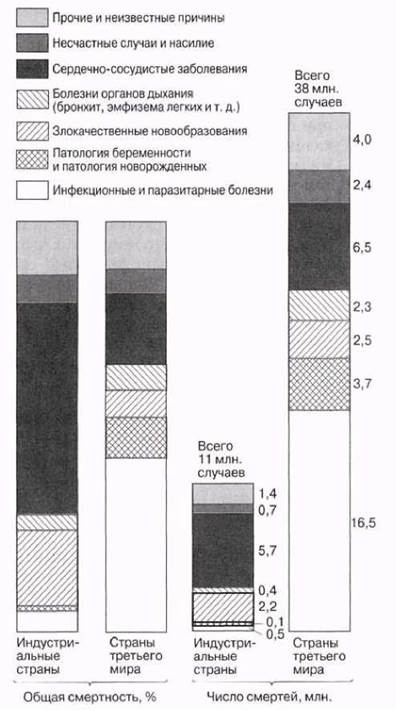
Fig. 15.1. Major causes of mortality in developed and developing countries in 1985. The left panel shows the percentage breakdown, and the right panel shows absolute numbers in millions. (From Lopez, A.D., 1993, Causes of death in the industrialized and the developing countries: estimates for 1985; in: Jamison, D.T., Mosley, H. (eds) Disease Control Priorities in Developing Countries, OUP.)
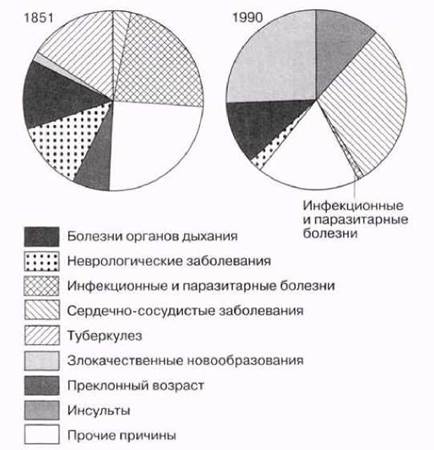
Fig. 15.2. Causes of mortality in England and Wales in 1851 and 1990 (data for 1851 from Registrar-General, 1855, England and Wales Report; data for 1990 from Registrar-General, 1992, Annual Abstract of Statistics 1992, HMSO, London, Table 2.20, p. 37.)
Table 15.1. Mortality from certain infectious diseases
Disease |
Estimated annual global deaths |
Respiratory infections (pneumonia, Bronchitis, Influenza, diphtheria, etc.) |
10 000 000 |
Diarrheal diseases (primarily cholera) |
4 300 000 |
Measles |
2 000 000 |
Malaria |
1 500 000 |
Tetanus |
1 200 000 |
Tuberculosis |
900 000 |
Hepatitis B |
800 000 |
Whooping cough (Pertussis) |
600 000 |
Typhoid fever |
600 000 |
Schistosomiasis (causative agent — parasitic flatworm) |
250 000 |
HIV infection |
200 000 |
How can these trends and the persistent, sharp divide between developed and developing countries be explained? At first glance, it is logical to attribute this to advances in medical care, yet Fig. 14.42 shows that measles mortality in England and Wales began to decline rapidly long before active Prevention measures were introduced. Measles vaccination was not implemented there until 1968. The same holds true for several other infections, such as whooping cough and tuberculosis, which claimed numerous lives at the beginning of the 20th century. The answer lies in the fact that social and economic factors play just as crucial a role in combating disease as medical care itself.
Certain severe infections, such as cholera, typhoid fever, and dysentery, are transmitted through fecal contamination of food and Water. In England and Wales, the incidence of these diseases dropped sharply following the passage of the 1875 Public Health Act, which regulated sanitation standards for sewage disposal and Treatment, as well as the purification of drinking water. Improving the quality of life is vital for the prevention of all infectious diseases, as it enhances the body's resistance to pathogens. Adequate Nutrition and sound living conditions play a particularly significant role. For instance, tuberculosis has declined because this respiratory infection spreads primarily among people living in overcrowded conditions (such as several individuals sharing a single room) and suffering from poor nutrition. Measles is especially dangerous in developing countries because it predominantly affects young children (often before the age of one, when vaccination is typically administered) whose immune systems are compromised. A child weakened by malnutrition, other infections, or parasites suffers a much more severe course of illness than a child growing up in favorable conditions.
Thus, infectious diseases have become rare in the UK and other developed countries largely due to improvements in healthcare, housing, and public nutrition. However, The Role of medicine proper—that is, advancements in preventive Methods (such as widespread immunization) and treatments (such as the advent of Antibiotics, discussed further below)—should not be underestimated. We are dealing with a complex interplay of socio-economic and medical factors, the relative importance of which depends on specific circumstances.
With the expansion of vaccination into developing countries, the incidence of infectious diseases there has also declined. The World Health Organization (WHO) (Sections 15.2.1 and Fig. 15.3) identifies six major target infections for prevention: measles, tetanus, pertussis (whooping cough), poliomyelitis, tuberculosis, and diphtheria.
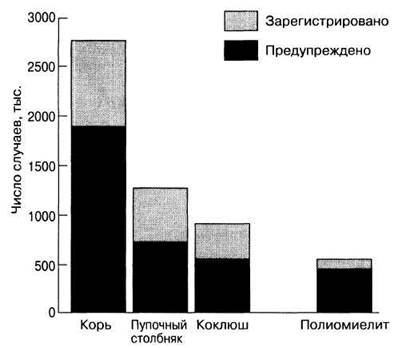
Fig. 15.3. Mortality from measles, neonatal tetanus, and pertussis, alongside the incidence of poliomyelitis (reported cases and those prevented by vaccination) in developing countries in 1990. (Work of WHO, Biennial Report 1992-3 (1994), WHO, Geneva.)
The virtual elimination of infectious disease mortality in developed countries has shifted other pathologies to the forefront of mortality statistics (Figs. 15.1 and 15.2). Chief among these are cardiovascular diseases (Section 15.5) and cancer (Section 7.9.5). These can be regarded as modern epidemics, against which society has not yet learned to fight effectively. In many cases, these conditions are "self-induced" by human behavior. However, certain serious illnesses in developed countries are actually a consequence of the benefits of civilization—specifically, increased Life expectancy and the associated rise in age-related pathologies. Cancer, for example, is much more prevalent among older adults.
Fig. 15.2 compares the causes of mortality in England and Wales in 1851 and 1990. The diagrams clearly illustrate the shifts associated with the dramatic decline in infectious diseases.
15.2.1. Vaccination
The Role of Vaccination
More than 10 million people worldwide die from infectious diseases every year. One of the most powerful weapons against them is vaccination, the advent of which stands as a major milestone in medical history. The principle behind vaccination is that a healthy individual is administered Antigens of a disease-causing Organism (via injection or orally, i.e., by swallowing) so that The Immune System "learns" to produce Antibodies against it. As a result, the Immune Response upon actual exposure is so rapid that the pathogens are destroyed before they can trigger symptoms.
For vaccination to succeed on a strategic level, it must cover as large a portion of Selection/30.html">The population as possible and continue until the target disease is virtually eradicated. In the UK, compulsory vaccination is unnecessary because health education ensures that the vast majority of citizens are vaccinated voluntarily. This prevents epidemics from spreading. Local outbreaks of infectious diseases can be contained when necessary through "ring vaccination"—that is, vaccinating everyone in contact with infected individuals and residents of the surrounding area. However, it is vital to remain vigilant. For example, after many parents in Britain stopped having their children vaccinated against whooping cough due to safety concerns, the incidence of the disease began to rise steadily.
It is also important to bear in mind that infectious diseases recognize no borders; consequently, combating infections requires coordinated international policies alongside national programs. Implementing these is one of the primary missions of the WHO.
The Eradication of Smallpox
The greatest triumph of vaccination has been the complete eradication of smallpox (variola). Until the late 1960s, annual cases of the disease across 33 different countries reached approximately 15 million. The WHO launched a campaign against this infection in 1956, and the last naturally occurring case was registered in Somalia in 1977. Since then, smallpox has been practically eliminated. Stocks of the virus are still maintained in specialized laboratories in the USA and Russia, though many scientists believe that all remaining virus cultures should be destroyed.
The factors that contributed to the successful eradication of smallpox include the following.
Vaccination
1. The surface antigens of the smallpox virus remained stable, meaning that the vaccine remained highly effective over many years. This is different from diseases like influenza and malaria, whose causative agents mutate frequently, altering their surface antigens. This allows them to evade the immune system, even when antibodies have already been produced following a previous infection or vaccination.
2. A thermostable vaccine was developed specifically for use in tropical and subtropical regions.
3. The vaccine's administration method was simple—via minor scratches on the arm—which made it easy to rapidly mobilize A large number of medical personnel for vaccination campaigns.
Epidemiological Surveillance
1. Infected individuals were easily identifiable.
2. Rewards were offered to those who reported new cases of the disease.
Anti-Epidemic Measures
1. Mass "ring vaccination" implemented in the areas surrounding an outbreak.
2. Mandatory isolation of infected individuals.
3. Tracing and identification of all contacts of infected persons.
4. Travel restrictions imposed on unvaccinated individuals.
All of these efforts required active international cooperation and substantial financial investment.
Vaccination Programmes
In some countries, vaccination is compulsory, whereas in the UK it is voluntary. Parents are encouraged to have their children vaccinated to protect them against various diseases (Table 15.2). Vaccination programmes have been particularly successful against poliomyelitis and diphtheria (Fig. 14.42), which have been virtually eradicated in developed countries. For example, between 1986 and 1991, only 13 cases of diphtheria and no deaths were recorded in the UK.
Table 15.2. Routine childhood immunisation schedule in the UK (Department of Health, Immunisation against Infectious Diseases, 1992 HMSO)
2 months |
3 months |
4 months |
1 year |
4 years |
10—13 years |
14 years |
14—15 years |
|
Diphtheria |
+ |
+ |
+ |
- |
+ |
- |
- |
- |
Tetanus |
+ |
+ |
+ |
- |
+ |
- |
- |
+ |
Polio |
+ |
+ |
+ |
- |
+ |
- |
- |
+ |
Pertussis (Whooping cough) |
+ |
+ |
+ |
- |
- |
- |
- |
- |
Measles |
- |
- |
- |
+1 |
- |
- |
- |
- |
Mumps |
- |
- |
- |
+1 |
- |
- |
- |
- |
Rubella Haemophilus influenzae b (bacterium causing respiratory infections) |
- |
- |
- |
+1 |
- |
+2 |
- |
- |
+4 |
+4 |
+4 |
+4 |
- |
- |
- |
- |
|
BCG (tuberculosis) |
- |
- |
- |
- |
- |
- |
+3 |
|
1 — Combined measles, mumps and rubella (MMR) vaccine, previously given at 2 years of age. 2 — Girls only. 3 — Tuberculin-negative, susceptible children only. 4 — Plus one dose between 13 months and 4 years of age. |
||||||||
By 1984, WHO programmes targeting six major infectious diseases (measles, pertussis, tetanus, poliomyelitis, tuberculosis, and diphtheria) had successfully immunized approximately 50% of children worldwide, and by the mid-1990s, this coverage had increased to 80%. According to some estimates, vaccination saved over 1 million lives between 1974 and 1984. However, despite these successes, by 1990 these infections were still responsible for about 3 million deaths annually, with roughly 4.6 million children remaining unvaccinated. Measles continued to claim 1.4 million lives per year (one death every 20 seconds), pertussis 490,000, and tuberculosis 450,000. Annual expenditure for WHO-coordinated programmes is approximately 1.5 billion US dollars (one-third of which is provided to countries as grant aid).
The WHO Expanded Programme on Immunization aims to ensure that by the year 2000, more than 90% of newborns globally are vaccinated against a range of bacterial and viral infections. Hepatitis B has been added to the target list, and the eradication of poliomyelitis is planned for the coming years.
Several critical Vaccines still need to be developed, such as those against malaria, dengue fever, sleeping sickness, helminth infections (parasitic worms), HIV, leprosy, and others. Furthermore, currently available preparations need to be replaced by more effective and safer alternatives. For example, the cholera vaccine offers only about 50% protection, and the resulting Immunity is relatively short-lived (see Section 15.3.1). The efficacy of the influenza vaccine also needs improvement.
Types of Vaccines
Different types of vaccines are discussed in Section 14.9.5. The debate over the relative merits and drawbacks of live versus killed vaccines has continued for many years. While live vaccines are undoubtedly more effective, their administration carries a higher risk. The widespread use of a specific vaccine—and consequently its epidemiological success—depends on numerous factors, including cost, safety, healthcare infrastructure, and public health awareness.
Vaccines can be produced and administered in various ways. For instance, in the UK, Three types of typhoid vaccines have been approved, containing, respectively:
1) whole killed Cells (no longer in use);
2) polysaccharide Histology/2.html">EXTRACT FROM THE capsule of the typhoid bacterium (Salmonella typhi);
3) a live attenuated strain of this bacterium.
The second type of vaccine was developed most recently (in 1992), requires the fewest doses, and is currently considered the preferred option.
While vaccine safety is the primary concern in developed countries, cost and the feasibility of immunizing the maximum population are likely more critical in the developing world.
Genetically engineered vaccines have been developed relatively recently. Many pathogenic microorganisms cannot be cultivated outside their natural host, making Traditional Methods of preparing antigenic formulations inapplicable. For example, the CAUSATIVE AGENT OF Syphilis, the spirochete Treponema pallidum, and the bacterium responsible for leprosy, Mycobacterium leprae, do not replicate in vitro (outside The Human Body); consequently, large quantities of live or killed vaccines cannot be produced from these microorganisms. An alternative approach is based on Recombinant DNA technology. Genes encoding the antigens required for vaccination are transferred from these pathogens into easily cultivated hosts (such as the bacterium E. coli, Yeast, or mammalian cells), which then serve as "factories" for producing the desired antigenic protein. This exact strategy was used to produce the hepatitis B vaccine. The Gene for the surface antigen of the hepatitis B virus was successfully identified, cloned, and expressed by inserting it into foreign DNA. However, the situation is not always this straightforward for all antigens.
Vaccine Safety and Efficacy
Debates concerning the safety and efficacy of vaccination periodically arise in society. By 1986, 160 million doses of the live attenuated measles vaccine had been administered in the UK, providing excellent population-level protection. In 5–15% of children, a fever develops on the fifth day post-vaccination, and one in a million vaccinees develops a Central Nervous system disorder (encephalitis). When such side effects become public knowledge, they can trigger significant public anxiety and resistance to vaccination. In reality, however, the probability of contracting encephalitis as a result of the measles vaccine is lower than the baseline risk of developing it from unknown causes. The whole-Cell pertussis vaccine also occasionally causes neurological complications, manifesting as convulsions (1 in 100,000 doses) or brain damage (1 in 300,000 doses). Measles and diphtheria vaccines may cause local inflammatory reactions and laryngitis. Nonetheless, unvaccinated children still die from these diseases; therefore, when deciding whether or not to vaccinate a child, parents must weigh all available information and recognize that they assume responsibility for the child's well-being.
Last update: 06/08/2026
Editorial and Educational Adaptation: This material has been compiled based on the primary/original source text. The project team performed an editorial review, corrected technical inaccuracies, structured sections, and adapted the content for an educational format.
What was processed:
- elimination of formatting defects (OCR errors, structural breaks, corrupted characters);
- editorial organization of content;
- standardization of terminology in accordance with academic sources;
- verification of factual statements against the original source text.
All mentions of the author, publication year, and origin of the primary text have been preserved in accordance with the source.