BIOLOGY Volume 1 - A Guide to General Biology - 2004
2. THE DIVERSITY OF LIFE ON EARTH
2.8. Kingdom Animalia (animals)
2.8.2. Phylum Cnidaria
The Classification and key CHARACTERISTICS OF THE phylum Cnidaria are summarized in Table 2.13. Cnidarians include jellyfish, sea anemones, and corals.
Class="center">Table 2.13. Classification and key characteristics of the phylum Cnidaria
Phylum Cnidaria |
||
Key characteristics |
||
Diploblastic animals; the body wall consists of two Cell layers: an outer ectoderm and an inner endoderm; these layers are separated by the mesoglea, an acellular gelatinous layer which may contain Cells that have migrated from other layers* Tissue level of Organization achieved Radial body Symmetry The body is sac-like with a single opening, the 'Mouth', which serves for both ingestion of food and egestion of undigested waste. The single cavity within the sac is called the gastric cavity (or coelenteron). Digestion takes place entirely within this cavity Two distinct body forms are characteristic: polyps and medusae. Polyps are sessile (non-motile); they can be solitary, such as Hydra, or colonial, such as Obelia. Medusae are free-swimming, solitary forms* Polymorphism is observed: individuals may vary in form and perform different Functions—a form of division of labour |
||
Class Hydrozoa (hydroids) |
Class Scyphozoa (jellyfish) |
Class Anthozoa (corals and sea anemones) |
Polyps dominate The life cycle |
The larval stage is sometimes represented by a small polyp |
Polyps only — more complex than in Hydrozoa |
Simple medusa |
A large, highly organized medusa dominates the life cycle |
Medusa absent |
Polyps solitary or colonial |
Polyps solitary (sea anemones, some corals) or colonial (most corals) |
|
Nematoblasts (stinging cells) |
Nematoblasts |
Nematoblasts |
|
Hydra (medusa stage absent) Obelia |
EXAMPLES: Aurelia (jellyfish) |
EXAMPLES: Actinia (sea anemone) Madrepora (coral) |
* Diagnostic feature. |
||
Diploblastic animals
The basic body plan is relatively simple. The body is formed from two cell layers: an outer ectoderm and an inner endoderm. This is known as a diploblastic level of organization. The ectodermal cells are in contact with the external environment, while the endodermal cells face inward, lining the gut or gastric cavity. This cavity communicates with the outside via a single opening (the 'mouth'). Feeding is aided by tentacles surrounding the mouth, which sweep food particles into the body cavity. Both ingestion of food and egestion of undigested waste take place through this single opening. The cells show a degree of specialization, allowing us to speak of a rudimentary tissue level of organization. In the ectoderm of the tentacles, for example, there are groups of stinging cells called nematoblasts. These cells are capable of discharging Three types of threads: some that pierce the prey, others that entangle it, and a third type that paralyzes or kills it. The ectoderm also contains sensory cells connected to Nerve Cells; the latter form a nerve net located in the mesoglea. Cells containing contractile, Muscle-like fibres provide for the movement of the body and tentacles, as well as the locomotion of free-swimming medusae. The endoderm contains cells specialized for digesting food and absorbing nutrients.
Radial symmetry
Cnidarian bodies exhibit radial symmetry. In other words, if a cnidarian's body is cut along any diameter, the resulting two halves are identical. Radial symmetry is generally associated with organisms incapable of locomotion (see also Section 2.8.8). Most animals possess bilateral symmetry (associated with an active, mobile lifestyle), which results not only in an elongated, streamlined body shape, but also in a higher degree of specialization among its various parts.
Polyps, medusae, and polymorphism
Cnidarians are characterized by two main body forms — the polyp and the medusa (Fig. 2.47). The polyp has a cylindrical shape and leads a sessile lifestyle. These organisms remain attached to a surface, such as a rock, throughout their lives. Their ability to move is very limited or completely absent. The medusa is a free-swimming, umbrella-shaped animal. In the Life Cycle of certain cnidarians, there is an Morphology/12.html">ALTERNATION OF GENERATIONS, in which medusae serve to disperse the species (see below). In this case, polyps reproduce asexually by budding off medusae, while medusae reproduce sexually to produce larvae, which develop into polyps. Individual polyps within a single colony may vary in form. For example, some may be specialized for capturing food, while others are specialized for asexual reproduction (see below). The occurrence of individuals existing in two or more different forms within a single species is called polymorphism.

Fig. 2.47. General body plan of cnidarians.
Size
Cnidarians are relatively small animals. The few large jellyfish consist mainly of mesoglea, in The formation of which living cells do not participate. Nutrients can rapidly diffuse only across the two thin layers — the endoderm and ectoderm. Furthermore, all cnidarian cells are in direct contact with the surrounding Water, which allows for very efficient gas exchange via diffusion. The surface area-to-volume ratio in these animals is high.
Fig. 2.48 shows various cnidarians; Obelia, Aurelia, and Actinia all inhabit marine environments. The life cycle of Obelia clearly illustrates polymorphism, featuring an alternation between a colonial polyp generation and a generation of small medusae. They are commonly found in shallow water, attached to rocks, shells, seaweed fronds, etc. The sea anemone (Actinia) is typically found near the coast of Britain, especially in sheltered locations such as rock pools and crevices.

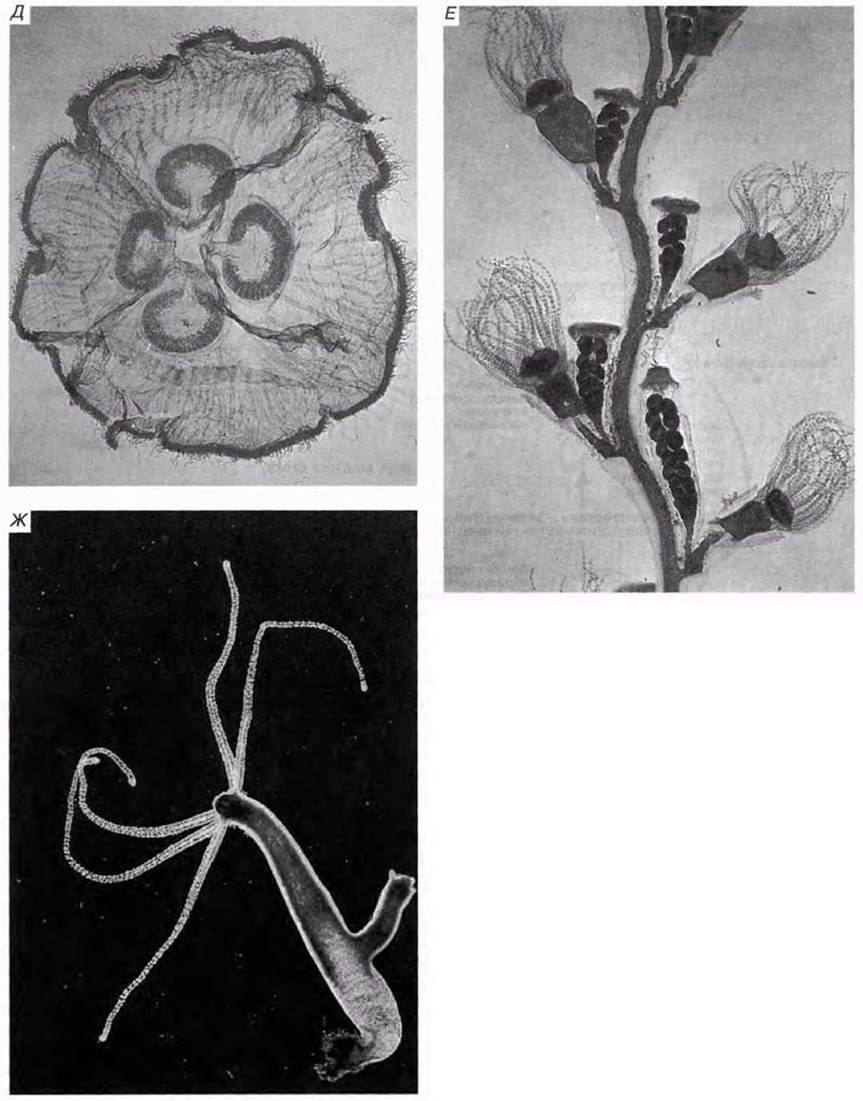
Fig. 2.48. Diversity of cnidarians. A. Hydra (Hydra), a solitary freshwater cnidarian. B. Obelia (Obelia), a marine colonial cnidarian with Two Types of polyps and a medusa stage. C. Aurelia (Aurelia), a medusa. D. Actinia (Actinia), a sea anemone. E. Aurelia (Aurelia), a medusa. F. Obelia colony. G. Hydra (Hydra).
Last update: 06/08/2026
Editorial and Educational Adaptation: This material has been compiled based on the primary/original source text. The project team performed an editorial review, corrected technical inaccuracies, structured sections, and adapted the content for an educational format.
What was processed:
- elimination of formatting defects (OCR errors, structural breaks, corrupted characters);
- editorial organization of content;
- standardization of terminology in accordance with academic sources;
- verification of factual statements against the original source text.
All mentions of the author, publication year, and origin of the primary text have been preserved in accordance with the source.