BIOLOGY Volume 1 - A Guide to General Biology - 2004
2. DIVERSITY OF LIFE ON EARTH
2.7. Kingdom Plantae
Although life on our planet likely originated about 3.5 billion years ago, the first organisms did not colonize land until at least 420 million years ago. These were the earliest plants. Plants are autotrophic eukaryotes that have adapted to life in a terrestrial environment. The only other autotrophs among eukaryotes are Algae, which specialized for Life in Water. As a reminder: autotrophs are organisms that use inorganic carbon, specifically carbon dioxide, as a source for synthesizing organic substances. However, In addition to a carbon source, such synthesis also requires energy (Section 2.3.4), and plants, being photoautotrophs, use light as their energy source. This mode of Nutrition is more commonly known as Photosynthesis.
The evolutionary history of plants is a story of gradually perfecting Adaptations to life on land. This very history will be one of the main themes in our study of plants. The Classification of the plants discussed in this book is shown in Fig. 2.33. It also provides a Brief Overview of some major trends in plant evolution associated with terrestrial adaptation, which will also be examined in this section.
Class="center">
Fig. 2.33. Plant Taxonomy and some major trends in plant evolution.
2.7.1. Phylum Bryophyta (liverworts and mosses)
Liverworts and mosses are the most primitive of all land plants. They are believed to have evolved from green algae. The phylum Bryophyta comprises two main classes—Hepaticae (liverworts) and Musci (mosses). Both groups are poorly adapted to terrestrial life and are therefore restricted to damp, shaded habitats. The classification and KEY FEATURES OF bryophytes are summarized in Table 2.8.
Table 2.8. Taxonomy and Features of the phylum Bryophyta (bryophytes)
Phylum Bryophyta |
|
General features Morphology/12.html">ALTERNATION OF GENERATIONS, with the gametophyte generation being dominant Lack of vascular tissue; i.e., neither xylem nor phloem is present Plant body is a thallus or slightly differentiated into simple "leaves" and "stems" True roots, stems, and leaves are absent; the gametophyte is anchored to the substrate by thread-like rhizoids The sporophyte is attached to the gametophyte, entirely dependent on it, and nourished by it Spores are produced in the sporophyte within a spore capsule located at the tip of a slender seta, elevated above the gametophyte Found primarily in damp, shaded locations |
|
Class Hepaticae (liverworts) |
Class Musci (mosses) |
Gametophyte is a simplified Structure, varying in form from thalloid (rarely) to "leafy" with a stem (in most species); transitional lobed forms also occur |
Gametophyte is "leafy" and possesses a "stem" |
"Leaves" (in leafy liverworts) are arranged along the stem in three rows |
"Leaves" are arranged spirally |
Rhizoids are unicellular |
Rhizoids are multicellular |
For spore dispersal, the sporophyte capsule splits into four Valves; spore dispersal is aided by elaters |
Spore dispersal from the sporophyte capsule occurs via a complex weather-dependent mechanism involving peristome Teeth and pores |
|
Pellia — a thalloid liverwort, Marchantia — a thalloid liverwort; antheridia and archegonia are borne on specialized stalked receptacles elevated above the thallus Lophocolea — a leafy liverwort; commonly found on decaying wood |
EXAMPLES: Funaria Mnium — a common woodland moss, similar in appearance to Funaria Sphagnum — a bog moss; forms layers of peat in damp, acidic environments (bogs) |
Bryophyta are small plants of simple structure. Their supportive and conducting Tissues are poorly developed or entirely absent. They lack differentiated xylem and phloem, as well as true roots. They are anchored in the soil by delicate filaments called rhizoids. Water and mineral salts are absorbed across the entire surface of the body, including the rhizoids. This means that, unlike true roots, rhizoids serve solely to anchor the plant in the substrate. (True roots, as well as true stems and leaves, contain Vascular Tissues.) Bryophytes lack a cuticular covering, or the cuticle is so thin that it does not prevent water loss (or uptake). Nevertheless, many bryophytes have adapted to withstand dry periods through mechanisms that are not yet fully understood. For example, it has been found that the well-known xerophytic moss Grimmia pulvinata can remain alive for over a year at 20 °C in a completely desiccated state. All Functions are restored immediately upon exposure to moisture.
Alternation of generations
Like all land plants and some of the most highly evolved algae, such as kelp, bryophytes exhibit an alternation of generations. Their life cycle involves the alternation of two distinct types of organisms: a haploid gametophyte generation and a diploid sporophyte generation succeed each other in turn, as shown schematically in Fig. 2.34. The haploid generation is called the gametophyte (from the Greek gametē — wife, gametēs — husband; phytón — plant) because it is capable of sexual reproduction and produces Gametes. Since gamete formation occurs via mitosis, they are also haploid. Upon fusion, gametes form a diploid zygote, which develops into the next generation—the diploid sporophytes. They are termed sporophytes because they are capable of asexual reproduction resulting in The production of spores. Spores are formed via Meiosis, which marks the return to the haploid state. Haploid spores give rise to the gametophyte generation. One of these two generations always predominates over the other, accounting for the greater part of The life cycle; this generation is termed dominant. In bryophytes, the gametophyte generation is dominant; in all other land plants, the sporophyte generation is dominant. By convention, the dominant generation is placed in the upper half of life cycle diagrams.
Study Fig. 2.34 carefully, as it provides a generalized Summary of the Life Cycle of all land plants, including the most highly developed flowering plants. Never forget that plant gametes are produced by mitosis, unlike in animals where they are formed by meiosis; meiotic division occurs during spore formation.

Fig. 2.34. Generalized plant life cycle illustrating the alternation of generations. Note the presence of haploid (n) and diploid (2n) stages. The gametophyte is always haploid and always produces gametes by mitotic division. The sporophyte is always diploid and always produces spores through meiotic division.
Class Hepaticae - liverworts
The Characteristic Features of the class Hepaticae are presented in Table 2.8. Structurally, liverworts are much simpler than mosses and are generally more restricted to damp, shaded habitats. They can be found along the banks of rivers and streams, on damp rocks, and among wetland vegetation. Most liverworts display regular lobes or well-defined "stems" with small, simple "leaflets." The simplest are the thalloid liverworts, whose body is a flat thallus not differentiated into stems and leaves.
An example is Pellia, a liverwort widely distributed throughout Great Britain. This plant is dull green in color, with flat "branches" measuring about 1 cm in width. The external features of Pellia are shown in Fig. 2.35.

Fig. 2.35. External features of Pellia (a liverwort). The gametophyte is shown with the attached, dependent sporophyte.
Class Musci - mosses
The Main Features of mosses are listed in Table 2.8. Mosses are much more differentiated than liverworts, but like liverworts, they are small plants found primarily in damp locations. They frequently form dense cushions.
Funaria is a common representative of mosses found in fields, cleared areas, and disturbed soils, where it is often among the first colonizers. Funaria is particularly fond of establishing itself on ash and burn sites. It is one of the most common weeds in greenhouses and gardens. The appearance of Funaria is shown in Fig. 2.36.
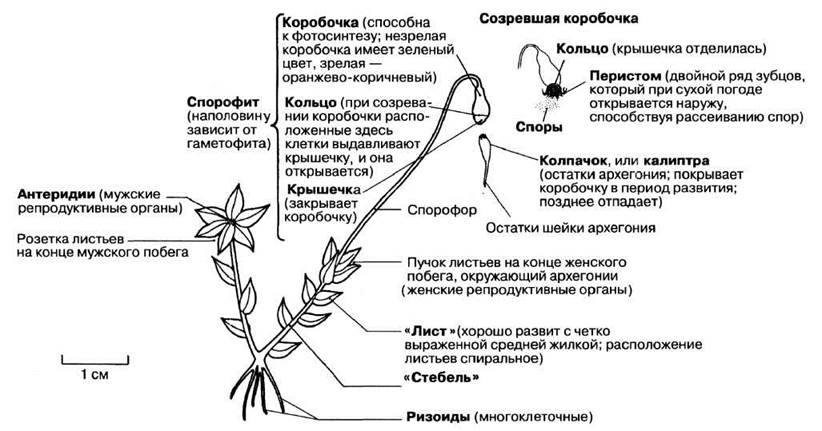
Fig. 2.36. External features of the moss Funaria. The gametophyte is shown with a semi-independent sporophyte attached to it.
Like liverworts, Funaria requires water for Fertilization. When The surface of the thallus becomes moist, mature antheridia absorb water and rupture, releasing male gametes (spermatozoids) onto the surface. Each spermatozoid is equipped with two flagella. The spermatozoids swim toward the archegonia, each of which contains a female gamete, or egg Cell. Fertilization—that is, the fusion of the sperm Nucleus with the egg nucleus—takes place within the archegonium. As a result of this fusion, a diploid zygote is formed, which grows out of the archegonium to give rise to a new sporophyte.
Last update: 06/08/2026
Editorial and Educational Adaptation: This material has been compiled based on the primary/original source text. The project team performed an editorial review, corrected technical inaccuracies, structured sections, and adapted the content for an educational format.
What was processed:
- elimination of formatting defects (OCR errors, structural breaks, corrupted characters);
- editorial organization of content;
- standardization of terminology in accordance with academic sources;
- verification of factual statements against the original source text.
All mentions of the author, publication year, and origin of the primary text have been preserved in accordance with the source.