BIOLOGY Volume 2 - A Guide to General Biology - 2004
19. HOMEOSTASIS
19.5. Endothermic Animals
19.5.6. Adaptations to Cold Climates
Dormancy
All ectotherms and many endotherms are unable to maintain a body Temperature during the cold season that would allow them to sustain normal activity, and instead enter a state of dormancy at low temperatures. Some truly remarkable adaptations to cold environments are known to exist. For instance, the larvae of hymenopterans of the genus Bracon, which parasitize the wheat stem sawfly, can survive temperatures below -40 °C. This ability is due to the accumulation of glycerol in the larval hemolymph, which acts as an antifreeze, preventing The formation of ice crystals that would otherwise damage Cell membranes.
Heat Exchangers
In many animals, excessive heat loss through exposed body parts is prevented by the arrangement of Blood Vessels operating on THE PRINCIPLE OF countercurrent heat exchangers. Arteries carrying blood to these extremities are surrounded by Veins returning blood to the core of the body. As a result, warmer arterial blood transfers some of its heat to the venous blood, while the cooler venous blood flowing back from the extremities is warmed by the incoming arterial blood. Because the blood entering the extremities is already pre-cooled, heat loss to the environment is significantly reduced. Such systems operate, for example, in the flukes of whales, the flippers of seals, the limbs of birds and mammals, as well as in mammalian Testes (Fig. 19.18).
The principle of countercurrent exchange is utilized by animals not only for Heat transfer, but also for the exchange of various substances, such as respiratory gases in fish gills and ions in the Loop of Henle (see sections 9.4.5 and 20.5.6, respectively).
Class="center">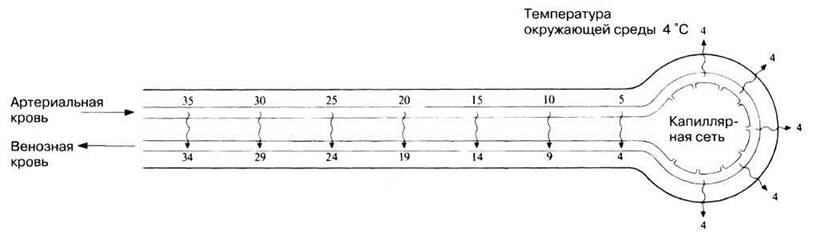
Fig. 19.18. Diagram of Blood Circulation between the trunk of an endothermic animal with a constant body temperature of 35 °C and its limb, such as a leg, at an ambient temperature of 4 °C. Heat is always transferred from a warmer body to a cooler one at a rate proportional to the temperature difference between them. In the countercurrent heat exchange example shown in the figure, blood enters the capillary network at 5 °C and leaves it at 4 °C. Consequently, heat loss to the environment corresponds to a temperature difference of just 1 °C. Similarly, the blood returning to the body's interior will also be 1 °C cooler than the blood leaving the core. This mechanism prevents massive heat loss and helps maintain a constant body temperature of 35 °C.
Hypothermia
Hypothermia refers to a drop in the core body temperature of endothermic animals below 32 °C. Induced hypothermia is widely used in cardiac surgery because it allows Heart operations to be performed without the risk of causing Brain damage to the patient. When body temperature is lowered to 15 °C, the metabolic demands of brain Cells drop to such an extent that Blood supply to the brain can be safely interrupted for up to 1 hour without any adverse consequences. For longer cardiac Procedures, heart-lung machines are used in conjunction with hypothermia.
Last update: 06/08/2026
Editorial and Educational Adaptation: This material has been compiled based on the primary/original source text. The project team performed an editorial review, corrected technical inaccuracies, structured sections, and adapted the content for an educational format.
What was processed:
- elimination of formatting defects (OCR errors, structural breaks, corrupted characters);
- editorial organization of content;
- standardization of terminology in accordance with academic sources;
- verification of factual statements against the original source text.
All mentions of the author, publication year, and origin of the primary text have been preserved in accordance with the source.