BIOLOGY Volume 1 - A Guide to General Biology - 2004
2. DIVERSITY OF LIFE ON EARTH
2.7. The Plant Kingdom
2.7.2. Phylum Filicinophyta (ferns)
The Main Features of Filicinophyta are listed in Table 2.9. Ferns are typically found only in shady, damp habitats. Few species can grow in open areas, although the common bracken (Pteridium) is an exception. Ferns are particularly abundant in tropical rainforests, where Temperature, light levels, and humidity are most favorable for them.
Class="center">Table 2.9. General characteristics of the phylum Filicinophyta (ferns)
Phylum Filicinophyta (ferns) |
General characteristics Morphology/12.html">ALTERNATION OF GENERATIONS, with the sporophyte generation being dominant Gametophyte reduced to a tiny prothallus Sporophyte possesses a true Vascular System (xylem and phloem); consequently, it has true roots, stems, and leaves Leaves are relatively large and are called fronds (singular: frond) Spores are produced in sporangia, typically clustered in structures called sori Dryopteris filix-mas (male fern) Pteridium (bracken) |
Ferns are vascular plants; in other words, they possess vascular tissue consisting of xylem and phloem, which function in the translocation (transport) of Water and nutrients throughout the plant body. Xylem vessels transport primarily water and mineral salts, whereas phloem transports mainly solutions of organic substances such as sugars. Vascular Tissues represent a major evolutionary advantage over the simple conducting Cells of certain bryophytes and Algae. These tissues are found exclusively in the sporophyte generation, which is precisely why sporophytes became dominant in all vascular plants.
Vascular tissues perform two vital Functions. First, they form a transport system that moves nutrients and water through a multicellular body, making The Development of a large, complex body possible. Second, they also provide mechanical support, since xylem, as a conducting tissue, contains lignified cells that are extremely strong and rigid.
Vascular plants also develop another lignified tissue known as sclerenchyma, which further enhances the mechanical role of the xylem (Section 6.2.1).
The sporophyte generation features true roots, stems, and leaves. Roots penetrate the soil, facilitating the uptake of water and dissolved substances into the plant, from where they are transported via the xylem to other PARTS OF THE plant body.
Once the plant body was structurally supported and able to rise above the ground surface, competition for light inevitably arose, driving a evolutionary trend toward increasingly taller forms. Ferns and tree ferns dominated the land for roughly 70 million years, from the Devonian period through the Permian. They were subsequently largely displaced, first by conifers and later by flowering plants (see Vol. 3, Appendix 4).
Despite significant progressive adaptations of the sporophyte generation to a terrestrial environment, the gametophyte of ferns—known as a prothallus—still faced major challenges. It is even smaller in size and less resistant to desiccation than the gametophyte of bryophytes. The prothallia produce sperm cells which, much like those in bryophytes, can only reach the female Gametes by swimming to them.
Male fern (Dryopteris filix-mas)
This is arguably the most widespread fern in the UK, found throughout the country in damp woodlands, parklands, and other shaded habitats. The fronds (leaves) of the sporophyte, growing up to a meter or more in height, arise from a thick, horizontal stem called a rhizome. Adventitious roots grow from the rhizome. Individual branches can break off from the main rhizome and give rise to new plants, representing a form of Vegetative Reproduction. At its base, the rhizome is covered in dry brown scales that protect the young leaves from frost and drought. Young leaves are tightly coiled into the characteristic fiddleheads typical of ferns. Further up the petiole, the scales gradually decrease in size and become more widely spaced. The stalk of the frond is called the stipe, and the leaflets branching off it on both sides are known as pinnae. Small, rounded lobes on the pinnae are called pinnules. The external Features of the Dryopteris filix-mas sporophyte can be seen in Fig. 2.37, and the sporophyte itself is illustrated in Fig. 2.38.
Spores are produced in late summer within specialized structures called sporangia. The sporangia are located on the underside of the pinnules in distinct clusters known as sori (Fig. 2.37, C, D, and E). Each sorus is protected by a membranous cover called an indusium. Inside each sporangium, meiotic division of diploid spore mother cells takes place, resulting in The formation of haploid spores. Upon maturation, the indusium shrivels and falls away, while the exposed walls of the sporangium begin to dry out. Eventually, the wall ruptures and the spores are "shot" out of the sporangium like tiny catapults (Fig. 2.37, E).

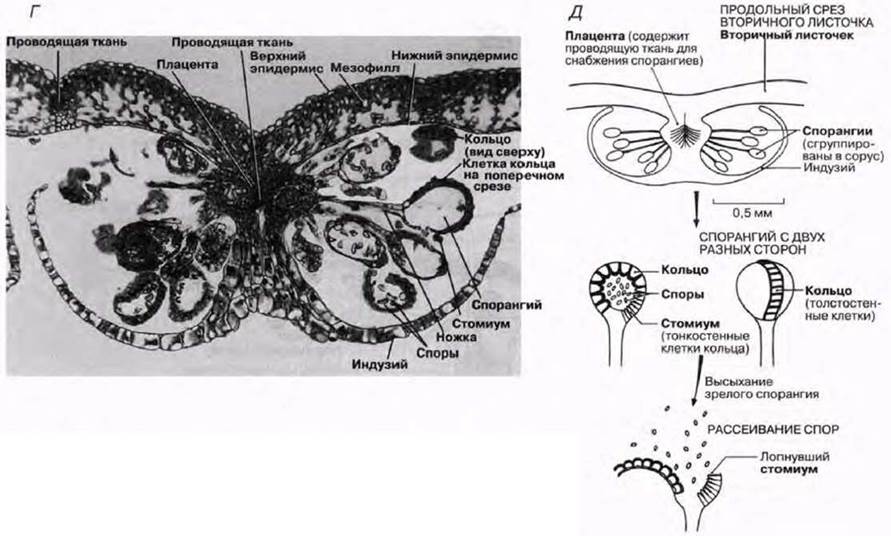
Fig. 2.37. External appearance and main features of the sporophyte Generation of the male fern Dryopteris filix-mas. A. Diagram and structural details of a single pinna; all other pinnae share the same Structure. B. Fern fronds. C. Lower surface of a leaf showing visible sori (some covered by an indusium). D. Cytology/practical/54.html">Longitudinal section of a sorus viewed under a Light Microscope. E. Schematic longitudinal section of a sorus showing sporangium structure details and dispersing spores.
The spores germinate, giving rise to the gametophyte generation. The gametophyte is a thin, Heart-shaped cellular plate about 1 cm in diameter (Fig. 2.38). This plate is green, capable of Photosynthesis, and anchored to the soil by unicellular rhizoids. Because such a delicate prothallus lacks a cuticle, it dries out rapidly and can therefore survive only in a damp environment.
Simple archegonia and antheridia develop on the underside of the gametophyte (prothallus). These reproductive Organs protect the gametes contained within them. Gametes are produced by mitosis from germline mother cells; as in bryophytes, antheridia produce sperm cells, while each archegonium produces a single egg Cell. The sperm cells are flagellated. Under damp conditions, mature sperm are released from the antheridia and swim through a film of water to the archegonia. Fertilization results in the formation of a diploid zygote. Note that fertilization in ferns, much like in bryophytes, remains dependent on the Presence of water.
The zygotes give rise to the sporophyte generation. The young embryo absorbs nutrients from the gametophyte until its own leaves and roots take over this function (Fig. 2.38, B). The gametophyte soon withers and dies.

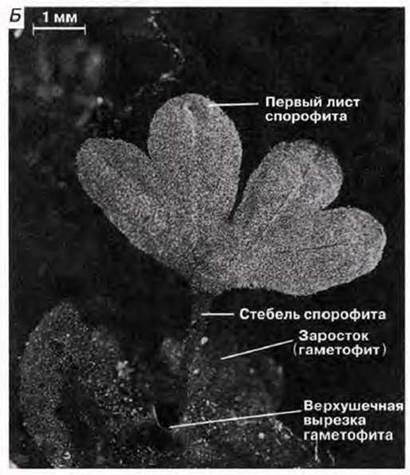
Fig. 2.38. External appearance of the gametophyte generation, or prothallus, of Dryopteris. A. The prothallus is green and capable of photosynthesis. It lacks both vascular tissues and a cuticle. B. Prothallus with the initial thallus of the sporophyte generation growing from it. Initially, the developing sporophyte depends on the gametophyte for water and mineral supply, but the sporophyte soon becomes an independent plant while the gametophyte dies away.
Last update: 06/08/2026
Editorial and Educational Adaptation: This material has been compiled based on the primary/original source text. The project team performed an editorial review, corrected technical inaccuracies, structured sections, and adapted the content for an educational format.
What was processed:
- elimination of formatting defects (OCR errors, structural breaks, corrupted characters);
- editorial organization of content;
- standardization of terminology in accordance with academic sources;
- verification of factual statements against the original source text.
All mentions of the author, publication year, and origin of the primary text have been preserved in accordance with the source.