BIOCHEMISTRY - L. Stryer - 1984
VOLUME 3
Part IV INFORMATION
CHAPTER 25. RNA INFORMATION AND TRANSCRIPTION
25.11. Transcription Is Initiated at Promoter Sites on DNA Templates
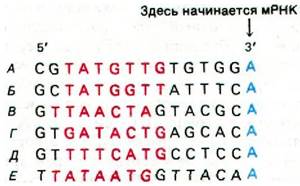
METABOLISM/31.html">Transcription begins at specific regions on the DNA template known as promoters. How does RNA polymerase locate these sites? One approach to this problem is to isolate the fragments protected by the RNA polymerase holoenzyme against Cleavage by pancreatic deoxyribonuclease and determine their nucleotide sequences. Another approach involves examining a series of mutants with altered (either increased or decreased) rates of transcription for specific genes. Such studies have revealed that promoter sites consist of approximately forty Base Pairs, corresponding to a DNA segment about 140 A long. Analysis of various promoters from E. coli and phages has demonstrated that the recognition signal function is performed primarily by a sequence of seven base pairs, the midpoint of which lies roughly 10 NUCLEOTIDES upstream from the point where mRNA coding begins (Fig. 25.13). A second recognition site is located about 35 nucleotides upstream from the mRNA start point; it also participates in the initial binding of RNA polymerase.
Class="center">Fig. 25.13. Promoter sequences of the lactose (A), galactose (B), and Tryptophan (C) operons of E. coli, phages  (D) and ɸX174 (E), and virus SV-40 (F). The putative Homology region, known as the Pribnow box, is highlighted in green
25.12. The σ-Subunit Confers Promoter Recognition on RNA Polymerase
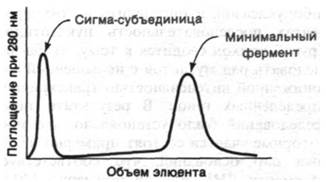
The RNA polymerase core enzyme (α2ββ') cannot initiate transcription at promoter sites. Specific initiation requires the α2ββ'σ holoenzyme. The Role of the sigma subunit was discovered through the following observations. When RNA polymerase was purified by phosphocellulose Column Chromatography, it exhibited virtually no activity when T4 phage DNA was used as a template, yet retained activity with calf Thymus DNA. Conversely, the same RNA polymerase purified by glycerol gradient centrifugation was highly active on both templates. These observations suggested that the phosphocellulose-purified RNA polymerase preparation lacked a specific factor. Indeed, this proved to be the case (Fig. 25.14). The activity of the enzyme purified on phosphocellulose is greatly enhanced by The addition of another fraction eluted from the column. This stimulatory factor possesses no catalytic activity on its own and was designated the sigma σ-factor. Subsequent experiments demonstrated that the phosphocellulose-purified enzyme lacked the σ-subunit, whereas the glycerol-purified enzyme contained it. Thus, the preparation exhibiting maximal activity with T4 phage DNA was the α2ββ'σ holoenzyme, whereas the α2ββ' core enzyme was unable to transcribe this DNA. Addition of the σ-subunit to the core enzyme reconstituted a fully active holoenzyme. The core enzyme was capable of transcribing calf thymus DNA because this template contains numerous single-stranded breaks. The RNA synthesized by the core polymerase in vitro does not correspond to the transcripts produced in vivo. Specifically, the core enzyme transcribes both strands of phage DNA templates, whereas the holoenzyme transcribes a single strand asymmetrically, exactly as it does in vivo.
Fig. 25.14. Separation of RNA polymerase into the σ-subunit and the core enzyme (minimum enzyme; α2ββ') on a phosphocellulose column
The sigma subunit ensures specific initiation by lowering the affinity of RNA polymerase for promoterless DNA by a factor of 10. In addition, the sigma subunit enhances the recognition of promoter sequences by RNA polymerase. Finally, the sigma subunit participates in unwinding the DNA double helix so that one of the strands can serve as a template. When the RNA polymerase holoenzyme binds, approximately one turn of the DNA helix is unwound, preparing the enzyme to form the first phosphodiester bond of the new RNA chain.
Once the Synthesis of the new RNA chain begins, the sigma subunit dissociates from the holoenzyme. The core enzyme continues to transcribe the DNA template. Thus, the function of the holoenzyme is promoter Location and initiation, whereas the function of the core enzyme is elongation. The released sigma subunit then associates with another molecule of core polymerase to participate in initiating a new transcription cycle.
The initiation of new RNA chains is regulated in multiple ways. Some promoter sequences ensure high initiation efficiency, whereas others are less efficient. Furthermore, initiation efficiency is regulated by Proteins that bind to the promoter region itself or adjacent to it. Repressors block transcription by preventing RNA polymerase binding, while positive regulatory factors promote initiation by facilitating RNA polymerase binding. We will discuss these important regulatory mechanisms in more detail in Chapter 28.
25.13. RNA Chains Start with pppG or pppA
Most newly synthesized RNA chains contain a kind of tag that indicates where their synthesis began. New RNA chains have a strictly defined 5'-end Structure: the molecule begins with either pppA or pppG. Unlike DNA Synthesis, a primer is not required in this case; RNA chains can be formed de novo.
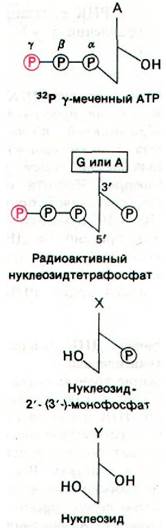
This 5'-terminal tag was discovered using two approaches. It was found that RNA chains incorporate 32P if the incubation mixture contains γ-32P-labeled ATP. Obviously, the incorporated label must be localized at the terminus, since only the α-phosphorus atom of a nucleoside triphosphate can participate in forming the internal phosphodiester bridges of RNA. Moreover, alkaline Hydrolysis of newly synthesized RNA yields Three types of products: nucleosides, nucleoside 2'-monophosphates (or nucleoside 3'-monophosphates), and nucleoside tetraphosphates (Fig. 25.15). When γ-32P-ATP was used as a substrate, adenosine 3'-phosphate 5'-triphosphate was formed. The γ-phosphorus atom of this nucleoside tetraphosphate contained the label. A similar result was obtained with γ-32P-GTP. However, if γ-labeled CTP or UTP is used, no radioactivity is incorporated. Consequently, the newly formed RNA chain has a triphosphate group at the 5'-end and a free OH group at the 3'-end.
Fig. 25.15. Products of alkaline hydrolysis of an RNA chain labeled with γ-32P-ATP
25.14. RNA Chains Are Synthesized in the 5'→ 3' Direction
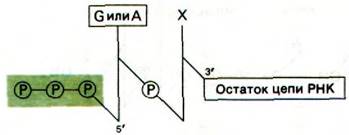
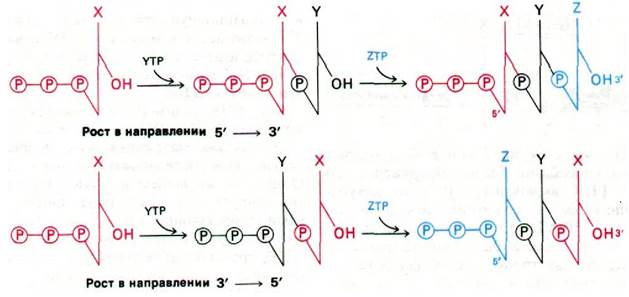
In which direction is RNA synthesized? In the 5' → 3' or 3' → 5' direction? Two opposing mechanisms of chain growth are illustrated in Fig. 25.16. For growth in the 5' → 3' direction, the triphosphate end is formed at the beginning of chain growth, whereas for 3' → 5' growth, the triphosphate end appears with the last incorporated residue. The kinetics of radioactivity incorporation into RNA synthesized from γ-32P-GTP (or ATP) indicates which of these possibilities occurs. If γ-32P-GTP is used as a substrate, The ratio of 32P incorporation to total nucleotide incorporation into the product reaches a maximum very rapidly after mixing the components and then gradually decreases over time. Meanwhile, the total radioactivity of the already labeled RNA does not decrease upon subsequent addition of a large excess of nonradioactive GTP to the incubation mixture. Thus, 32P is incorporated into the RNA molecule at the beginning of synthesis rather than at the end. Consequently, RNA chain growth proceeds in the 5' → 3' direction, just as in DNA synthesis.
Fig. 25.16. Expected position of the 32P label for 5' → 3' versus 3' → 5' growth. The actually observed position of the label shows that RNA is synthesized in the 5' → 3' direction
The RNA polymerase core enzyme moves along the template DNA strand in the 3' → 5' direction because the template strand is antiparallel to the newly synthesized DNA strand. A single RNA polymerase molecule synthesizes the entire transcript—in other words, transcription is processive. As the next segment of DNA unwinds, the previously transcribed region regains its double-helical conformation. The maximum elongation rate is approximately 50 nucleotides per second.
It is important to emphasize that RNA polymerase lacks nuclease activity. Unlike DNA polymerase, RNA polymerase does not proofread the newly formed polynucleotide chain. Consequently, The fidelity of transcription is significantly lower than that of Replication. The error rate during RNA Synthesis is approximately one error per 104–105 nucleotides, which is 105 times higher than during DNA synthesis. The Cell compensates for this much lower fidelity of RNA synthesis by producing numerous copies of RNA transcripts from a single Gene.
Last update: 06/08/2026
Editorial and Educational Adaptation: This material has been compiled based on the primary/original source text. The project team performed an editorial review, corrected technical inaccuracies, structured sections, and adapted the content for an educational format.
What was processed:
- elimination of formatting defects (OCR errors, structural breaks, corrupted characters);
- editorial organization of content;
- standardization of terminology in accordance with academic sources;
- verification of factual statements against the original source text.
All mentions of the author, publication year, and origin of the primary text have been preserved in accordance with the source.