BIOCHEMISTRY - L. Stryer - 1984
VOLUME 3
PART V. MOLECULAR PHYSIOLOGY
CHAPTER 36. MEMBRANE TRANSPORT
Introduction/36.html">Biological Membranes serve as highly selective permeability barriers. The flux of molecules and ions between The Cell and its environment is tightly regulated by specific transport systems. Transport processes perform several vital Functions.
1. They regulate cell volume and maintain intracellular pH and ionic composition within narrow fluctuation ranges, which creates favorable conditions for enzyme activity.
2. They Histology/2.html">EXTRACT FROM THE medium and concentrate substrates of energy and plastic METABOLISM (fuels and building blocks), as well as mediate The excretion of toxic substances.
3. They establish ionic gradients, which are essential for maintaining the excitability of nerves and Muscles.
Molecular mechanisms underlying many transport processes are currently beginning to be elucidated. In this chapter, we will examine A number of transport systems that ensure The transfer of ions, sugars, and Amino Acids across the biological membranes of bacterial and animal Cells. We will also discuss transport Antibiotics produced by microorganisms, since the analysis of their Structure made it clear how transport systems distinguish between ions such as Na+ and K+. The final part of this chapter describes the channels connecting the contents of adjacent cells. These pathways (Fig. 36.1) play a crucial role in Intercellular Communication.
Class="center">Fig. 36.1. Electron micrograph of negatively stained Intercellular junctions isolated from Liver cells. Through such channels, 15 Å in diameter, ions and small molecules can flow from one cell to another

36.1. Distinction Between Passive and Active Transport
Whether a transport process is active or passive depends on The change in Free energy of the transported components. Let us consider the case where an uncharged solute is transported (Fig. 36.2). The free energy of its transfer from compartment 1, where its concentration is c1, to compartment 2, where its concentration is c2, is given by
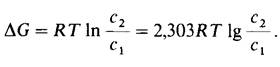
Fig. 36.2. Free energy change for the transfer of an uncharged solute from a compartment with concentration c1 to a compartment with concentration c2 (A), and of monovalent ions across a membrane to a side having the same charge sign as the ion (B). Note that a Membrane Potential of 59 mV requires the same free energy change for The transport of a monovalent ion at 25°C as a concentration gradient equal to 10

For a charged component, the electrical potential of the membrane must also be taken into account. The sum of the concentration and electrical components yields the Electrochemical Potential. The change in free energy in this case will be

where Z is the electrical charge of the transported component, ∆V is the membrane potential difference in volts, and F is the Faraday constant (23,062 kcal • V-1 • mol-1).
If ∆G is positive, the transport process must be active; conversely, if ∆G is negative, transport can occur passively. Active Transport requires coupling to an influx of free energy, whereas passive transport can proceed spontaneously. Consider, for example, the transport of an uncharged substance from c1 = 10-3 mM to c2 = 10-1 mM: ∆G = 2.3RTlg (10-1/10-3) = 2.3 • 1.98 • 298 • 2 = + 2.7 kcal/mol.
At 25°C (298 K) ∆G = + 2.7 kcal/mol, indicating active transport, which requires an influx of free energy. Such a transport process can be driven, for example, by the Hydrolysis of ATP, whose energy is —7.3 kcal/mol under standard conditions.
Last update: 06/08/2026
Editorial and Educational Adaptation: This material has been compiled based on the primary/original source text. The project team performed an editorial review, corrected technical inaccuracies, structured sections, and adapted the content for an educational format.
What was processed:
- elimination of formatting defects (OCR errors, structural breaks, corrupted characters);
- editorial organization of content;
- standardization of terminology in accordance with academic sources;
- verification of factual statements against the original source text.
All mentions of the author, publication year, and origin of the primary text have been preserved in accordance with the source.