BIOCHEMISTRY - L. Stryer - 1984
VOLUME 2
PART II GENERATION AND STORAGE OF METABOLIC ENERGY
CHAPTER 15. THE PENTOSE PHOSPHATE PATHWAY AND GLUCONEOGENESIS
15.17. Oxaloacetate is shuttled into the cytosol and converted into phosphoenolpyruvate
Pyruvate carboxylase is a mitochondrial enzyme, whereas the Other Enzymes of Gluconeogenesis are located in the Cytoplasm. Oxaloacetate, the product of the pyruvate carboxylase reaction, is transported across the mitochondrial membrane in the form of malate. Its reduction to malate takes place in the Cell/35.html">Mitochondria under the action of a NADH-dependent malate dehydrogenase. The resulting malate is transported by a carrier across the mitochondrial membrane and is re-oxidized to oxaloacetate by a Cytosol NAD+-dependent malate dehydrogenase.
Oxaloacetate undergoes simultaneous decarboxylation and phosphorylation in the cytosol under the action of phosphoenolpyruvate carboxykinase.
At this stage, the CO2 attached to pyruvate by pyruvate carboxylase is released. The phosphorylation reaction becomes energetically feasible thanks to simultaneous decarboxylation. Decarboxylation processes frequently drive reactions that would otherwise be highly endergonic. We will encounter this mechanism again in the section dedicated to fatty acid synthesis.
15.18. Six high-energy phosphate bonds are consumed in the synthesis of glucose from pyruvate
The stoichiometry of gluconeogenesis is described by the equation
2 Pyruvate + 4 ATP + 2GTP + 2NADH + 2Н2О → Glucose + 4ADP + 2GDP + 6 Pi + 2NAD+
∆G0 = - 9 kcal/mol.
The Stoichiometry of the reversal of Glycolysis is of a different nature:
2 Pyruvate + 2ATP + 2NADH + 2Н2O → Glucose + 2ADP + 2Pi + 2NAD+
∆G0 = + 20 kcal/mol.
Note that the Synthesis of glucose from pyruvate via gluconeogenesis utilizes six high-energy phosphate bonds, whereas The conversion of glucose into pyruvate during glycolysis yields only two ATP molecules. Thus, the excess "cost" of gluconeogenesis is equal to four high-energy phosphate bonds per one molecule of glucose synthesized from pyruvate. To transform an energetically unfavorable process (the reversal of glycolysis, ∆G0' = + 20 kcal/mol) into an energetically favorable one (gluconeogenesis, ∆G0 = - 9 kcal/mol), four extra high-energy phosphate bonds are required. Viewing this energetic difference between glycolysis and gluconeogenesis from another angle, we recall that THE CONTRIBUTION OF a single ATP equivalent changes the Equilibrium Constant of a reaction by a factor of approximately 108 (sec. 11.7). Consequently, the contribution of four additional high-energy bonds in gluconeogenesis alters this constant by a factor of 1032, making the conversion of pyruvate into glucose thermodynamically favorable.
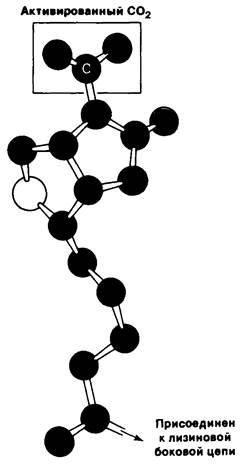
Class="center">Fig. 15.6. Molecular model of carboxybiotin
15.19. Gluconeogenesis and glycolysis are reciprocally regulated
Gluconeogenesis and glycolysis are coordinated in such a way that when The activity of one of these pathways is relatively low, the other pathway is highly active. If both reaction sequences were simultaneously highly active, the Hydrolysis of four ~ P (two ATP + two GTP) would occur per reaction cycle. Under the conditions existing within The Cell, both glycolysis and gluconeogenesis are highly exergonic processes, so there are no thermodynamic barriers to the operation of such cycles. The fact that the activity of these two processes never reaches a high level simultaneously is most likely due to the appropriate regulation of individual enzymes in each pathway. For example, AMP stimulates Phosphofructokinase (sec. 12.9) but inhibits fructose-1,6-bisphosphatase. Citrate exerts the opposite effect on these enzymes. Consequently, the phosphorylation of fructose-6-phosphate, the rate-limiting step of glycolysis, is enhanced at a low cellular energy charge. Conversely, at a high energy charge and an excess of Tricarboxylic Acid Cycle intermediates, fructose-1,6-bisphosphate is hydrolyzed and gluconeogenesis is stimulated. Pyruvate kinase (sec. 12.7) and pyruvate carboxylase (sec. 15.16) are also reciprocally regulated. Fructose-1,6-bisphosphate stimulates, whereas ATP inhibits, pyruvate kinase, whereas pyruvate carboxylase is stimulated by acetyl-CoA and inhibited by ADP. Thus, the enrichment of Liver Cells with fuel molecules and ATP favors the conversion of pyruvate to phosphoenolpyruvate and gluconeogenesis.
Last update: 06/08/2026
Editorial and Educational Adaptation: This material has been compiled based on the primary/original source text. The project team performed an editorial review, corrected technical inaccuracies, structured sections, and adapted the content for an educational format.
What was processed:
- elimination of formatting defects (OCR errors, structural breaks, corrupted characters);
- editorial organization of content;
- standardization of terminology in accordance with academic sources;
- verification of factual statements against the original source text.
All mentions of the author, publication year, and origin of the primary text have been preserved in accordance with the source.