BIOCHEMISTRY - L. Stryer - 1984
VOLUME 2
PART II GENERATION AND STORAGE OF METABOLIC ENERGY
CHAPTER 15. THE PENTOSE PHOSPHATE PATHWAY AND GLUCONEOGENESIS
15.14. Gluconeogenesis Is Not the Reversal of Glycolysis
In Glycolysis, glucose is converted into Pyruvate, whereas in Gluconeogenesis, pyruvate is converted into glucose. However, gluconeogenesis is by no means simply the reverse of glycolysis. It must proceed via a different pathway because the thermodynamic equilibrium of glycolysis lies heavily in the direction of pyruvate formation. Under normal intracellular conditions, the actual value of ∆G for The formation of pyruvate from glucose is approximately — 20 kcal/mol (Section 12.9). The free-energy drop during glycolysis occurs mainly at three irreversible steps catalyzed by hexokinase, Phosphofructokinase, and pyruvate kinase.
The pathway of gluconeogenesis bypasses these virtually irreversible reactions of glycolysis through the following new steps:
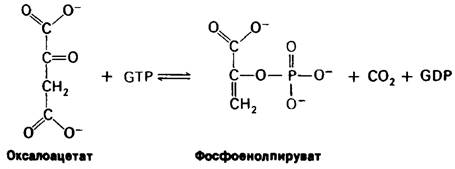
1. Phosphoenolpyruvate is formed from pyruvate via oxaloacetate. First, pyruvate is carboxylated to oxaloacetate at the expense of one ATP molecule. Then, oxaloacetate undergoes decarboxylation and phosphorylation to yield phosphoenolpyruvate, driven by a second high-energy phosphate bond.
Пируват + СО2 + АТР + Н2О ⇄ Оксалоацетат + ADP + Рi + 2Н+,
Оксалоацетат + GT ⇄ Фосфоенолпируват + GDP + СO2.
The first reaction is catalyzed by pyruvate carboxylase, and the second by phosphoenolpyruvate carboxykinase. Summing these reactions gives
Пируват + АТР + GTP + Н2O ⇄ Фосфоенолпируват + ADP + Pi + 2H+.
This pathway for the formation of phosphoenolpyruvate from pyruvate is thermodynamically favorable, as ∆G0 is + 0.2 kcal/mol, in contrast to + 7.5 kcal/mol for the reaction catalyzed by pyruvate kinase. This significantly more favorable value of ∆G0' is due to the participation of an additional high-energy phosphate bond in the process.
2. Fructose 6-phosphate is formed from fructose 1,6-bisphosphate by the Hydrolysis of the phosphate ester at C-1. This exergonic hydrolysis is catalyzed by fructose 1,6-bisphosphatase.
Фруктозо-1,6-6исфосфат + Н2O → Фруктозо-6-фосфат + Рi.
3. Glucose is formed by the hydrolysis of glucose 6-phosphate, a reaction catalyzed by glucose 6-phosphatase.
Глюкозо-6-фосфат + Н2O → Глюкоза + Рi.
Class="center">Table 15.2. Differences between glycolytic and gluconeogenic Enzymes
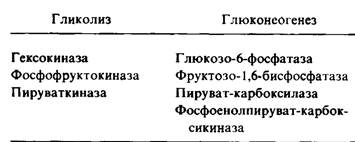
Glucose 6-phosphatase is bound to the Endoplasmic reticulum and acts on a substrate localized in the Cytosol. This enzyme is absent in the Brain and Muscles; consequently, these Organs do not export free glucose.
15.15. Biotin Is a Mobile Carrier of Activated СO2
The discovery that oxaloacetate is formed from pyruvate in Cell/35.html">Mitochondria led Merton Utter to the discovery of pyruvate carboxylase in 1960. This enzyme is of particular interest because of its catalytic and allosteric properties. Pyruvate carboxylase contains a covalently attached prosthetic group, biotin, which Functions as a carrier of activated СO2.

The carboxyl terminus of biotin is linked via an amide bond to the ε-amino group of a specific Lysine residue.
It is worth noting that biotin is attached to pyruvate carboxylase by a long, flexible tether, remarkably similar to the arm that links lipoamide in the pyruvate dehydrogenase complex.
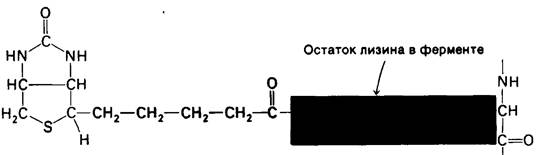
Pyruvate carboxylation proceeds in two stages:

In the carboxybiotin-enzyme intermediate, the carboxyl group is linked to the N-1 atom of the biotin ring.

In this intermediate, the carboxyl group is activated. The ∆G0' for its Cleavage
СO2 ≈ Биотин—фермент + Н+→ СO2 + Биотин—фермент
is –4.7 kcal/mol, which enables carboxybiotin to transfer СO2 to acceptors without any additional expenditure of Free energy.

The activated carboxyl group is subsequently transferred from carboxybiotin to pyruvate, yielding oxaloacetate. A long, flexible arm linking biotin to the enzyme allows this prosthetic group to swing between the enzyme's two active sites (the ATP-bicarbonate site and the pyruvate site).
15.16. Pyruvate carboxylase is activated by acetyl-CoA
The activity of pyruvate carboxylase depends on the presence of acetyl-CoA. In the absence of enzyme-bound acetyl-CoA (or a closely related acyl-CoA), biotin is not carboxylated. The second partial reaction is independent of acetyl-CoA. The allosteric activation of pyruvate carboxylase by acetyl-CoA serves as a crucial physiological control mechanism. Oxaloacetate, the product of the pyruvate carboxylase reaction, functions simultaneously as a stoichiometric intermediate in gluconeogenesis and a catalytic intermediate in The Tricarboxylic Acid Cycle. A high level of acetyl-CoA signals a cellular demand for more oxaloacetate. When ATP is abundant, oxaloacetate is channeled into gluconeogenesis. Conversely, under conditions of ATP deficiency, oxaloacetate enters the tricarboxylic acid cycle by condensing with acetyl-CoA.
Thus, pyruvate carboxylase is not only essential for gluconeogenesis, but also plays a critical role in maintaining the required concentrations of tricarboxylic acid cycle intermediates. These intermediates must be continually replenished because they are drained off by various biosynthetic pathways, such as heme synthesis. This vital function of pyruvate carboxylase is known as anaplerotic, which translates to "filling up" or replenishing.
Last update: 06/08/2026
Editorial and Educational Adaptation: This material has been compiled based on the primary/original source text. The project team performed an editorial review, corrected technical inaccuracies, structured sections, and adapted the content for an educational format.
What was processed:
- elimination of formatting defects (OCR errors, structural breaks, corrupted characters);
- editorial organization of content;
- standardization of terminology in accordance with academic sources;
- verification of factual statements against the original source text.
All mentions of the author, publication year, and origin of the primary text have been preserved in accordance with the source.