Biochemistry: The Chemical Reactions of Living Cells, Volume 3 - D. Metzler 1980
Light in Biology
Properties of Light
The Earth is bathed in sunlight, a source that provides not only warmth but also the energy essential for All living organisms. Of the 3∙104 kJ∙m-2 of solar energy reaching the Earth daily [1, 2], roughly 30 kJ is captured through Photosynthesis [3]. In the upper stratosphere, high-energy radiation interacts with oxygen, forming the protective ozone layer. Light penetrating the atmosphere allows us to perceive our surroundings and gives objects their distinct colors. It regulates plant flowering as well as the germination of seeds and spores. In biochemical laboratories, light and Other forms of electromagnetic radiation spanning a broad energy spectrum are utilized for experimental purposes. X-rays, ultraviolet, and infrared rays, alongside ultra-short waves, aid in investigating the molecules that make up living matter. Light permeates virtually every aspect of human life, with its interactions with Biomolecules being of paramount importance. This chapter serves as a brief Introduction to the subject and includes a list of References for Further Reading.
Class="center">A. Properties of Light
Light is a form of electromagnetic radiation exhibiting The properties of both waves and particles (photons). A photon's energy is typically characterized by the frequency of the corresponding radiation (or its reciprocal, the vacuum wavelength; Table 13-1). Figure 13-1 illustrates a logarithmic scale of the electromagnetic spectrum [4]. At the high-energy end of the scale, to the right of the depicted segment, lie gamma and cosmic rays, whereas the low-energy end comprises radio waves with wavelengths reaching many kilometers. A narrow section of the scale—roughly from 10 nm to several micrometers, which is the focus of this chapter—encompasses the ultraviolet region, visible light, and the near-infrared region. This section is shown magnified in Figure 13-1 (second line from the top). Light reaching the Earth's surface occupies a narrow window from 320 to 1100 nm. The human eye is capable of perceiving light across an even narrower range: 380–760 nm, covering all the colors of the rainbow. The maximum absorption bands for the aromatic rings of Proteins and Nucleic Acids are 280 nm and 260 nm, respectively. Although wavelengths in this range are largely absorbed by the stratospheric ozone layer, sufficient ultraviolet radiation penetrates the atmosphere to cause numerous Mutations and sunburns.
Table 13-1 Selected Properties of Light


FIG. 13-1. Section of the electromagnetic spectrum. The letters V, I, B, G, Y, O, R above the visible light region denote the various colors. The CuKa mark corresponds to the X-ray wavelength widely used in X-ray crystallographic Analysis of proteins and other organic Materials.
Chemists increasingly use frequency or wavenumber as a measure of light energy. The wavenumber v is the reciprocal of the wavelength and is typically expressed in cm-1 (reciprocal centimeters, sometimes called kaysers). Other units—such as µm-1 (10,000 cm-1) or mm-1—may gain wider acceptance in the future. Most absorption spectra presented in this book plot absorption as a function of wavenumber, measured in cm-1. The frequency v in hertz is equal to  where c' is the speed of light. (The speed of light in a vacuum is denoted by c and equals 3.00 ∙ 108 m∙s-1.) The energy of a light quantum E is given by hv, where h is Planck's constant, 6.626∙10-34 J∙s. From a chemical standpoint, the most useful unit is the energy of one Einstein, i.e., one mole of photons (6.023∙1023 quanta). The energy expressed in kJ per Einstein is equal to
  (in cm-1, in vacuum). All the necessary energetic relationships are summarized in Table 13-1. The bottom three scales in Figure 13-1 also illustrate the relationships between
  and wavelength.
A light wave is associated with oscillations of electric and magnetic field vectors [5–7]. When light propagates along the x-axis, the electric field vector E is typically oriented along the y-axis, its magnitude being a function of wavelength λ and time:

The magnetic field vector H is orthogonal to the electric field vector, and its magnitude is determined by the equation:

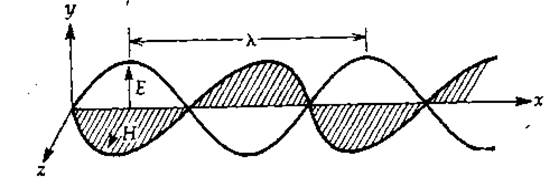
The propagation speed of light c' in a given medium depends on ε, the Dielectric Constant of the medium, and u, its magnetic permeability:

The refractive index of a medium relative to a vacuum is denoted by the symbol n. It indicates how many times slower light travels in that medium compared to a vacuum and is also a function of wavelength. For the sodium D-line (λ = 589 nm), n is 1.00029 in air and 1.33 in Water at 25 °C.
The term φ in equations (13-1) and (13-2) represents the wave phase. Light is generally incoherent—the phase φ varies among the different photons that make up a light beam. Coherent light emitted by lasers consists of photons with identical phase characteristics. If the electric field vectors of all photons in a light beam lie in a single plane, the light is referred to as plane-polarized (this occurs when light passes through certain types of crystals). The direction of polarization is defined as the direction of the electric field vector E. Light can also be circularly polarized, in which case the electric field vector describes a right- or left-handed helix. Superimposing two identical beams—one right-circularly polarized and the other left-circularly polarized—yields plane-polarized light. Conversely, plane-polarized light can be resolved into right- and left-circularly polarized components.
Last update: 06/08/2026
Editorial and Educational Adaptation: This material has been compiled based on the primary/original source text. The project team performed an editorial review, corrected technical inaccuracies, structured sections, and adapted the content for an educational format.
What was processed:
- elimination of formatting defects (OCR errors, structural breaks, corrupted characters);
- editorial organization of content;
- standardization of terminology in accordance with academic sources;
- verification of factual statements against the original source text.
All mentions of the author, publication year, and origin of the primary text have been preserved in accordance with the source.