Biochemistry: The Chemical Reactions of Living Cells, Volume 1 - D. Metzler 1980
How Molecules Interact with One Another
Muscles
Contraction in Non-Muscle Cells
Eukaryotic flagellar movement is apparently based on the sliding of microtubule filaments (Supplement 4-A), which is somewhat analogous to the sliding of Muscle filaments [96]. The similarity to muscle is also supported by the presence of a protein with ATPase activity. Actomyosin-like Proteins have recently been discovered in many other Cells. It is possible that the contractile protein found in the Brain is responsible for the rapid release of Neurotransmitters from vesicles at synaptic terminals [97]. Actin has been isolated from the primitive Organism Dictyostelium and appears to be a universal component of Eukaryotic cells [98]. Cytoplasmic microfilaments are frequently composed of actin. In fibroblasts, these fibers form three-dimensional matrices approximately 100 nm thick, located directly beneath The Cell membrane. Microfilaments of another type aggregate to form "stress fibers" along cell edges. The preparation of actin-specific fluorescent Antibodies has made it possible to localize actin using an ultraviolet Microscope [99] (Supplement 4-A). Myosin can now be considered an equally widespread protein [98, 100]. A possible mechanism for the functioning of non-muscle contractile systems [98] is illustrated schematically in Fig. 4-25.
Class="center">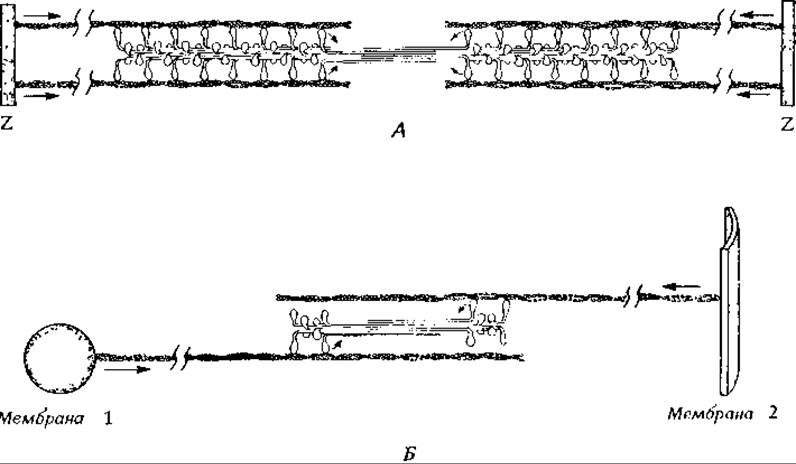
FIG. 4-25. A. Schematic representation of a striated muscle sarcomere. B. Scheme of the interaction between myosin and membrane-bound actin, leading to directed Introduction/41.html">Movement in Non-muscle cells. The diagram illustrates how a membrane-bound vesicle is pulled toward another membrane, such as The Plasma Membrane. An essential feature of this model is the bipolar nature of myosin aggregates [98]
Last update: 06/08/2026
Editorial and Educational Adaptation: This material has been compiled based on the primary/original source text. The project team performed an editorial review, corrected technical inaccuracies, structured sections, and adapted the content for an educational format.
What was processed:
- elimination of formatting defects (OCR errors, structural breaks, corrupted characters);
- editorial organization of content;
- standardization of terminology in accordance with academic sources;
- verification of factual statements against the original source text.
All mentions of the author, publication year, and origin of the primary text have been preserved in accordance with the source.