Biochemistry of Amino Acids - A. Maister 1961
Disorders of Amino Acid Metabolism in Certain Pathological Conditions
Tryptophan Metabolism
Increased Serotonin Production
Human Tryptophan METABOLISM pathways include the Conversion of Tryptophan into nicotinic acid via kynurenine, as well as the oxidation and decarboxylation of tryptophan to form 5-hydroxytryptamine (serotonin) (p. 201). Under normal conditions, each of these pathways accounts for only a few percent of total tryptophan Metabolism in the Body.
In patients with advanced malignant carcinoid (a tumor originating from enterochromaffin or argentaffin Cells), tryptophan metabolism proceeds predominantly via its conversion into serotonin [182]. These patients often exhibit symptoms characteristic of pellagra. Apparently, when dietary nicotinic acid is low, the restricted Biosynthesis of nicotinic acid from tryptophan in this condition leads to signs of niacin deficiency. Carcinoid syndrome is typically characterized by weight loss, cutaneous flush, chronic diarrhea, dyspnea episodes, and Heart valve lesions [183–187]. The chromaffin Cells of the gastrointestinal tract produce serotonin [188, 189]; carcinoid tumors arising from these cells contain significant amounts of serotonin [182, 190, 191]. Urinalysis in several patients with malignant carcinoid revealed a dramatic increase in The excretion of 5-hydroxyindoleacetic acid, a serotonin metabolite [182] (p. 407).
Class="center">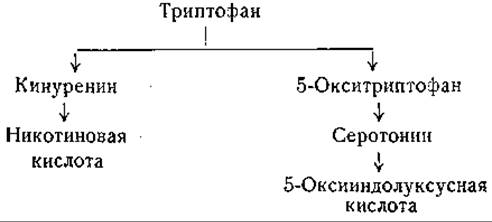
Blood and urine serotonin levels in such patients are significantly elevated compared to normal values. In addition to serotonin and 5-hydroxyindoleacetic acid, other 5-hydroxyindole derivatives have been found in the urine of carcinoid patients [182], and data indicate the presence of these compounds in the urine of healthy individuals as well [237]. Upon examining carcinoid tumors, Sjoerdsma et al. [182] found that they contain large amounts of 5-hydroxyindole derivatives, predominantly serotonin. Following partial tumor resection, urinary excretion of 5-hydroxyindoleacetic acid decreased; the fact that it still remained above normal was attributed to the presence of metastases.
The clinical manifestations observed in patients with malignant carcinoid tumors are clearly associated with excessive serotonin production by the tumor and its metastases, reduced biosynthesis of nicotinic acid, and Protein deficiency caused by tryptophan depletion. While healthy individuals consume only about 1% of dietary tryptophan for serotonin synthesis, patients with malignant carcinoid may divert up to 60% of their total tryptophan toward serotonin production.
Serotonin was isolated simultaneously and independently by Rapport and co-workers [238] and Erspamer [118, 189, 192], the latter referring to this compound as enteramine. Notably, almost all serotonin in the blood is localized in Blood Platelets. Its pharmacological profile has been described in several reviews [189, 239]. It is well known to exert a stimulating effect on smooth Muscle, resulting in enhanced intestinal motility, bronchoconstriction, and vasoconstriction. The release of serotonin from platelets may play a role in vasoconstriction, thereby contributing to hemostasis [193, 194]. Many symptoms observed in patients with malignant carcinoid are likely mediated by the action of serotonin on Cytology/cytology/32.html">Smooth Muscle tissue.
In mammals, serotonin is found in the walls of The Stomach and intestines, as well as in the blood and Brain. Its presence in the brain has led to the hypothesis that it plays a crucial role in this organ. Furthermore, it was discovered that a chemically related compound, lysergic acid diethylamide—which induces hallucinations and other psychiatric disturbances in healthy individuals at extremely low doses (e.g., 40 μg)—inhibits the smooth muscle effects of serotonin in vitro [195, 196].
Last update: 06/08/2026
Editorial and Educational Adaptation: This material has been compiled based on the primary/original source text. The project team performed an editorial review, corrected technical inaccuracies, structured sections, and adapted the content for an educational format.
What was processed:
- elimination of formatting defects (OCR errors, structural breaks, corrupted characters);
- editorial organization of content;
- standardization of terminology in accordance with academic sources;
- verification of factual statements against the original source text.
All mentions of the author, publication year, and origin of the primary text have been preserved in accordance with the source.