Biochemistry of Amino Acids - A. Majster 1961
Intermediary Metabolism of Amino Acids
Phenylalanine and Tyrosine
Biosynthesis in Microorganisms
Davis and co-workers [118, 890–892] made a detailed study of The Biosynthesis of aromatic Amino Acids in Escherichia coli, elucidating many steps of this pathway. The sequence of reactions described below was established primarily through experiments with mutants of E. coli and other microorganisms [894, 895] (Fig. 20).
Class="center">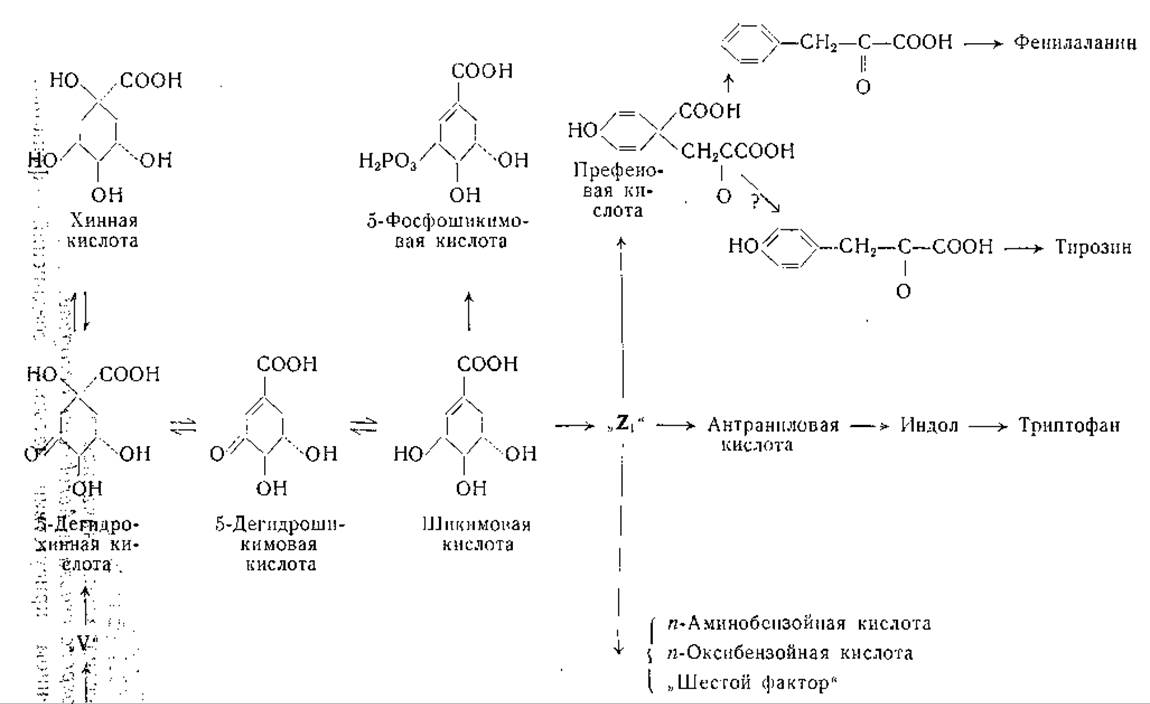
Fig. 20. Pathway of aromatic amino acid biogenesis.
The research began with the discovery of E. coli, Neurospora crassa, and Aerobacter aerogenes mutants requiring the simultaneous presence of four compounds: phenylalanine, Tyrosine, Tryptophan, and p-aminobenzoic acid [896]. Under certain conditions, they also require p-hydroxybenzoic acid [897] and a sixth, as yet unidentified factor [898]. It was later found that shikimic acid—a compound discovered in A number of plants—can replace all six factors required for the growth of these mutants [896]. Shikimic acid accumulates in cultures of certain microorganisms in which later steps of the biosynthetic pathway are blocked; this acid was isolated and identified. It was found that cultures of mutants blocked at a stage preceding The formation of shikimic acid accumulate 5-dehydroshikimic acid [899], and it was established that the latter is preceded by 5-dehydroquinic acid [900, 901]. The related quinic acid, which is widespread in plants, was shown to support the growth of certain mutants [900, 902]. Meanwhile, data indicate that quinic acid is evidently not a true intermediate in the biosynthesis of aromatic amino acids. In particular, quinic acid dehydrogenase has not been found in organisms that carry out this synthesis [903, 904].
The enzyme catalyzing the interconversion of dehydroshikimic and shikimic acids—dehydroshikimate reductase—operates with the participation of triphosphopyridine nucleotide [905]. Dehydroquinase, the enzyme catalyzing the interconversion of dehydroquinic and dehydroshikimic acids, apparently does not require Cofactors. These Enzymes have been found in all organisms investigated that synthesize aromatic Amino Acids and are absent in the corresponding mutant strains.
Cultures of certain mutants blocked at stages subsequent to the formation of shikimic acid accumulate 5-phosphoshikimic acid and an unidentified compound "Z1", which yields shikimic acid upon acid Hydrolysis [906]. Evidence suggests that compound Z1 is a true intermediate that follows shikimic acid in the biosynthetic pathway. At the same time, there is reason to believe that 5-phosphoshikimic acid does not lie directly on the main biosynthetic route [907]. It has been found that cultures of certain phenylalanine-requiring mutants accumulate another compound termed prephenic acid [908–911]. This compound is highly unstable; upon mild acidification, it is rapidly converted into phenylpyruvic acid [912, 913]. Certain tyrosine-requiring mutants of E. coli also produce prephenic acid. Schemes explaining The conversion of prephenic acid into phenylpyruvic and p-hydroxyphenylpyruvic acids have been formulated [912].
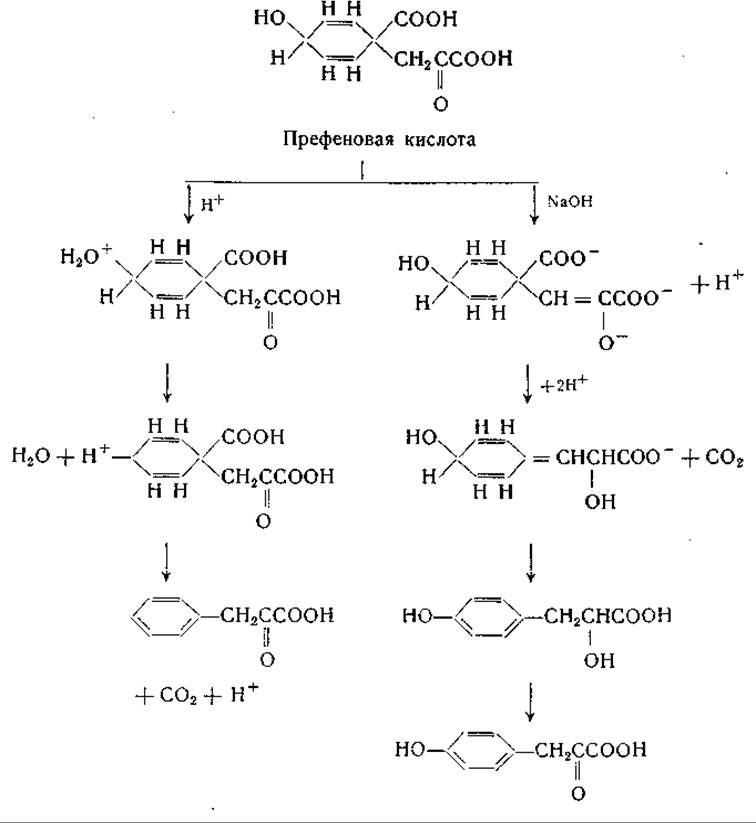
A recent report indicates that prephenic acid is converted into n-hydroxyphenyllactic acid [1132].
Compound Z1 likely serves as a common precursor for 1) prephenic acid, which is a precursor of phenylalanine and possibly tyrosine, 2) anthranilic acid, 3) n-hydroxybenzoic acid, 4) n-aminobenzoic acid, and 5) an unidentified "sixth factor" (see Fig. 20). In the search for an intermediate preceding 5-dehydroshikimic acid, an as-yet-unidentified compound V was discovered. Studies on the synthesis of shikimic acid in E. coli Cells using labeled glucose have shown that the carboxyl carbon atom and the C-1 and C-2 ring carbon atoms originate from a 3-carbon glycolytic intermediate.
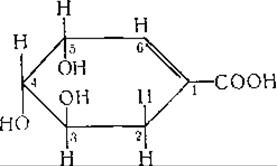
Carbon atoms C-3, C-4, C-5, and C-6 originate from a tetrose phosphate molecule generated in The pentose phosphate cycle [893, 914—916, 1133]. Experiments with Cell-free extracts have provided Evidence for the conversion of D-erythrose-4-phosphate and phosphoenolpyruvate into dehydroshikimic acid. Although the formation of dehydroshikimic acid from sedoheptulose-1,7-diphosphate has been established, this transformation is apparently associated with The breakdown of sedoheptulose diphosphate into erythrose-4-phosphate and phosphoenolpyruvate [917]. The pathway of aromatic Amino acid synthesis suggested by these studies is consistent with data obtained by other researchers studying the biosynthesis of tyrosine and phenylalanine from labeled precursors in Yeast [918—922].
The Mechanism of tyrosine formation has not yet been fully elucidated. Some microorganisms are capable of converting phenylalanine into tyrosine [923], but this process apparently does not occur in E. coli. In this Organism, tyrosine is likely the product of amination of n-hydroxyphenylpyruvic acid, which may be formed from prephenic acid (see above). Data obtained from E. coli experiments using antimetabolites, such as phenylserine, led to the Conclusion that tyrosine might be formed via The oxidation of phenylalanine [924, 925, 928]. The results of another study [926] indicate that phenylserine inhibits the utilization of phenylalanine by Bacteria, but not of tyrosine, and that under these conditions, tyrosine can apparently be converted into phenylalanine. Such transformations may result from the reversible conversion of both amino acids into a common precursor molecule. It has also been suggested that a-phenylglycine can serve as a precursor of phenylalanine [927].
Higher Animals are unable to synthesize aromatic amino acids de novo; however, it has been demonstrated that certain aromatization reactions of cyclic compounds can occur in animal Tissues. Quinic acid, which is converted into benzoic acid, and several other cyclic compounds undergo transformation into Aromatic Compounds in Liver and Kidney preparations [929].
Last update: 06/08/2026
Editorial and Educational Adaptation: This material has been compiled based on the primary/original source text. The project team performed an editorial review, corrected technical inaccuracies, structured sections, and adapted the content for an educational format.
What was processed:
- elimination of formatting defects (OCR errors, structural breaks, corrupted characters);
- editorial organization of content;
- standardization of terminology in accordance with academic sources;
- verification of factual statements against the original source text.
All mentions of the author, publication year, and origin of the primary text have been preserved in accordance with the source.