Human Biochemistry Volume 1 - Murray R. 1993
Bioenergetics and Metabolism of Carbohydrates and Lipids
Metabolism of Acylglycerols and Sphingolipids
Phospholipids and Sphingolipids in Certain Pathologies (Lipidoses)
A number of disorders are characterized by the accumulation of excessive amounts of these Lipids within Cells, most frequently in neural Tissues. These conditions can be divided into three categories: 1) diseases caused by true demyelination of nerve fibers, 2) sphingolipidoses, and 3) leukodystrophies.
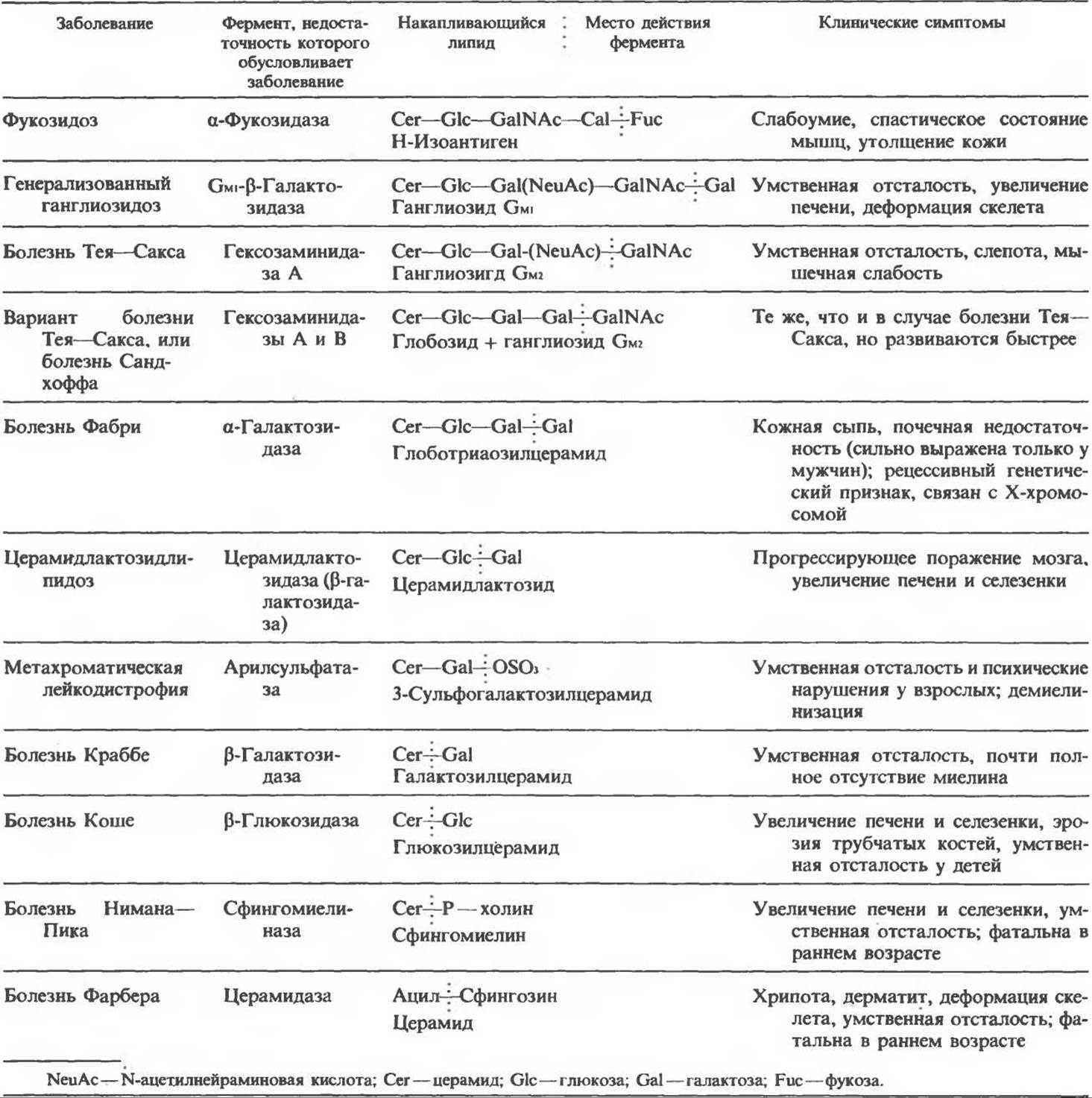
Class="center">Table 25.1. Sphingolipidoses
In multiple sclerosis, which belongs to the first group of disorders, There is a decrease in the levels of both Phospholipids (specifically, ethanolamine plasmalogen) and Sphingolipids in the White matter OF the Brain; As a result, The chemical composition of white matter comes to resemble that of Gray matter. Cholesterol esters, which are normally absent, are detected in the white matter, and the CEREBROSPINAL FLUID is characterized by an elevated phospholipid content.
Sphingolipidoses are a group of inherited disorders that typically manifest in childhood. These conditions belong to the broad category of lysosomal storage diseases (Neufeld, Lim, Shapiro, 1975).
Lipid storage diseases share several consistent features: 1) Complex Lipids containing ceramide as a structural component accumulate in tissues; 2) The rate of Synthesis of the stored lipid is comparable to its Biosynthesis rate in healthy individuals; 3) these disorders involve a deficiency of a specific lysosomal enzyme required for lipid Hydrolysis; 4) the degree of reduction in enzyme activity is uniform across all tissues. Taking all these features into account, specialized diagnostic Methods for these disorders have been developed. It has also become possible to identify heterozygous carriers of the defective genes responsible for these conditions and to diagnose sphingolipid dystrophy in the fetus. Data on the primary lipidoses are summarized in Table 25.1.
Multiple sulfatase deficiency leads to the accumulation of sulfogalactosylceramide, sulfosteroids, and Proteoglycans due to the simultaneous deficiency of acylsulfatases A, B, and C, as well as steroid sulfatase.
Bell R. М., Coleman R. A. Enzymes of glycerolipid synthesis in eukaryotes, Ann. Rev. Biochem., 1980, 49, 459.
Boyer P. D. (ed.) The Enzymes, 3rd ed. Vol. 16, Lipid Enzymology. Academic Press, 1983.
Brady R.O. Sphingolipidoses, Annu. Rev. Biochem., 1978, 47, 687.
Hanahan D.J. Platelet-activsting factor, Ann. Rev. Biochem., 1986, 55, 483.
Hawthorne J. N., Anseil G. B. (eds). Phospolipids, Elsevier, 1982.
Neufeld E. F., Lim T. W.. Shapiro L. J. Inherited Disorders of lysosomal METABOLISM, Ann. Rev. Biochem., 1975, 44, 357. Various authors: Disorders characterized by evidence of abnormal Lipid Metabolism. In: The Metabolic Basis of Inherited Disease, 5th ed. Stanbury J. B. et al. (eds). McGraw-Hill, 1983.
Various authors: Metabolism of triacylglycerols; Phospholipid Metabolism; ether-linked glycerolipids; sphingolipids. In: BIOCHEMISTRY OF LIPIDS and Hormоnes. Vance D. E., Vance J. E. (eds). Benjamin/Cummings, 1985.
Last update: 06/08/2026
Editorial and Educational Adaptation: This material has been compiled based on the primary/original source text. The project team performed an editorial review, corrected technical inaccuracies, structured sections, and adapted the content for an educational format.
What was processed:
- elimination of formatting defects (OCR errors, structural breaks, corrupted characters);
- editorial organization of content;
- standardization of terminology in accordance with academic sources;
- verification of factual statements against the original source text.
All mentions of the author, publication year, and origin of the primary text have been preserved in accordance with the source.