Human Biochemistry, Volume 1 - Murray R. 1993
Bioenergetics and Carbohydrate and Lipid Metabolism
Regulation of Carbohydrate Metabolism
Metabolic Control of Enzymatic Reactions
A hypothetical metabolic pathway comprising stages A, B, C, and D is illustrated in Fig. 22.1. In this pathway, the reactions A ↔ B and C ↔ D are near-equilibrium, whereas the reaction B ↔ С is nonequilibrium. The flux rate through such a metabolic pathway can be regulated by the availability of substrate A. This depends on its supply from the Blood, which, in turn, is determined by The amount of food entering the intestine or by the rates of certain key reactions that release and supply main substrates to the blood, where their concentration is maintained at a steady level. Examples include the initiating reaction catalyzed by Liver phosphorylase, which supplies the blood with glucose, as well as the reaction catalyzed by adipose tissue hormone-sensitive lipase, which provides free Fatty acids. The rate of the process also depends on the ability of substrate A to cross Cell membranes, the efficiency of removal of end product D, and the availability of co-substrates or co-factors, designated as X and Y in Fig. 22.1.
Class="center">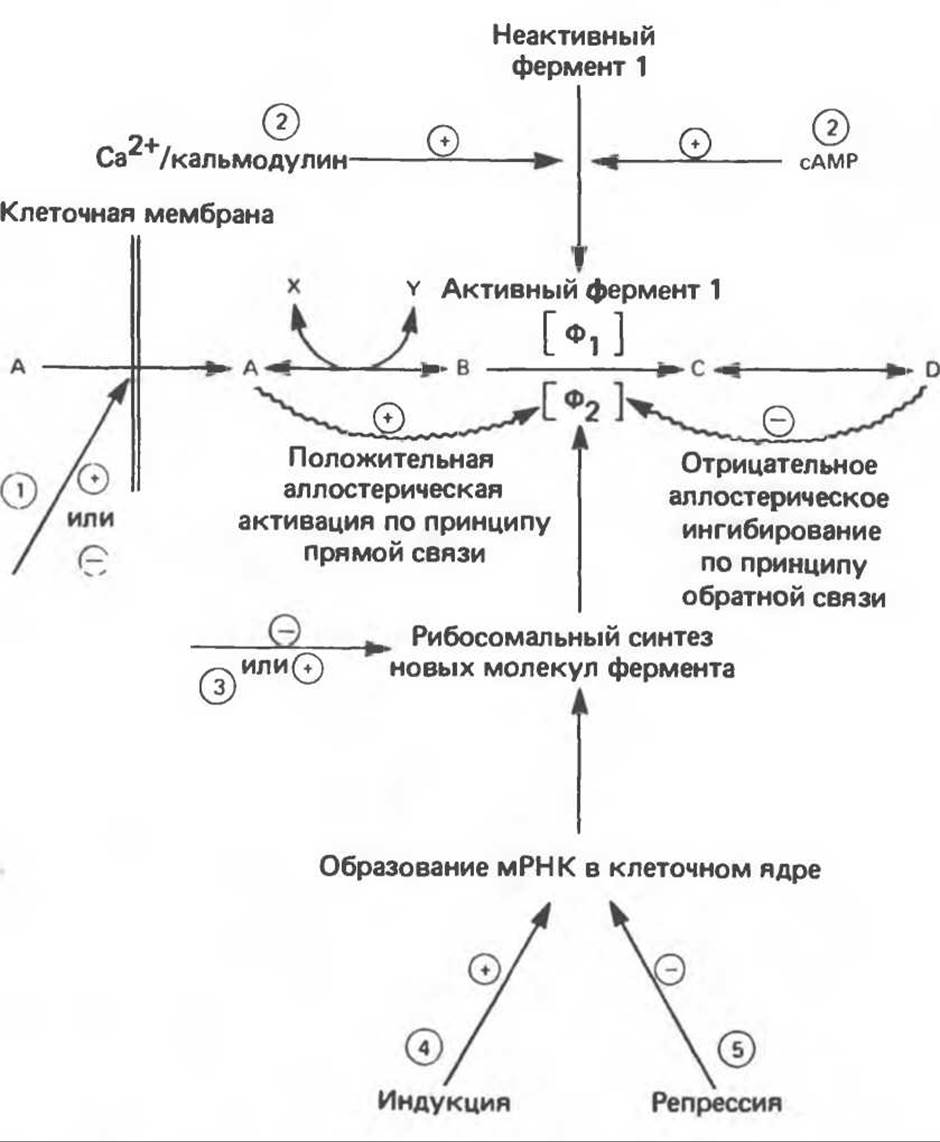
Fig. 22.1. Mechanisms of REGULATION OF ENZYMATIC reactions. Numbers in circles indicate probable sites of hormone action. 1 — change in membrane permeability; 2 — transition of an enzyme from an inactive to an active form; 3 — alteration of the rate of mRNA Translation at the ribosomal level; 4 — induction of new mRNA formation; 5 — repression of mRNA formation.
Enzymes catalyzing nonequilibrium reactions are most frequently allosteric, and their regulation is rapidly accomplished via feedback or feedforward mechanisms by the action of allosteric modulators in response to cellular demands (see Ch. 9). Other regulatory mechanisms, associated with hormonal action, serve the needs of the Organism as a whole. Hormonal regulation is mediated by several mechanisms (see Ch. 43), one of which is the Covalent Modification of enzymes via phosphorylation and dephosphorylation. This process occurs rapidly; one of the intermediate steps often involves The formation of cAMP, which in turn stimulates the transition of an enzyme from one form (e.g., inactive) to another. The process further involves a cAMP-dependent protein kinase, which catalyzes enzyme phosphorylation, or specific Phosphatases that catalyze its dephosphorylation. The active form may be either the phosphorylated enzyme, as in the case of enzymes catalyzing Catabolic pathways (e.g., phosphorylase a), or the dephosphorylated enzyme, as in the case of enzymes catalyzing biosynthetic processes (e.g., Glycogen synthase a).
Phosphorylation of certain regulatory enzymes can occur without the involvement of cAMP and cAMP-dependent protein kinase. Phosphorylation of these enzymes is governed by metabolic signals such as Changes in the [ATP]/[ADP] ratio (e.g., Pyruvate dehydrogenase; Fig. 22.3) or The activity of Ca2+/calmodulin-dependent protein Kinases (e.g., phosphorylase kinase; Fig. 19.5).
The synthesis of enzymes controlling the rate of Metabolic pathways can be altered by Hormones. Because this involves the synthesis of new protein molecules, The change in activity occurs relatively slowly and typically in response to alterations in the quantity and composition of dietary intake. Hormones can act as Inducers or repressors of mRNA synthesis in The Nucleus or as stimulators of the translational stage of Protein Synthesis at the ribosomal level (Ch. 41 and 43).
Last update: 06/08/2026
Editorial and Educational Adaptation: This material has been compiled based on the primary/original source text. The project team performed an editorial review, corrected technical inaccuracies, structured sections, and adapted the content for an educational format.
What was processed:
- elimination of formatting defects (OCR errors, structural breaks, corrupted characters);
- editorial organization of content;
- standardization of terminology in accordance with academic sources;
- verification of factual statements against the original source text.
All mentions of the author, publication year, and origin of the primary text have been preserved in accordance with the source.